I spent almost half of my career in investigations. I was even commander of the investigations division of our county’s homicide task force for six years. I studied the craft, and trained, read and worked hard. Still, what I don’t know about investigations could fill a generally large receptacle. What I was good at was being incredibly lucky.
As commander of investigations I was fortunate enough to have an organized obsessive-compulsive Sgt. Dave Kundrot. Alagna, Vasil, Malatia, Abenante, Wirsing, Nevara, Heim, Belanger—they were exceptional detectives and self-starters. On the task force I found the same luck. There are too many to count who were at the core of an incredibly successful and effective team. My skill was in assigning them based on their individual talents.
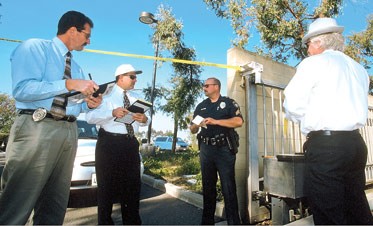
So with my experience in mind, the editors at Law Officer asked me to put together a list of the top 10 things not to do at a crime scene. So here goes.
No. 1: Don’t cover the body with a blanket! I’ve seen this done several times, usually by inexperienced police officers. But they aren’t the only culprits of this evidence-destroying practice. Often the guilty parties are firefighters, emergency medical personnel and well-meaning citizens.
I explained to fire supervisors many times about how covering bodies transfers material, contaminants and other evidence from one part of the crime scene to another. They politely listened and told me they got it. But, they didn’t get it. Next dead body—a blanket on it.
When questioned why their response was always a version of: “We’re just preserving the integrity of the dead person.” And no matter how many times you explain, “He’s dead so integrity isn’t his biggest issue!” many, not all, just had a hard time grasping that concept.
Solution: Make them watch 200 episodes of NCIS.
No. 2: Don’t unload or secure guns in an already secure crime scene! Early on in my detective career I responded to a guy shot in an apartment. When I arrived a senior patrol officer—training a recruit—had two guns that belonged to somebody unloaded and handcuffed together on top of the refrigerator! It was a condo with no one present but the two uniform cops!
I asked the officer why he moved the guns and he said with a condescending tone, “Needed to make the guns safe.”
I queried: “Safe from who?”
“Ya never know,” he snorted.
So I continued. “Did you take a picture of them before you moved them? Did you make sure you didn’t smudge fingerprints? Did you read them their Miranda rights before you hooked them up and detained them on the fridge?”
He wasn’t amused.
No. 3: Don’t let a parade of curious cops walk through any crime scene! One of the first shootings I was involved in was in a neighboring town and I was just a back-up watching the rear door. But what I noticed after entering the house was how every officer working that night walked into the crime scene so they could see the gore. They stepped on pills, kicked bullet casings and literally picked up the deceased in order to peak at the entrance wound in the back of the dead guy’s head.
Bottom line: Even if you find it for some reason fascinating, restrain yourself and do your job.
No. 4: Don’t fail to keep a comprehensive log of everyone who walks into a crime scene! And when I say everyone, I mean EVERYONE. That includes bosses, chiefs, mayors, alderman, prosecutors, the chief’s mother, the mayor’s neighbor and nosey cops.
Let them know you’re logging their entry. Better yet, try to keep them out. Suggest that they might wind up in court or in a deposition if they’re on the list. Then—watch ’em run.
No. 5: Don’t be afraid to take charge! I don’t care if you are a rookie with three weeks experience: If you’re the first one there, TAKE CONTROL OF THE SCENE. Relinquish it when someone shows up who outranks you or who actually knows what they’re doing, but, believe me, controlling the scene will be greatly appreciated by those who need to investigate and are concerned about scene integrity (see: the O.J. Simpson case).
No. 6: Don’t forget to take pictures! Take ’em soon. Take ’em often. You never have too many (see below). Start shooting as soon as it’s tactically safe to do so. Remember: Use anything you can for scale or to establish positioning.
No. 7: Don’t take stupid pictures! Cops pretending they’re kissing the dead guy’s ear doesn’t look good in court. Putting funny hats on the victim or placing cigarettes in the mouth are also bad ideas. Pictures of officers playing with sex toys found in the closet or wearing dildo hats (yes, I’ve seen that) are not only unnecessary, they’re discoverable and tough to explain to three grandmothers sitting on the jury. Smoking or drinking at the scene is also a big no-no, made even more so when it ends up in a picture.
You’re professionals, so act that way!
No. 8: Don’t overdo Miranda Warnings! First understand the parameters of the decision. Know what custody is and how the court views it (from the perspective of a reasonable person in the position of the suspect). And the warnings only have to be read once if they’re done correctly. Document: when they were read, by whom, how (should always be from a card in my opinion), where exactly, who witnessed them (have at least one person if possible), and what was the response of the suspect (what they actually said). That part is important. Remember they have to understand and waive them.
No. 9: Don’t forget to keep a timeline! As soon as you can, get that thing going. Use the same timepiece for each entry whenever possible, and coordinate with dispatch times. Try to be precise but allow for some approximates. It ain’t an exact science but using the timeline shows professionalism and an attention to detail.
No. 10: Don’t discard your notes! There is case law about this issue, so it’s better to save any notes you take, even if they are on a napkin. All is discoverable. Therefore, write them as though you were a professional, because after all you are. Jotting down juvenile jargon such as: “Found the asshole hiding in the closet” isn’t recommended.
Conclusion
So there it is. A short, abbreviated list of ‘don’ts.’ Maybe too simplistic and rudimentary for some, but reminders are a good thing.
At some point everything you do, say, don’t do, don’t say, write or don’t write may be an issue for a professional defense attorney or plaintiff’s attorney and brought up in court. Remember: You live and die by what you write in your reports. You live and die professionally by how you conduct yourself. And know this: if you screw up one investigation, it can affect your subsequent investigations for years to come.