SPECIAL REPORT: THE HUMANITY OF SERVICE
Behind every badge is a human being who accepts the responsibility of protecting others. Yet those who serve are themselves in need of encouragement, affirmation, and the recognition of their dignity. This special report explores the profound human dimension of policing through a Bronx homecoming—an encounter with the men and women of the NYPD’s 52nd Precinct that affirms a fundamental truth: the strength of the protector is sustained not only by duty, but also by the humanity we extend to one another.
STATEMENT OF RECORD
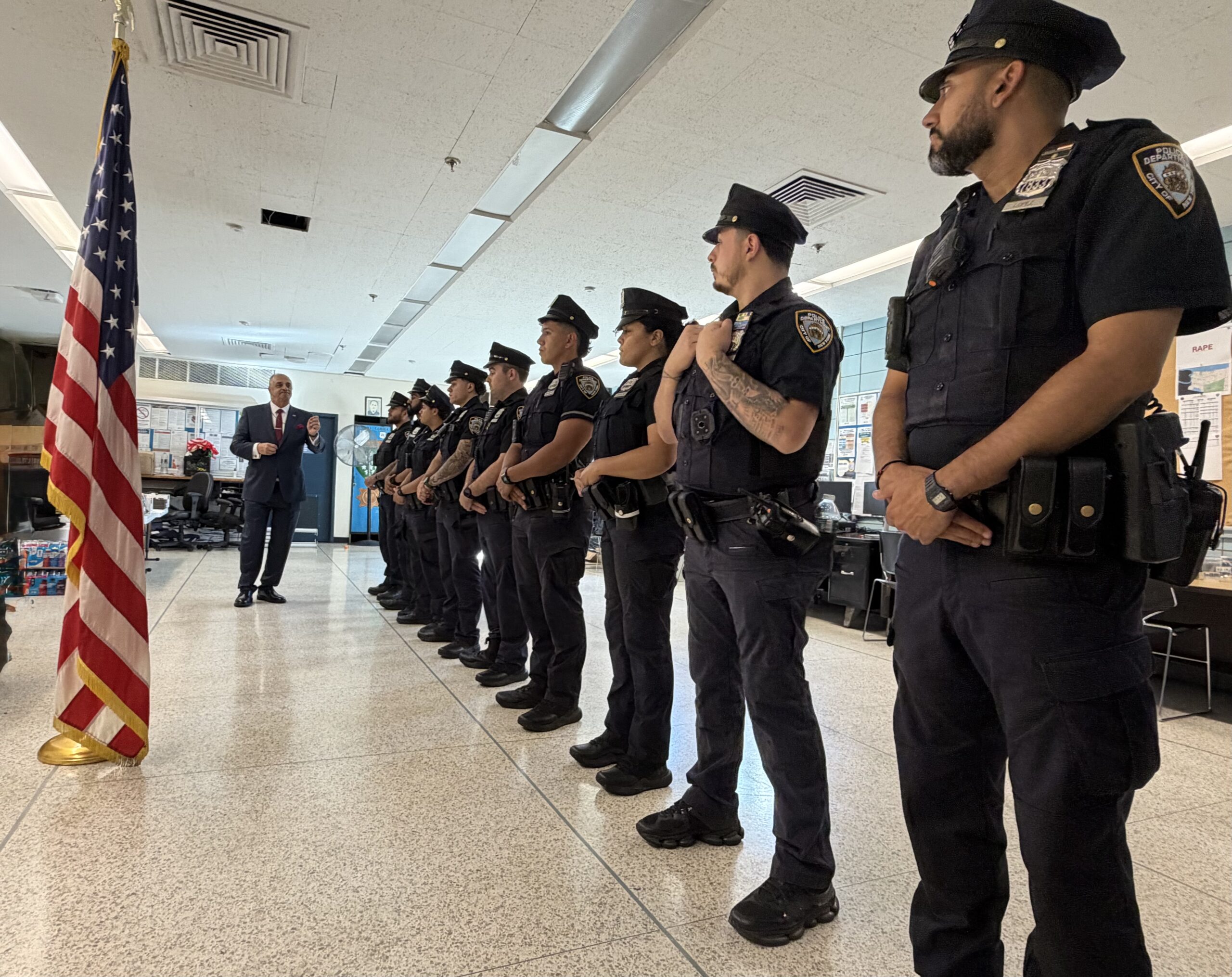
On October 7, 2026, Vincent J. Bove returned to the Bronx, the community where he spent the first 20 years of his life, for an afternoon with the men and women of the New York City Police Department’s 52nd Precinct. What began as a return to a familiar neighborhood became an opportunity for meaningful conversation, encouragement, affirmation, and gratitude.
The initiative included two roll calls, an encounter with approximately 20 members of the Detective Unit, and engagement with command staff and other precinct personnel. In all, Bove connected with more than 100 officers, detectives, and members of the command and precinct personnel. He also distributed nearly 100 Liberation Monument cards, reflecting on freedom, sacrifice, and the responsibility of those who willingly protect something larger than themselves.
Deputy Inspector Asif Iqbal, Commanding Officer of the 52nd Precinct, welcomed Bove graciously and personally introduced him throughout the command. His hospitality reflected an appreciation for the people under his leadership and the value of bringing them together with someone whose work centers on ethical leadership, morale, and the human dimensions of police service.

(Photo courtesy of the NYPD for Reawakening America LLC.)
The afternoon was not a conventional presentation. Its purpose was more fundamental: to be present, to listen, to encourage, and to recognize the dignity of the individual wearing the uniform.
The initiative took on added urgency following an incident in which an NYPD detective was stabbed within the confines of the 52nd Precinct. In preparing for the visit, Deputy Inspector Iqbal and Bove recognized the importance of addressing the human dimensions of police service, particularly ethical leadership, morale, and emotional fortitude. Bove made scheduling the initiative a priority, understanding that timely encouragement, affirmation, and support are essential elements of leadership, especially when personnel face challenging circumstances.
WHEN ENCOUNTER IS THE MESSAGE
There are moments when what matters most is simply being there—not to lecture, prescribe, or measure, but to demonstrate through one’s presence that another person matters.
That truth extends far beyond policing. Every person, regardless of position or profession, needs encouragement, affirmation, and appreciation. We need to know that our efforts are seen, that our contributions have meaning, and that we do not have to carry every responsibility alone.
For police officers, whose working lives often require composure amid fear, uncertainty, conflict, and tragedy, that fundamental need can be easy to overlook. They are expected to respond when others are frightened, enter circumstances from which others retreat, and exercise sound judgment under pressure. Yet professional responsibility does not diminish their humanity.
The badge does not eliminate the need for encouragement, nor does professional strength mean that someone never needs to hear that his or her service is valued. Recognizing that need is not an acknowledgment of weakness. It is an expression of our shared humanity.
I did not return to the Bronx to teach the men and women of the 52nd Precinct about humanity. I came to meet them as fellow human beings—to listen, share a few moments, and express my appreciation for the responsibility they have accepted on behalf of their community. Sometimes the significance of an encounter lies less in the number of words exchanged than in the sincerity with which people meet one another.
We do not have to share the same profession to recognize one another’s humanity. We simply have to be willing to encounter it.
RETURNING TO THE BRONX
The journey to the 52nd Precinct carried a significance that extended beyond the afternoon’s scheduled encounters. Traveling by train from Madison, New Jersey, into Penn Station and then making my way toward the Bronx, I walked through the neighborhood where I had spent the first 20 years of my life.
The streets brought back memories of family, friends, schools, and the people who helped shape the person I eventually became. Time changes communities. Buildings and businesses give way to new ones, generations move on, and neighborhoods acquire new identities. Yet as I walked toward the precinct, I was reminded of an enduring reality: communities still depend upon people willing to protect them.

(Photo by Vincent J. Bove for Reawakening America LLC.)
Today, that responsibility rests in part with the men and women of the NYPD. Returning to a place that had helped form me, then meeting those entrusted with protecting it, connected my personal past with the present life of the community.
I was not simply revisiting familiar streets. I was encountering a Bronx that had continued to evolve, with a new generation of public servants carrying forward the responsibility of keeping its people safe.
In that sense, the visit was more than a precinct engagement. It was a homecoming—and an opportunity to express my gratitude to those who now serve the community that once was mine.
STANDING WITH MORE THAN 100 PROTECTORS
The afternoon brought me into direct contact with more than 100 officers, detectives, and members of the command and precinct personnel of the NYPD’s 52nd Precinct. These encounters reinforced a conviction central to my work: the strength of an institution rests not only upon its mission, but also upon the character and humanity of the people entrusted with carrying it out.
The first roll call included approximately 30 officers and leaders. A second roll call later in the afternoon brought the total number of officers addressed at roll calls to approximately 60. I also spent meaningful time with approximately 20 detectives from the Detective Unit.
The Greatest Detectives in the World.
That is the proud motto by which these detectives identify themselves, and I addressed them accordingly. Their motto reflects a professional identity built around the demands of investigative service. Detective work requires persistence, sound judgment, attention to detail, and a determination to uncover the truth, often while confronting some of the most difficult circumstances in people’s lives. Its consequences extend beyond the investigation itself, affecting victims, families, and the safety of the communities these detectives serve.
I am particularly grateful to Lieutenant Kreshnik Bakraqi, Commanding Officer of the Detective Unit, for assembling his detectives and personally inviting me to address them. His initiative made this encounter possible, and I appreciated his confidence and the opportunity to speak directly with these dedicated members of the 52nd Precinct.
Yet the significance of the afternoon could not be measured by numbers alone. Each officer and detective brought an individual life, a personal history, and responsibilities extending well beyond the workplace. That recognition informed our conversations about encouragement, human connection, and the dignity of those who accept the responsibility of protecting others.
I also reflected on the work of Dr. Conrad Baars and his insights into the human need for affirmation. That need does not disappear when someone assumes a demanding professional role. Indeed, those who devote themselves to the care and protection of others can find their own need for encouragement overlooked amid the expectations placed upon them.
A person should not have to experience a crisis before hearing that he or she matters. An officer should not have to reach retirement before receiving sincere expressions of gratitude, nor should a detective have to suffer a physical, psychological, or emotional wound before others recognize the burdens that can accompany a life of service.
For me, this is an essential dimension of preventive leadership: recognizing the person while the work continues, acknowledging the commitment while the responsibility remains, and expressing appreciation before circumstances remind us of what we may have taken for granted. Encouragement and affirmation belong in the ordinary culture of professional life, not merely in moments of crisis or at the conclusion of a career.
The officers and detectives of the 52nd Precinct carry responsibilities that deserve respect. They should also know that their efforts are recognized and their service is valued. People deserve to know that they matter—not someday, but today.
PROTECTORS OF CIVILIZATION AND THE NATION
My understanding of service has been profoundly shaped by encounters with history, particularly my recent visits to American World War II military cemeteries in Italy. Standing among the graves of Americans who had traveled thousands of miles from home and sacrificed their lives in defense of freedom brought the meaning of service into unmistakable focus. Their resting places remind us that the freedoms people inherit are not self-sustaining. They endure because generations of men and women have accepted the responsibility of protecting something greater than themselves.
That responsibility continues in different forms and under different circumstances. The American serviceman who confronted the threats of the Second World War and the police officer who answers a dangerous call on a Bronx street do not occupy identical battlefields. Yet both represent a fundamental truth about civilization: its preservation depends upon people willing to accept responsibility for the safety and well-being of others.
During my visit to the 52nd Precinct, I wanted the officers to appreciate the significance of their contribution to that enduring responsibility. Their service unfolds on neighborhood streets rather than distant battlefields, but its consequences reach deeply into the lives of ordinary people. Families depend upon public safety, communities depend upon order and stability, and the freedoms that allow people to live, work, worship, and raise their children in security depend, in part, upon those willing to protect them.
I told the officers something I deeply believe: “The community survives because of you.” This was not an expression of flattery, but a recognition of the essential place public servants occupy in the life of a community. Without people willing to confront danger, respond to emergencies, and accept responsibility for public safety, the conditions necessary for a stable and flourishing society would be gravely weakened.
Yet the police are not separate from the community they protect. They are part of it. The officers of the 52nd Precinct serve people whose hopes, fears, families, and aspirations are not fundamentally different from their own. Recognizing that common bond is essential to understanding the relationship between law enforcement and the public.
This is the foundation of my Community Police Partnership™ philosophy: policing and community life are interdependent, bound together by a shared responsibility for preserving the safety, dignity, and well-being of the people who call a neighborhood home. Public safety is strengthened when officers and residents recognize one another not as opposing interests, but as partners in sustaining the conditions that allow a community to thrive.
As I discussed in my Law Officer article, “Principles of American Policing for 21st Century Law Enforcement”, the police and the community must stand together, working in partnership, protecting one another, and strengthening the bonds of trust upon which a free society depends. These principles are not abstract ideals; they find their meaning in the daily encounters between officers and the people they serve.
The American servicemen whose graves I visited in Italy left behind a legacy of sacrifice in defense of freedom. The men and women of the NYPD carry their own responsibility here at home. Their service deserves the authority necessary to fulfill their mission, together with the understanding, respect, and appreciation of the communities they protect.
The connection between these servicemen and the officers of the 52nd Precinct is not that their duties are identical, but that both exemplify the responsibility of serving something greater than oneself. Recognizing the contribution of the men and women protecting the Bronx is one way of honoring the enduring bond between those who protect and those who are protected.
THE RADIANCE OF THE SHIELD: CHARACTER, AUTHORITY, AND HUMAN DIGNITY
During my encounter with the officers of the 52nd Precinct, I reflected on a principle at the heart of ethical leadership: the distinction between the authority represented by a police shield and the character of the individual entrusted with wearing it. The shield represents the authority of the office, the responsibilities conferred by law, and the public trust accompanying the badge. Yet its deeper significance depends upon something that cannot be issued with a uniform or bestowed by rank. As I explained to the officers, the shield represents their authority, but the character behind it is what illuminates that shield and makes it radiant.
Authority is essential to effective policing, but authority alone does not define the quality of the person who exercises it. Integrity, restraint, compassion, courage, and respect for human dignity give authority its moral dimension. The shield identifies the office an officer holds; the officer’s conduct reveals the character with which that responsibility is carried.
The person wearing the shield is never defined entirely by the profession. Each officer and detective is also a son or daughter, a parent, a spouse, a sibling, a friend, and a neighbor. Each brings to the workplace a life shaped by relationships, experiences, hopes, disappointments, and responsibilities that continue beyond the end of a tour of duty. The demands of policing do not suspend those realities, nor does professional composure eliminate the capacity to experience fear, grief, exhaustion, or loss.
Recognizing this humanity does not diminish the authority of the badge. It deepens our understanding of the individual entrusted with that authority. The same person expected to demonstrate sound judgment under pressure may also need encouragement, understanding, and affirmation. Recognition should not have to wait until retirement, a personal crisis, or a tragic event. It belongs within the life of the profession, while the work continues and the responsibilities remain.
This understanding informs my concept of The Wounded Protector™: the recognition that those who dedicate themselves to protecting others are not immune to the wounds that life and service can inflict. Some wounds are visible; others are carried privately, beyond the awareness of colleagues, supervisors, and the communities being served. Acknowledging this reality is not an expression of diminished confidence in our protectors. It is an affirmation of their humanity.
We honor the badge by respecting the responsibilities it represents, and we honor the officer by recognizing the person entrusted with carrying them. Ethical leadership must therefore attend both to the integrity of the authority exercised and to the well-being of the individual who exercises it. A culture that values its protectors cannot depend upon their strength alone; it must also recognize their sacrifices and understand that those who accept responsibility for the welfare of others deserve consideration and support themselves.
The shield represents authority; character gives it radiance. Behind that radiance is a human being whose dignity must never be forgotten.
A COMMANDING OFFICER WHO LEADS BY EXAMPLE
I was particularly grateful for the hospitality and generosity of Deputy Inspector Asif Iqbal, Commanding Officer of the 52nd Precinct. From the moment I arrived, he made me feel welcome and took a personal interest in introducing me throughout the command. He connected me with command staff, sergeants, lieutenants, officers, visitors, and representatives of other agencies. This was more than a courtesy; it reflected his appreciation for his personnel and his desire to make my visit an encounter with the command as a whole.
What impressed me was the manner in which he welcomed me into his professional home. A commanding officer’s influence extends beyond the administration of a precinct. Leadership is also expressed through the relationships a commander cultivates, the respect shown to personnel, and an understanding that an organization’s effectiveness depends upon the commitment of the people who serve within it. Deputy Inspector Iqbal spoke with me about the dignity and privilege of serving the people of the Bronx and conveyed his appreciation for the men and women entrusted to his leadership. His gratitude was unmistakable and left a lasting impression.
Policies, procedures, and accountability are indispensable to effective policing, but their implementation ultimately rests with people. Officers must exercise sound judgment and maintain professional standards; leaders, in turn, must recognize the demands placed upon those carrying out the mission. Deputy Inspector Iqbal’s personal attention throughout the afternoon offered a tangible example of how leadership and human connection can reinforce one another. I appreciated his hospitality and the opportunity to spend time with the members of his command.
AFFIRMATION AT THE BEGINNING OF A CAREER
Later in the afternoon, I participated in another roll call, this time involving predominantly newer officers. Their presence brought another dimension to the day’s encounters. Those beginning a career in policing enter the profession with expectations, ideals, and a willingness to accept responsibility for others. Experience will eventually introduce them to circumstances they could not fully anticipate at the outset, testing not only their knowledge and judgment but also their resilience and understanding of the human beings they encounter.
The formation of a police officer therefore involves more than acquiring technical competence or learning the requirements of the job. It also involves developing an appreciation for the influence one’s conduct can have on another person’s life. A thoughtful response, a moment of patience, or a sincere expression of concern can shape an encounter in ways that extend beyond the immediate circumstances. The same is true within the department, where a colleague’s willingness to listen or offer encouragement can make a meaningful difference during a difficult period.
I wanted these newer officers to understand that such gestures are not peripheral to professional life. They are part of the human relationships through which trust, sound judgment, and mutual respect are sustained. Asking a fellow officer how he or she is doing should not require a special occasion, nor should encouragement be reserved for moments when a problem has become impossible to ignore. These expressions of concern are most meaningful when they are part of the ordinary culture of service.
The officers beginning their careers will help shape the future of their profession, not only through the decisions they make in the field, but also through the way they treat their colleagues and the people they serve. Remembering why they entered policing, remaining attentive to the dignity of others, and recognizing the value of human connection can help sustain the sense of purpose that first drew them to the work. These qualities complement professional training by giving its application a distinctly human dimension.
POLICING AS A HUMAN ENCOUNTER
The principle of human encounter has implications for the profession as a whole. Public safety depends upon sound judgment and professional conduct, but the trust that sustains policing is built through everyday interactions—between officers and residents, and among colleagues within the department.
For officers, respectful communication and attentive listening are not alternatives to professional competence; they are among the ways it is expressed. Within a department, the same attentiveness can strengthen trust, belonging, and mutual support.
My Community Police Partnership™ philosophy rests on the recognition that police and residents share responsibility for the safety and well-being of their community. That partnership begins with mutual respect and is strengthened when each recognizes the humanity and legitimate responsibilities of the other.
THE LIBERATION MONUMENT: FREEDOM REQUIRES PROTECTION
During the afternoon, I distributed nearly 100 Liberation Monument cards, each carrying a message that has become increasingly meaningful to me: freedom is preserved by those willing to protect it.
Standing among the graves of American servicemen in Italy brought home to me that freedom is never self-sustaining. Generations have defended it, and some gave their lives for it. The Liberation Monument cards carried that history into the precinct, connecting the sacrifices of those who served overseas with the responsibility to protect freedom here at home.
The officers of the 52nd Precinct carry that responsibility in a different setting. Their work unfolds in the neighborhoods, streets, and homes of the communities they serve. The circumstances differ from those of a battlefield, but the obligation to confront danger and protect others remains.
By distributing nearly 100 cards, I wanted the officers to see their daily service as part of the larger American story of freedom, sacrifice, and the responsibility to preserve what earlier generations worked so hard to secure.
THE POLICE AND THE COMMUNITY MUST STAND TOGETHER
Throughout the afternoon, I returned to a principle foundational to my philosophy of American policing: the police and the community must stand together, protecting one another and strengthening the bonds of trust upon which a free society depends.
The police cannot protect a community in isolation, just as a community cannot thrive without people willing to accept responsibility for its safety. This relationship cannot be sustained through enforcement or public relations alone. It requires genuine human connection, mutual respect, and an understanding that public safety is a shared responsibility.
That means officers knowing the communities they serve and residents recognizing the people behind the uniform. The men and women entrusted with protecting a neighborhood are themselves part of its human fabric, with families, relationships, hopes, and concerns of their own. Their professional responsibilities distinguish their daily experiences, but do not separate them from the people they protect.
This is the foundation of my Community Police Partnership™ philosophy—not a slogan, but a relationship grounded in interdependence. When police and residents recognize their mutual stake in the community’s well-being, they strengthen the trust necessary for effective policing and a safer neighborhood.
The partnership also carries a responsibility for the public. We cannot expect protectors to stand beside us in difficult moments without recognizing our own obligation to stand beside them. Partnership means more than calling upon officers when help is needed. It means appreciating their service, respecting their humanity, and contributing to a community in which trust can take root and endure.
The relationship is reciprocal: those who accept the responsibility of protecting a community deserve the recognition and support of the people whose lives they safeguard.
FROM THE BRONX TO THE FIREHOUSE
My afternoon did not end when I left the 52nd Precinct. On my way back toward Penn Station, I stopped at FDNY Engine Company 1 and Ladder Company 24, located at 142 West 31st Street in Manhattan.
I had visited the firehouse before, and once again the firefighters welcomed me warmly. I distributed Liberation Monument cards and thanked them for their service to New York City. Among those I met was a firefighter who also serves in the United States military. I expressed my appreciation for his commitment to both our city and our country, recognizing the additional responsibility he had accepted in service to others.
The uniforms differ, and the missions unfold under different circumstances, but service, sacrifice, and courage unite these public servants. Whether responding to an emergency on a New York City street or serving the nation, they accept responsibilities that demand commitment and often place them in harm’s way.
Before continuing toward Penn Station, I took time to shake hands with the firefighters and express my gratitude. It was a simple encounter, but one that reinforced the message of the afternoon: appreciation should be conveyed directly to the people whose work makes a difference in our lives.
The visit extended the day’s message beyond the Bronx. Across the NYPD and FDNY, men and women undertake demanding responsibilities on behalf of people they may never know personally. Their work deserves professional respect, but so does the individual behind the uniform—the human being who carries the weight and responsibility of service into each working day.
SOMETIMES YOU HAVE TO RETURN HOME
As I made my way back toward Penn Station, I reflected on the meaning of returning to the Bronx, where I had spent the first 20 years of my life. The afternoon had brought my personal history into contact with the present life of the community and the men and women now entrusted with protecting it.
My work with the NYPD is about relationships, listening, and recognizing the dignity of the individual behind the badge. Those who accept responsibility for protecting others should know that their efforts are appreciated and their humanity recognized.
Sometimes the most meaningful message is conveyed through presence: showing up, engaging another person sincerely, and expressing gratitude without waiting for a special occasion. That was the spirit in which I returned to the Bronx and the spirit I encountered throughout the afternoon.
I left the 52nd Precinct grateful for the opportunity to spend time with the men and women entrusted with protecting a community that was once my home. To the personnel of the 52nd Precinct: thank you for your service. Stay safe, stay united, and never forget that your work matters because of the responsibilities you fulfill and the lives you touch.
I also wish to express my sincere gratitude to Inspector Joseph Pulgarin, Commanding Officer of the NYPD’s 44th Precinct in the Bronx. Following my earlier initiatives with his officers and detectives, Inspector Pulgarin recommended me to Deputy Inspector Asif Iqbal of the 52nd Precinct. I deeply appreciate his confidence and collegiality, which helped make this encounter possible.
A free community depends upon those willing to protect it, but the responsibility for sustaining that relationship does not rest with the protectors alone. The community must recognize their service, respect their humanity, and stand beside them as they stand beside us.
The protectors deserve to be protected, too.
SELECTED VINCENT J. BOVE LAW OFFICER ARTICLES
Principles of American Policing™ for 21st-Century Law Enforcement
Reinvigorating Ethical Policing Leadership™, Vigilance, and Collaboration in Challenging Times
A framework for ethical policing, reciprocal police-community responsibility, constitutional service, and the enduring principles that sustain public trust.
https://www.lawofficer.com/principles-of-american-policing/
The Reawakening America Principles™ for 21st-Century Policing
A Timeless Philosophy of Ethical Leadership, Human Dignity, Emotional Fortitude, and Constitutional Service
A comprehensive philosophy of policing grounded in character, encounter, affirmation, resilience, and the responsibility to recognize and protect the humanity of those who serve.
https://www.lawofficer.com/reawakening-america/
Respect Is the Badge: The Heart of the 21st-Century Ethical Officer
An examination of respect as a defining expression of ethical leadership, professional character, human dignity, and the public trust entrusted to those who wear the badge.
https://www.lawofficer.com/respect-is-the-badge/
FULL CHRONOLOGY OF VINCENT J. BOVE’S LAW OFFICER ARTICLES
Explore the complete publication chronology of Vincent J. Bove’s work for Law Officer, documenting his continuing contributions to ethical leadership, the humanity of the protector, officer morale, emotional fortitude, suicide prevention, police-community partnership, and the principles of 21st-century policing.
https://www.lawofficer.com/author/vbove/