I recently came across an image on social media that caught my attention. It showed two pictures.
In the first, a man was pulling a heavy load, represented by a single box labeled WORK.
Beneath it was a picture of a woman pulling what appeared to be a much heavier load, represented by several boxes labeled laundry, washing dishes, folding clothes, cooking dinner, and other household responsibilities.
The accompanying message essentially suggested that men shouldn’t complain about women doing all the work at home because, after all, men only have to work.
At first glance, someone might find the comparison humorous or even relatable. But I think it presents a much bigger problem. It makes an assumption that what one person carries is somehow less significant simply because the other person’s responsibilities are more visible or easier to count.
And I don’t think that’s a fair assessment of marriage. More importantly, I don’t think it adequately considers what many men, particularly those in law enforcement, carry home with them every day.
An officer’s work doesn’t necessarily end when his shift ends.
Consider what we ask of a law enforcement officer.
We expect him to walk into unpredictable situations, confront people who may want to hurt him, make split-second decisions with potentially lifelong consequences, and maintain composure when everyone else around him may be losing theirs.
He deals with human suffering, domestic violence, child abuse, death, addiction, hostility, and sometimes the worst things people are capable of doing to one another.
He is expected to remain professional when someone spits in his face, threatens his life, questions his integrity, or treats him as though he is the problem simply because he represents the law.
But the challenges don’t always end on the street.
Sometimes the people and circumstances that make an officer’s professional life difficult aren’t criminals. They are internal politics, favoritism, nepotism, inconsistent leadership, unfair treatment, toxic workplace environments, and the constant frustration of watching people advance for reasons that have little to do with merit.
Sometimes an officer spends an entire career trying to do the right thing in an environment that doesn’t always reward doing the right thing.
He may feel overlooked, underappreciated, isolated, or defeated. He may spend his day defending the principles of an organization while simultaneously trying to navigate the very organizational conduct that undermines those principles.
And there is another dimension to this that deserves attention.
Some officers spend their professional lives surrounded by people who seem determined to make them feel inadequate. They face workplace politics, favoritism, isolation, and individuals who repeatedly question their competence, undermine their contributions, and make them feel as though they are worthless or useless.
They spend their days fighting battles that aren’t always visible, trying to maintain their professionalism while navigating an environment that can slowly wear down their confidence and sense of worth.
And sometimes, after enduring all of that, they come home hoping to find a little peace, acceptance, and reassurance, only to feel as though they have walked into another environment where they are treated as though they are equally inadequate.
Imagine spending eight, ten, or twelve hours being made to feel that nothing you do is good enough, only to come home and hear another list of everything you’re doing wrong. Imagine feeling undervalued by the people you work with and then feeling unappreciated by the person you share your life with.
That doesn’t mean a wife should suppress her needs, ignore legitimate frustrations, or accept an unequal partnership. She deserves to be heard, supported, and appreciated, too. But there is a difference between holding your spouse accountable and making your spouse feel as though they have no value.
A marriage should not become another battlefield where two people who are already carrying heavy loads spend their time fighting each other.
Sometimes the person sitting across from you isn’t your opponent. They’re the person who has been fighting battles all day and needs to know that, at least at home, they’re not fighting alone.
Through all of this, an officer is expected to show up the next day, put on the uniform, and perform as though none of it affects him.
We call that professionalism. Sometimes, however, we forget that professionalism doesn’t mean the absence of emotional consequences.
The uniform comes off. The weight doesn’t necessarily come off with it.
This is where the conversation about mental health becomes especially important.
Many officers have learned to compartmentalize. They become accustomed to absorbing stress, suppressing frustration, and putting their emotions aside because the job demands it.
They learn to keep moving.
But keeping moving is not the same as being okay.
And when an officer finally walks through his front door, he is not necessarily walking in with an empty emotional tank.
He may be physically exhausted, mentally drained, frustrated by something that happened at work, or simply trying to process another day of carrying responsibilities that few people outside the profession fully understand.
He may not have the words to explain what he is feeling. He may not even want to talk about it immediately.
That doesn’t mean he doesn’t care about his family. It doesn’t mean he doesn’t appreciate what his wife does. And it certainly doesn’t mean that he believes his responsibilities end when he gets home.
But imagine carrying all of that throughout the day, only to walk through the front door and immediately feel as though you have entered another environment where you must defend your contribution.
Instead of receiving a moment of understanding, he is greeted with complaints that he is lazy, that he doesn’t help enough, or that all he does is go to work.
Now, to be clear, this isn’t an argument that household responsibilities should automatically fall on women. It isn’t an argument that a man should be excused from being an active husband or father because he works outside the home. And it certainly isn’t an argument that the responsibilities of managing a household are insignificant.
They are not.
Laundry doesn’t wash itself. Dishes don’t magically disappear. Children need attention. Meals need preparation. Household responsibilities can be exhausting, repetitive, and emotionally demanding.
A woman who carries those responsibilities deserves recognition, appreciation, and support just as much as a man who carries the responsibilities of his profession.
But why does recognizing one person’s burden require minimizing the other’s?
A marriage isn’t a competition to determine who is more exhausted, who works harder, or who has the greater right to complain.
It is a partnership.
A husband should recognize that his wife may have spent the day managing a household, caring for children, working outside the home, or handling a hundred responsibilities that nobody else notices.
Likewise, a wife should recognize that her husband may have spent the day managing situations that most people would never want to experience, dealing with professional pressures that follow him home, and carrying psychological weight that isn’t always visible.
Neither person should have to prove that their exhaustion is legitimate before receiving compassion.
And this is particularly important when we talk about law enforcement marriages.
An officer’s home should be a place where he can take a breath. A place where he doesn’t have to wear the uniform, maintain the professional facade, or constantly demonstrate that he is strong enough to handle everything.
He needs to know that he is respected beyond his badge, appreciated beyond his paycheck, and loved beyond what he provides.
Sometimes the greatest support a wife can offer isn’t solving his workplace problems or having the perfect words. It’s simply recognizing that he may need a moment to decompress, asking how he is doing, listening without immediately criticizing, and reminding him that he doesn’t have to fight every battle alone.
And husbands must offer that same consideration in return.
A wife shouldn’t have to beg for appreciation, assistance, affection, or emotional support. She shouldn’t feel that her responsibilities are invisible simply because her husband has a demanding career.
Respect in a marriage cannot be a one-way expectation. It has to be a mutual practice.
We often talk about the importance of supporting our officers, and rightfully so. We discuss peer support, counseling, mental health awareness, and the importance of recognizing the psychological demands of the profession.
But we should also recognize the importance of the environment an officer returns to.
Home cannot always undo what happens at work. A spouse cannot be expected to serve as a therapist or carry responsibility for another person’s mental health. But the relationship can either provide an important source of support or become another source of chronic stress.
That distinction matters.
An officer who feels respected, valued, and supported at home has an important foundation from which to face the challenges of his profession. And a wife who feels equally respected, valued, and supported has that same foundation.
Neither should feel alone while living in a partnership.
There is something else worth remembering: sometimes the person who appears to be doing the least is actually carrying something you cannot see.
A man sitting quietly on the couch may not necessarily be lazy. He may be decompressing. A woman who seems overwhelmed by household responsibilities may not necessarily be complaining. She may be asking for help because she genuinely needs it.
We should be careful about assigning motives to people without understanding what they are experiencing.
The same principle we expect officers to exercise in the field applies at home: assess before judging.
The point isn’t to determine who carries the heavier load. The point is to make sure neither person has to carry theirs alone.
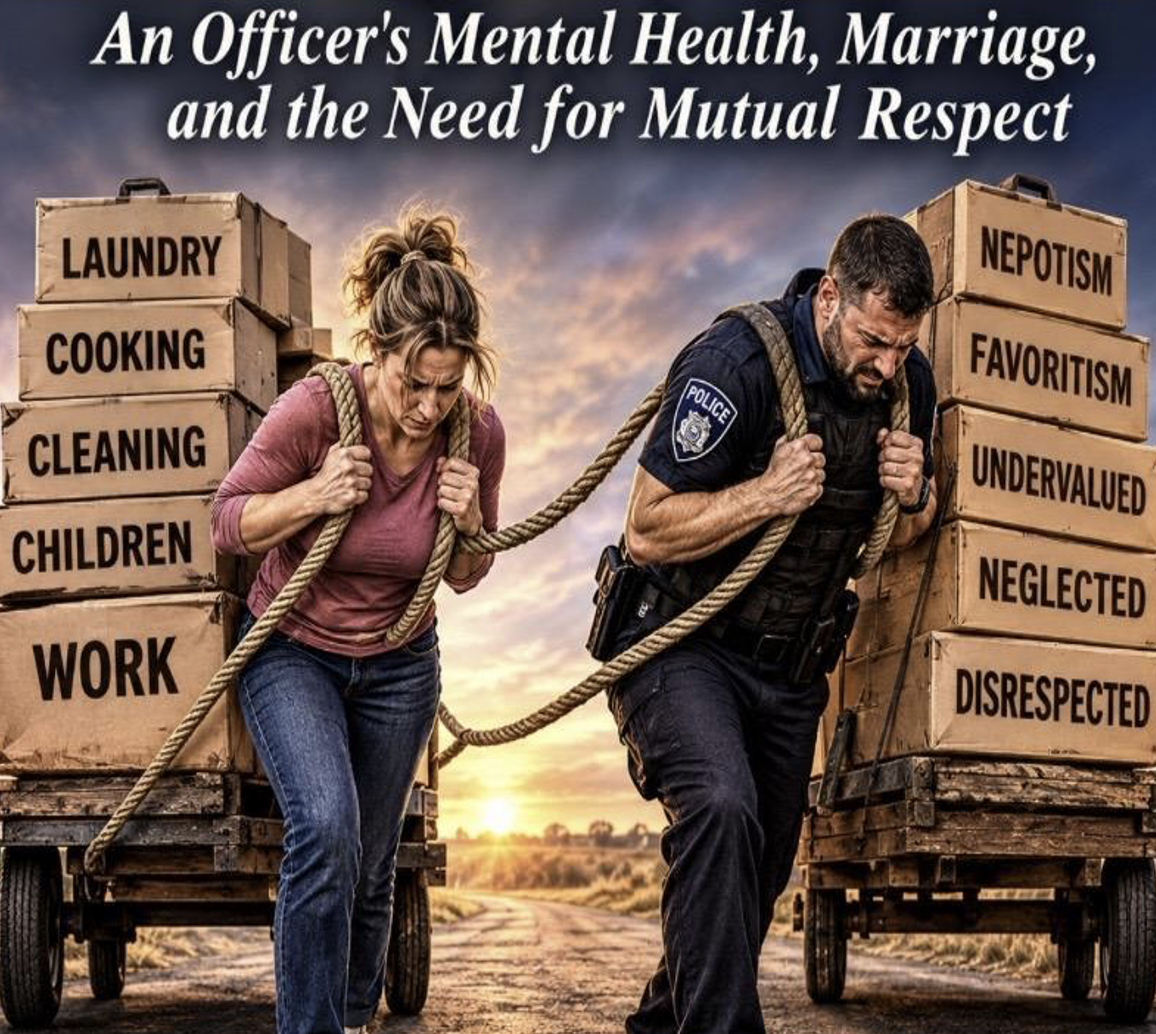
The man pulling the box labeled WORK in that picture deserves recognition. So does the woman pulling the boxes labeled LAUNDRY, DISHES, COOKING, and everything else.
But perhaps there is a better picture of marriage.
One where neither person is standing on the opposite side of the load, arguing about who has it harder.
Instead, they are standing beside one another, recognizing that they are on the same team.
Because the purpose of marriage isn’t to compete over who contributes more. It is to build a life in which both people feel that what they contribute matters.
And for the men and women who serve in law enforcement, that understanding can mean more than we sometimes realize.
An officer spends much of his professional life protecting, serving, and looking out for others.
It is okay for him to need someone to look out for him, too.
The badge may represent the responsibility he carries for his community. But he is still a human being when he takes it off. And he deserves to come home to a partnership where he is seen, respected, appreciated, and supported not another place where he has to prove his worth.
The same is true for his wife.
Because at the end of the day, a successful marriage isn’t about keeping score of who carried the most boxes.
It’s about making sure that both people know they have someone willing to help carry the load.
Officer Eric Aguiar, LLB, has more than 15 years of law enforcement experience 3 of whi, with a professional focus on tactical leadership, crisis response, and continuous development. His perspective is shaped by operational experience, formal legal education, and a belief that effective policing depends on preparation, sound judgment, communication, and continuous improvement.