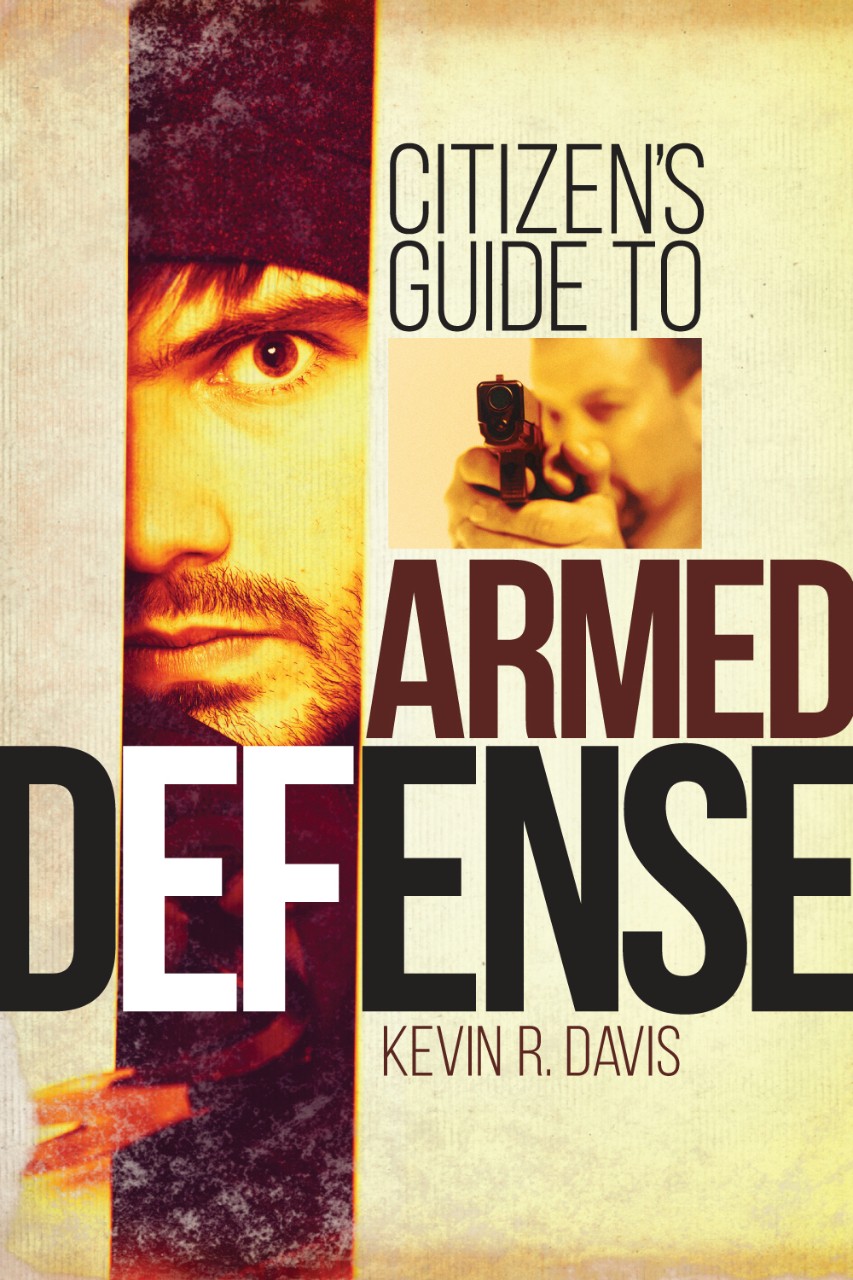
In recent years, the United States Supreme Court recognized that the Second Amendment applies to individual firearms ownership. Not for sport, not for hunting, but for the fundamental right to be armed for self-defense. In his new book, Kevin Davis takes a deep look into the elements of self-defense and protection of others. This life and death responsibility is one of the most serious implications that every firearm owner and carrier, whether a law enforcement officer or citizen must be fully aware of. In Citizen’s Guide to Armed Defense, Davis eloquently details this fact.
Using compelling case studies, histories of deadly force incidents from officers in his agency, himself and the citizens of his community, Davis establishes the reality of violence committed by criminals who have one goal in mind: To make you their victim.
In The Citizen’s Guide, Davis demonstrates that each person carries with them the ability to be prepared for violent confrontation. Such ability does not come with birth as a genetic code, but requires skills that can only be acquired by correct training and continued practice.
Going point by point, Davis lays out the foundation elements of a comprehensive training program. First and of greatest importance is mindset. In his opening chapter titled, “Why We Arm,” Davis tells of the kidnapping and murder of two young school girls. His classmates, the girls were only ten years old when the reality of evil invaded their lives. From that point forward, he takes the reader through the events of his life as a professional law enforcement officer and trainer and that of a changing society where the everyday citizen is faced with the everyday criminal.
Coupled with mindset, Davis explains the absolute need to be aware of one’s surroundings, maintaining a posture of readiness that is sensed by others, most importantly by those who would do you harm. The quote from fellow author Scott Flint highlights Davis’ point, “Awareness repels violence, fear attracts it.”
Mindset, firearms, ammunition, support gear, defensive tactics and training, are all broken down point by point, making this a book not only for the armed citizen but also for every law enforcement officer regardless of time on the job. The elements of the threat, the means and methods in which we respond often apply equally to each person in harm’s way, regardless of position or title. Davis clearly shows through the examples of the book that the only title the violent offender recognizes is “victim.”
The law of self-defense is clearly and competently outlined. Davis clearly understands the issues and describes the elements of justifiable use of deadly force. One of the most important points a reader can take away from Davis’s explanation is that simply because the law says you can, doesn’t mean you should. Knowing when to shoot can be far more important than knowing how to shoot. But it does not have to be one or the other, as Davis writes, it is the combination of firearm skills and a solid understanding of the law that affords the citizen and police officer the highest possibility of winning against a criminal attacker on the street or home.
In his chapter “The Investigation,” Davis takes the reader to the final step: What happens after a self-defense incident? What if you must shoot to defend your life? What do you do when the police arrive, who do you call to assist you, what do you say at the scene? This could be the entire book as there as so many issues involved. Davis does an excellent job of distilling the points that can support the involved citizen or police officer. He also demonstrates by both actual events and his own experiences as an expert witness that facts can be distorted and misunderstood as a result of human nature and the extraordinary stress of the events. Every person should have skilled legal representation after a life or death incident and Davis makes it clear that trying to go it alone could be a costly mistake. The legal system is no place for amateurs and Davis summarizes the process of a preliminary hearing and grand jury proceeding. To be the focus of either of these means you have been charged criminally or charges are being considered. Avoidance of threats and the criminal justice system is what Davis teaches.
As the book nears completion, Davis gives attention to women’s preparation and response to violent attacks in his chapter, “Ladies, Guns, and Armed Defense.” He gives the history of some of the most violent attacks directed toward women police officers and their life saving responses; even when badly wounded. Their actions prove that there is no gender issue in self-defense. Every woman can be equally up to the task, it simply takes motivation and the belief that it is needed. Davis goes over handgun selection as many issues apply to smaller hand shooters. Gear and holsters; the means to carry a handgun are summarized.
There is much more to Citizens Guide to Armed Defense. It is a book for every person who makes the decision to be armed and prepared both mentally and physically. Get a copy, read it, live the principles and pass it along to a family member or coworker so the effort of individual responsibility and preparedness continues.
The Citizens Guide to Armed Defense is available for purchase here.