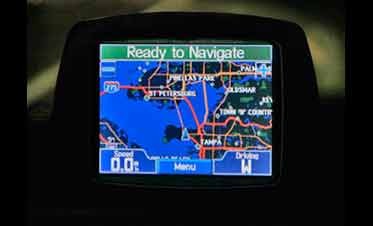
Like millions of motorists, Eric Hanson used a GPS unit in his Chevrolet TrailBlazer to find his way around. He probably didn't expect that prosecutors would eventually use it too — to help convict him of killing four family members.
Prosecutors in suburban Chicago analyzed data from the Garmin GPS device to pinpoint where Hanson had been on the morning after his parents were fatally shot and his sister and brother-in-law bludgeoned to death in 2005. He was convicted of the killings earlier this year and sentenced to death.
Hanson's trial was among recent criminal cases around the country in which authorities used GPS navigation devices to help establish a defendant's whereabouts. Experts say such evidence will almost certainly become more common in court as GPS systems become more affordable and show up in more vehicles.
"There's no real doubt," said Alan Brill, a Minnesota-based computer forensics expert who has worked with the FBI and Secret Service. "This follows every other technology that turns out to have information of forensic value. I think what we're seeing is evolutionary."
Using technology to track a person's location is nothing new. For years, police have been able to trace cell phone signals and use other dashboard devices such as automatic toll-collection systems to confirm a driver's whereabouts.
But the growing popularity of GPS systems — in cars, cell phones and other handheld devices — gives authorities another powerful tool to track suspects.
Among recent cases:
_ In September, a man in Butte, Mont., pleaded guilty to rape shortly after a judge ruled that evidence from the GPS unit in his car could be used against him at trial. Prosecutors planned to use it to show that Brian D. Adolf "prowled" through town looking for a victim.
_ In New Brighton, Pa., a trucker's GPS system led police to charge him with setting his own home on fire. GPS records showed his rig was parked about 100 yards from his house at the time of the fire.
_ In the case of a missing Chicago-area woman named Stacy Peterson, investigators sought GPS records from the SUV owned by her husband, former police officer Drew Peterson. She still hasn't been found, and no one has been charged.
Developed for the military, GPS navigation systems started showing up in cars in the 1990s. Prices have dropped sharply in the past few years, and many units are now available for less than $150.
The Consumer Electronics Association estimates 20 percent of American households own a portable GPS system and 9 percent have vehicles equipped with in-dash systems.
A GPS unit receives signals from satellites to determine its position on the ground. That data can be used by mapping software to display the device's location to within a few yards.
Detectives are often able to extract map searches and desired destinations that have been entered into a GPS unit by the user. Some devices are equipped with a "track back" feature that can show where the unit was at a particular time.
"What we're dealing with here is a use of the technology that I don't think the good people at Magellan or Garmin or TomTom really thought about when they were developing it," said Brill, referring to manufacturers of GPS devices.
Law enforcement sometimes uses secretly planted GPS devices to monitor suspects. The practice, often done without a warrant or court order, has been criticized by privacy advocates who argue that it is unconstitutional.
The GPS feature on a cell phone has already helped solve at least one crime. In 2006, police in Virginia Beach, Va., used the GPS on a homicide victim's cell phone to find the phone and her purse in a garbage can behind a home. The home was linked to the man who was eventually charged with killing her.
Jon Price, a trainer at Garmin Ltd., the leading maker of commercial GPS units in the U.S., started getting calls five years ago to work with law enforcement in cases involving GPS data from the company's units was being used as evidence.
Price estimates he's helped with about 25 criminal cases, some of them involving GPS-equipped boats running drugs out of South America. He's testified as an expert witness in a half-dozen cases, including the Hanson murder trial.
"Typically the GPS data being used is for the purpose of contradicting (defendants') alibis," Price said.
GPS data is usually just one part of the criminal case because attorneys also have to prove the defendant possessed the unit and entered the information into it.
But Renee Hutchins, a University of Maryland law professor and former defense attorney, recently wrote an article suggesting GPS data is protected under the Fourth Amendment. She said police should only be allowed to acquire it by showing probable cause and getting a warrant signed by a judge.
"I think that in the last couple of years, people are starting to be aware that if they have these units in their car, people can keep track of you," Hutchins said. "I think it's a growing public awareness. The problem is … that most people feel like, 'I'm not doing anything wrong, so who cares?' But I think that's the wrong way of looking at it."