Note: This article originally appeared in Tactical Behavior Science.
A concealed gun has weight, and weight changes how people move. Someone carrying a concealed handgun tends to touch it, guard it, walk around it, and keep it out of view. Those adjustments are the signs officers learn to spot.
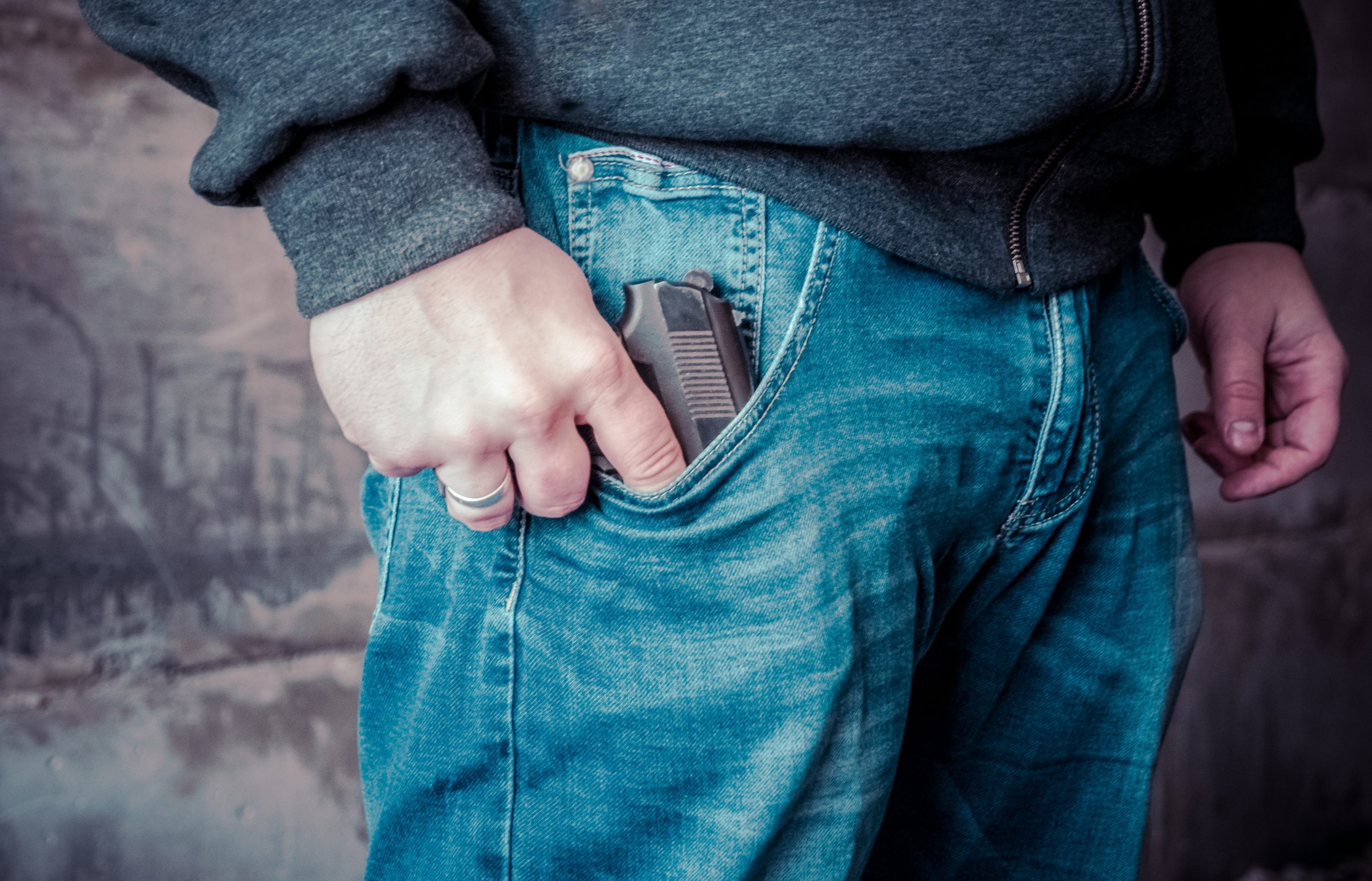
The stakes are high. Most offenders who carry illegally don’t use a holster. In an FBI study of 37 offenders who shot officers, 48% carried the gun in the front waistband. The rest kept it at the small of their back, in the groin area, or in a pocket. A loose gun shifts with every step, so the suspect has to manage it.
In short, gravity is not your friend.
The Classic Signs
It starts with answering one question: which side is the person’s strong side?
Watches, rings, how someone holds a phone, or how they light a cigarette all hint at a dominant hand. Most people are right-handed, and most right-handed people who carry illegally tuck the gun loose in the right front waistband. That’s where it feels secure and easy to reach.
From there, officers should watch for:
- The security feel. People who carry a gun touch it, consciously and unconsciously, to confirm it’s still there. Look for a pat, a brush of the hand, or an elbow pressed against the hip.
- A stiff or shortened arm swing on the gun side, sometimes called a “dead arm.”
- A shorter stride on the gun side, especially when the person is hurrying.
- Adjustments. Hitching pants up, tugging clothing down, or turning away from view to reposition something.
- Protective turning. Keeping the gun side away from people, or holding an arm across the body in a crowd.
- Clothing that doesn’t fit the conditions. A heavy coat on a warm day, or an open coat on a cold one. One gloved hand while the other stays in a pocket. A belt with no belt loops.
- Uneven weight. A gun pulls a jacket pocket, hood, or bag down. Look for a sag on one side.
- Getting in and out of vehicles. Holding the waistband when standing up, or a dipping shoulder during a stop, could mean a gun going under the seat.
None of this is proof. They are reasons to look closer.
What veteran gun-interdiction officers look for
In 2021, The Police Journal published “Behavioral Indicators of concealed and unholstered firearms carrying.” 16 subject-matter experts were interviewed, each with at least 10 years of experience spotting armed people in public. The researchers sorted the signs into two groups.
Signs caused by the gun’s weight and bulk:
| Sign | What it looks like |
|---|---|
| Security feel | Repeatedly touching or patting the spot where the gun is |
| Shortened or disrupted stride | Shorter step on one side, or a slight waddle |
| Shortened arm swing | One arm stays pinned to the body. Less daylight between arm and torso on that side |
| Adjusting pants or belt | Hitching the belt, especially when standing up or getting out of a car |
| Repositioning | A lift or circular push on the outside of clothing to move the gun back into place |
| Clothing fiber stress | A crease running from shoulder to a weighted pocket |
| Printing | The gun’s outline showing through clothing |
| Picking | Pulling a shirt away from the body to hide a print |
| Blading | Turning the gun side away, or setting it a half step back to draw |
Signs caused by the carrier’s awareness of threats:
| Sign | What it looks like |
|---|---|
| Scanning | Constantly checking everyone nearby |
| Threat analysis | Prolonged study of one person, often an officer, plus exits |
| Target glance | A quick look at the exact target, seconds before reaching or striking |
| Evasive maneuvers | Changing direction or creating distance as officers approach |
| Adversarial distance | Moving to a spot to shoot from or take cover, or refusing to leave it |
| Arms in semi-defensive position | Hands held at waist level, body slightly turned |
| Hands in pockets | A hand resting on a gun carried in a pocket |
| Dissociation | Trying to become invisible: suddenly busy with a phone, avoiding eye contact |
| Adrenaline cues | Shaking, sweating, flushed face, pacing or rocking |
The study also stressed timing. People change behavior once they know they’re being watched. A carrier may act normally until an officer appears, then start scanning, adjusting, or drifting away. The researchers mapped five stages: unthreatened, officer present, being watched, initial contact, and interdiction. The same behavior can mean different things at each stage.
Does carrying a gun really change how you walk?
Yes. That claim is now backed by some measurement. In a 2018 study, gait indicators were studied using a motion-tracking depth camera to record 26 people walking twice: once unarmed, and once with a loaded pistol concealed on the right hip under a jacket.
The camera tracked 25 points on each person’s body. Of the 20 measurements that best separated armed from unarmed walks, 15 involved the arms and legs. With the gun on the right hip:
- The right arm moved out away from the body, likely to avoid bumping the gun.
- The left arm swung less.
- The right leg lifted less and stayed closer to the body, shortening the stride on the gun side.
Those results align with what the veteran officers describe: an unnatural arm swing and a shorter, disrupted stride on the carry side.
The study has clear limits. It was small, lab-based, and every participant carried in the same spot. Real people carry in different places, wear different clothes, and walk in every direction. Still, it shows gait changes are physical, not just officer folklore.
The limits: false alarms, lawful carriers, and the law
These signs come with real caveats.
They haven’t been validated as predictors. The Meehan study documents what experienced officers report, not what has been tested against a control group in the field. Validation is the next step, and it’s exactly why we launched Tactical Behavior Science.
Many have innocent explanations. A security feel can mean a wallet, cash, or a phone. A stiff gait can be an injury. Scanning and nervousness are common in anyone stopped by police.
Carrying a gun is often legal. In much of the country, a person can lawfully carry a concealed handgun. Spotting a gun tells you a weapon is present. It does not tell you a crime is happening or that the person intends harm.
Behavior, not appearance. The researchers stress that these cues are about what a person does, not how they look. That protects civil liberties and also improves observation.
The law treats these signs the same way. In Pennsylvania v. Mimms (1977), the Supreme Court held that a bulge in a jacket let an officer to reasonably conclude the driver was armed and dangerous. Later courts have relied on that, as in Anderson v. Russell (4th Cir. 2001). But a single furtive gesture in a high-crime area has often been found insufficient to justify a stop. What carries weight in court is the same thing that carries weight on the street: a cluster of specific, observed behaviors.
The researchers offer two guardrails against false alarms. First, look for clusters, such as a disrupted stride plus scanning plus repeated waistband touching plus printing. Second, treat any read as a starting point for more observation, not a conclusion.
From “he’s carrying” to “he’s about to use it”
Knowing someone is armed is only half the problem. The question that matters most to an officer is whether that person is about to use the weapon. That’s where our signature course, Seconds for Survival, and the FOCUS system come in.
FOCUS reviewed five years of officer video and tracked what subjects did before attacking officers.
We classified scanning, blading, and arm tight as high-consequence cues. When they show up, they matter. Officers who were shot or shot at faced an average of 4.8 warning signs before, and recognizing those is why the training matters.
Practical takeaways for officers
- Find the strong side first. It tells you where to look and which side to watch.
- Watch the walk before the contact. Arm swing, stride, and security feels are easiest to see before the person knows you’re watching.
- Note the change when you appear. Scanning, adjusting, or drifting away as you arrive is more telling than any one behavior.
- Count the cues. One sign is a reason to look closer. A cluster is a reason to plan your approach, cover, and get to a more advantageous position.
- Write down specifics. “Right arm pinned to right hip, no arm swing, touched right waistband three times as I approached” holds up far better than “appeared to be armed.”
Frequently asked questions
How can you tell if someone is carrying a concealed gun? Look for behavior around the waistband and the carry side. Common signs include repeatedly touching one spot, a stiff or shortened arm swing, a shorter stride on one side, adjusting pants or a belt, and the gun’s outline printing through clothing. No single sign is proof; clusters matter.
What is a “security feel”? It’s a quick touch, pat, or elbow press to confirm a concealed item is still in place. People carrying guns do it consciously and unconsciously. People carrying cash, phones, or drugs can do it too.
Where do criminals usually carry guns? Most carry without a holster. In an FBI study of offenders who shot officers, 48% carried in the front waistband, 20% in the small of the back, 22% in the groin area, and 11% in a pocket.
Does carrying a gun change how someone walks? Yes. A 2018 motion-capture study found that a pistol on the right hip changed arm swing on both sides and shortened the right-leg stride.
Can police stop you for looking like you’re carrying a gun? It depends on the state and the facts. Carrying is legal in many places. Courts have allowed officers to treat a gun-shaped bulge as a sign someone is armed and dangerous, but a single furtive movement is often not enough for a stop.
See the warning before the weapon comes out
The signs someone is carrying a concealed gun are real, and you can learn them. The harder skill is reading what comes next: whether an armed person is settling into compliance or building toward an attack.
FOCUS teaches officers to recognize the behavioral cues that come before violence and to turn what they see into a defensible, real-time risk assessment.
- See how the FOCUS methodology works
- View training dates and certification levels
- Bring FOCUS to your agency
Related reading: Pre-Attack Indicators: Why Police Training Has Almost No Research Behind It.
Sources
- Meehan, N., Strange, C., & Garinther, A. (2021). It’s the walk, not the talk: Behavioral indicators of concealed and unholstered firearms carrying. The Police Journal, 94(4), 462–480.
- Muchiri, H., et al. (2018). Gait indicators of concealed firearm carrying, analyzed with Kinect skeletal tracking. International Journal of Scientific Research in Computer Science, Engineering and Information Technology, 3(8), 368–383.
- Pinizzotto, A. J., Davis, E. F., & Miller, C. E. (2006). Violent Encounters: A Study of Felonious Assaults on Our Nation’s Law Enforcement Officers. FBI.
- FOCUS study findings, Tactical Behavior Science training materials. tacbehavior.com
- Pennsylvania v. Mimms, 434 U.S. 106 (1977).
- Anderson v. Russell, 247 F.3d 125 (4th Cir. 2001).
- Argueta v. Jaradi (5th Cir. 2023).