As trainers, we do a good job of getting our training done with the time and resources that our departments grant us. Some of the academies combine PT and DT into a block of instruction–40 or 80 hours–depending on the length of the basic recruit curriculum. The PT portion naturally impacts our time to teach DT. On paper, 80 hours sounds like sufficient time, but when you get into the actual "hands-on" instruction, most of us find that a couple of problems materialize.
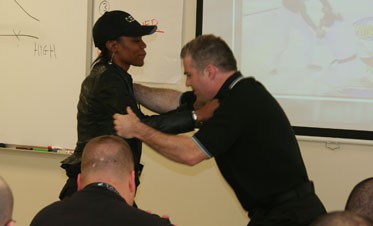
First is time. Rather than teaching all gross motor skills (big muscle groups), in many of our programs we are teaching complex skills (fine motor skills), i.e. arm bars, bar hammer lock, etc. Some students grasp the concept and technique quickly; most do not. In addition to that, we teach defensive moves and escapes–things such as what to do if someone grabs your wrist or shoulder. These are good techniques to learn, don't get me wrong, but how often does it happen, and would we better serve our people by teaching "reality", in other words–what's actually happening on the street?
I had the opportunity to attend a class entitled, The 5 Minute Fighter. My friend, Sgt. Jeff Quail, heads a full-time Canadian Police Service Tactical Team. He's also the inventor of the ShocKnife , the Chief Instructor at Setcan , and is a court-declared expert in defensive tactics. About eight years ago, he did some introspection regarding the tactics that he was teaching. He came to the conclusion that he had been lying to his students; he did not believe in the efficacy of the techniques that he was telling them would work. The entire premise of The 5 Minute Fighter is this: If you had only five minutes to teach DTs to your students, what would you teach them? The answer–work on skills that most of them possess.
Under stress, for instance, a fight, we revert to what we inherently know. We spend hours in the gym teaching boxing–how to throw jabs, left hooks, right crosses, and uppercuts. We waste time on blocks and footwork. Why? We're not teaching our people to be boxers; hopefully we're teaching them how to win confrontations. However, one valuable thing that we do gain from putting the gloves on our students is to allow some of them the experience of what it feels like to actually be hit–hard.
Quail did a little experimenting on his own. He reviewed footage of street encounters and cage-type fighting. He also paired-up students who had no instruction at all. What he found was that most people will naturally throw a powerful punch, even those with no boxing training! Furthermore, the interview, or tactical stance that we have taught for ages–the one where we never stand directly in front of someone, but rather off at a 45 degree angle to their left or right shoulder, is rarely ever used. Most confrontations (fights) occur when the two combatants are standing face to face. So Quail thought to himself, "Why not prepare my students for what happens all the time on the street? Why not teach reality?"
He set out to devise a system that employed the use of dominant side tools: punches and kicks. He found that the majority of people didn't need to be taught balance; they automatically attained a position of balance once a threat appeared. They lowered their center of gravity and gained a wider base. To prove his point, he used the bombing at the 1996 Atlanta Olympics as an illustration. If you watch the people on the tape, as if on cue, the instant the bomb explodes everyone crouches into a defensive posture. You can see the same phenomenon occur in many gun battles as well.
Quail's system defines four specific zones that people utilize in a fight:
- Safety zone: both combatants standing apart and unable to reach each other with a punch or kick
- Standing unrestricted: both are close enough to strike one another yet neither one has hands on the other to restrict their movement (10% of fights are in this category)
- Standing restricted: both have hands on, one may be grabbing the other's shoulder, clothing, etc., therefore their striking ability is restricted (20% in this category)
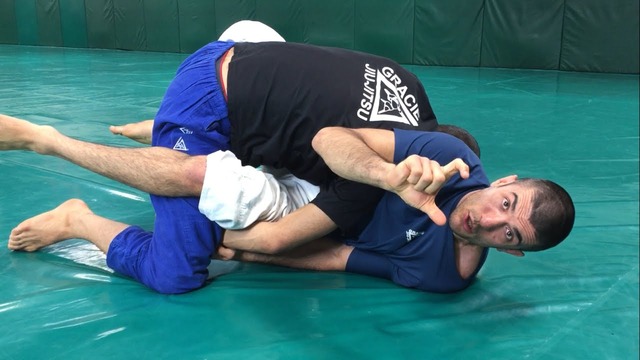
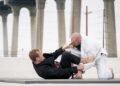
- Ground: as we know, most every encounter (70%) will eventually go to the ground.
The 5 Minute Fighter teaches a student to train for what they are likely to face. Since only 10% of our fights are standing unrestricted, why teach jabs, hooks, etc? We should be training to be able to punch when someone has grabbed our arm or clothing, when we can't get that big powerhouse punch delivered. Teach gross motor skills like punches and kicks. Better yet, spend the most time on ground fighting, since that's where our adversary will take us.
The philosophy of "One Round versus Round One" is simply this: we are used to dividing our training into time increments. We'll have them box for two minute rounds, or we'll have them grapple for two or three minutes. The body adjusts to that workload. But since we don't have "rounds" on the street; we fight until we win, lose, or are too exhausted to continue. When round one is over, we let our students rest until it's time for round two. But the reality is that every fight that we're in on the street is "one round." That's how we need to train.
I recognize that some of the above is anathema to what many of us have been teaching, yet I submit to you that this concept makes sense if you analyze it in the context of the incidents that we are involved in on the street. Jeff Quail has been teaching this system in Canada for eight years. His police service has adopted this method of training, recognizing the pragmatism that it reflects. For more information, you can contact Jeff at [email protected] or [email protected]. Stay safe, brothers and sisters!