There are different kinds of computers than can be used by patrol cops. I will share some of the gory details that define each type: laptop, mobile and handheld. No geek-speak. No techno-jargon. You can read this over while sipping a cup of coffee. If you want more detail, e-mail or call me.
Each computer type best serves a certain, very specific type of cop and cop work. That is, (believe this or not): there are some computer sales people who want you to buy what makes them the most money, rather than what's actually best for your agency. I know: you're shocked at the notion. Uh-huh.
The types of computers
Laptop computerscame along first. They are built to (you guessed it): sit on a person's lap. We see them on airplanes, in classrooms, at the library, and so on. Typically, a laptop computer has a cover that is hinged at the back so it will lock in the closed position with a "click". The cover holds the screen. The keyboard is on the base along with a finger pad and two buttons that provide mouse capabilities. Some laptops have touch screens. Some also have backlit keyboards. Connections for power, internet, printers, and the like are either on the back or side edges of the laptop. Many laptop computers have a "gang plug" that mates to a similar plug on a docking station built especially for that purpose. The docking station allows all of the connections to be made through the one plug rather than with individual wires/plugs. Laptop computers have gained exponentially in features and sophistication over the years. A laptop provides the ultimate in portability for a fully-functional computer. Panasonic has established itself as the industry leader for laptop computers with its Toughbook product line.
Mobile computers are not laptops, even though the technically challenged among us often use the terms interchangeably. Simply, a mobile computer is built to be installed in (or on) a vehicle. They are not easily removed. Unlike their laptop cousins, they do not need regular A/C current for power–they run on the vehicular standard of 12 volts, DC. You may have these in your agencies. You can see them on the inventory carts at Home Depot and other large retailers where they are used for inventory control and purchasing.
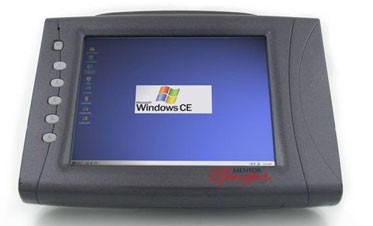
A mobile computer may be one where the video display, the hard drives and processor are all in a single unit. These are commonly called "tablet" computers because they are self-contained and are in the shape of a tablet or clipboard. The most widely used mobile computers have the processor, hard drives and connections in a separate cabinet that might be beneath the display, in the glove box, or in the trunk of the car.
Beyond their need to be installed in a vehicle, one of the most telling identifiers of a mobile computer is that the keyboard is not attached to the display. Connections can be made in various manners, but because of the permanence of the installation, the issue of easy access for those wires is largely irrelevant. The prominent manufacturers of mobile computers are Motorola and Data911.
Handheldcomputers are not brand new on the scene. They've been around for a while, generally referred to as Personal Digital Assistants or PDAs. While these devices are extremely portable, they have very limited functionality, very limited storage, and extremely limited ability to connect with the rest of the word on a "real-time" basis.
Handheld computers have a small display screen. Some have a complete keyboard, e.g. a BlackBerry. In those situations, the keys can be very small. Some manufacturers have addressed this issue by putting a limited number of "hard" keys on the computer with a full keyboard that is electronically displayed on the screen. Some of the more mature manufacturers offer a host of optional devices to make the handheld easier to use: magnetic swipe readers, barcode scanners, limited picture taking, GPS locators, and now wireless connectivity to the internet.
For printing, a handheld has options. Some are "all-in-one" units that are combined with a printer. Others connect via a cable or docking station. Still others use wireless technology like Bluetooth or Wi-Fi via "hot spot" access points hardwired to the internet
Some of the most popular commercial-grade handheld computers are made by Symbol Technologies (a wholly owned subsidiary of Motorola) and Intermec.
Ideal places to use them
Laptopcomputers are probably the most widely deployed type of computer in policing today. Unfortunately, in most instances, laptops were chosen for the wrong reason and were not the best choice for the cops who must use them. The primary benefit of a laptop is the ultimate in portability and full computer features. Some agencies have chosen to assign a laptop computer to each patrol officer. The computer goes with the cop, i.e. on patrol, home off-duty, classroom training, and roll call. In those situations, the value of portability outweighs the disadvantages of a laptop.
Disadvantages, you say? Yup. The keyboard is fixed and attached to the computer. A patrol officer who uses the computer for report writing or other extended tasks will find that being "twisted up" while sitting in the car in order to reach the keyboard will be uncomfortable. In some cases, it has led to low back injuries that resulted in workers' compensation claims. The officer's ability to manipulate the angle, height, and tilt of the screen is limited only to how far the entire computer can be moved. This often becomes an issue for the cop who is trying to see the screen in very bright sunlight.
If the computer does not have a touch screen, the entire experience becomes terrible, at best. I've seen cops steering with their knees while using both hands on the mouse pad trying to click on something on the screen. Aaarrrgh!
If the computer will be removed regularly from the vehicle (if not, then you shouldn't be using a laptop): a mount with a docking station is a must. The alternative requires the plugging/unplugging of a host of cables which get in the way on the shift, become frayed, and are generally a pain where one sits.
For a patrol car, laptops are best deployed with officers who primarily handle traffic enforcement. They have fewer reports than section cars (often only DUI arrests). They are entering short bursts of information, i.e. plates/tags, etc. If those laptops are equipped with a magnetic stripe reader to read the back of a driver's license and a high-speed thermal printer to print traffic tickets, the cop is in technology heaven.
Mobilecomputers are ideally suited to general patrol. They can be firmly mounted. There are more mounting options. They are built for the kind of abuse that's dished out in a car.
The keyboard is a separate item. For cops who must complete reports and other such stuff in the car, being able to place the keyboard wherever it's comfortable (like their lap) is a back-saver. There are generally more options when it comes to mounts for mobile computers and more options when deciding exactly how to configure the car interior because you are dealing with two separate and smaller pieces than a single box, i.e. a laptop.
Connections are permanent, so there's less chance cables will get in the cop's way. Mobile installations tend to be more durable with fewer breakdowns. Every mobile computer that I've seen in recent years has a touch-screen as a standard feature. Mobile computers also generally offer brighter screens which are more able to produce an acceptable view in very bright sunlight. Mobile computers don't have tops or lids that get in the way or become loose and go sideways when running code.
There's a downside here, as well. Often, a mobile computer costs more (initially) than a laptop. When considering the total costs of ownership over three to five years, the costs become much more comparable to laptops.
The mobile computer is tied to the car. It doesn't go with the officer. Depending on your agency's deployment plan a mobile choice could either cost more, or less than laptops.
If the computer goes down, it's not as easy to simply pull it and replace it with another to get the car back on the road. That's not to say it's impossible, it's just not as easy.
Handheldcomputers are a dream to some cops and a nightmare to others. It depends on the situation in which they are being used.
I've had experience training cops on the use of electronic ticketing software in agencies around the country. Given the choice, the handheld computer will be their last choice.
Handhelds are great for some cops. Motor officers on bikes often prefer a handheld. Cops assigned to municipal parking lots or airport parking areas love them. Cops on horseback really have no other choice. Cops in the field where any other computer form won't fit will do best with a handheld.
There are detectives, guys on the narc squad, school resource officers, and other cops who are mobile but don't always operate from a car can put handheld computers to good use.
There are many software applications (like Microsoft Office) that allow retrieval of email, managing a calendar, writing tickets, and yes–running subjects and vehicles. BIO-key has created MobileCop, that looks the same no matter what kind of computer it's on and that will give the field cop total access to NCIC, state systems, departmental records, and so forth.
The downside issues quickly become self-evident. Most handhelds don't have internet connection today, though that may change over time. That means that tickets, reports, etc. cannot be pre-populated with information from NCIC.
Watching a pudgy-pawed cop try to key data into one of these tiny handhelds is comparable to watching a bear cub play with a mouse turd. Their only saving grace is if the handheld can scan the driver's license or VIN tag on the car. Otherwise, it's a pain.
To what I said earlier: given a choice between a handheld and a laptop or mobile computer, the handheld comes in last place every time.
The handheld should only be deployed when there no tactically sound or practical method to deploy one of its fully-functioned and full-sized cousins.
The Traps
Manufacturers have long used smoke and mirrors to sell their stuff to unwitting buyers for police agencies.
The laptop guys have told stories of how patrol officers will be able to arrive at the scene of a crime, carrying their laptop computer and use it to quickly and conveniently record information about all of the people and potential dozens of pieces of property associated with the incident. And, command officers swallowed that line. Maybe they should both go to a matinee of "Alicein Wonderland." The reality:
- No cop wants anything extra to carry or that could potentially tie up a hand that will be needed in self-defense.
- No cop worth his salt will surrender his breast pocket notebook in favor of stepping through some poorly designed form with the victim at a crime scene.
Some agencies have allowed (even encouraged) their officers to take the computers on scene. That usually comes to a quick end because the cop realizes it's the result of a fantasyland dream of the IT staff, or one of the computers comes up missing. From then on, they're locked down in the car.
When on scene, the cop wants all of his senses devoted to his surroundings, not some silly computer that may, or may not, work the way he expects.
The concept of assigning a laptop to each officer sounds really good on paper. The result is often computers that are "information silos" that require the cop to get his own computer when he wants to see something he's done in the past. The computers are not built to seamlessly integrate data storage into a central spot. If it's "his" computer, some cops will find ways to make "adjustments" of their very own — like unauthorized software that the agency comes to regret.
Today's world of ever-higher-speed wireless connections are leading to a new environment where computers are chosen for where they will be used, e.g. the car, the report writing room, the booking area, etc. and where officers have access to their stuff by virtue of signing on with a secure password. That eliminates the need to transport hardware by making the data portable to wherever the cop is working at the moment. That's the way the world is heading. Just look at the new iPhone if you want proof.
Mobile computer makers seem to be most tuned into the patrol environment. The two companies I mentioned earlier: Motorola and Data 911, have very deep roots in law enforcement. They are among the few who understand and don't try to sling a lot of BS in order to sell their gear.
Handhelds are great in the right places. But, they're disasters in the wrong place. I recently went to train a medium sized agency that has a mobile computer in every car. The agency was about to deploy electronic ticketing software. I was shocked–no, make that pissed–that they had been sold handheld computers to use for e-ticketing. I knew that the cops would have greatly preferred to use that same software on the computers already in their cars. I asked a representative of the software company why that was done. The answer was telling: the company makes a lot more money when they sell a handheld computer rather than just the software on an existing computer. It made for a better financial report to the corporate parent.
As hard as it may be to believe, this same outfit has convinced the state agency in Idaho to force their cops to use tiny handheld computers to write traffic crash reports. Could you imagine being at a scene somewhere trying to tap out hundreds of boxes on an itty-bitty screen? It's a recipe for a cop losing track of his surroundings in a way that could bring him/her great harm.
Now, let me be clear: when it's a handheld or nothing, the handheld may be a good alternative. It depends on what it does to the cop's ability to stay aware of his surroundings. Undercover cops and cops who are not in cars can do well with a handheld. But, take them no further.
What to do now
Don't be a sheep. Don't make a choice just because another (maybe bigger) agency in your area chose a certain type or brand of computer. That doesn't make it right for you. As a growth strategy (many years ago), Panasonic priced their computers so that their laptops were the lowest and certainly cost less than mobile computers. Purchasing departments across the land chose Panasonic–not because it was the best fit, but because it was the lowest price. Unable to articulate why another option was better, the cops were forced to live with it. Panasonic and the Toughbook have become institutionalized. That's not a bad thing. But, recognize it for what it is and why that brand is so widely used.
For a whole host of reasons, I recommend that hardware not be purchased from a software provider. Software companies arbitrarily inflate the price of the hardware usually without adding any value. They also are driven to steer you to the choice that makes them the most money, rather than what will work best for your situation.
There are a whole host of reputable hardware manufacturers out there. Certainly, Motorola is one of the oldest and most trusted names in our business. Use them as a benchmark. They have every kind of computer you can think of, and probably some that you haven't. Data911 is right up there, as well.
Think of like this. When it's time to buy a new car, some folks will sell their old car on their own, rather than trading it in. They do this because they can get more money on the open market for the old car than they can on a trade-in and equally important, one never knows how much the price of the new car has been pushed up as a result of the trade. The smart money guy keeps those transactions separate. I'm suggesting that the same theory applies to the purchase of hardware and software. Get a written commitment from both suppliers in advance that the hardware and software are compatible and then buy from them separately.
Laptop, mobile and handheld computers are each terrific — when they are put to their best intended use. Examine your situation carefully. And, do it from the angle of the grunt cops who will use this gear. Then, choose the type of computer that will help them to their jobs while maintaining or improving their safety.
That's pretty much it.
If you'd like some one-on-one advice or help, feel free to contact me through the information in my author profile.
Stay safe out there!