Driving down the Southern Illinois’ interstate in a rented blue Dodge, the drug courier thought his chances of being caught were almost nil, though there was enough cocaine in the trunk to send him to prison for a very, very long time.
He had made this run several times before, getting pulled over only once for speeding. But within 10 minutes, the courier was driving again. “If he only knew what he just let go,” he had thought as he drove away.
On this trip, the courier saw two identical 4" x 4" signs, one on each side of the highway, and his heart started pounding again.
“Drug Checkpoint One Mile K-9.”
Several police cars waited for him on both sides of the road. No doubt their dogs would detect the cocaine.
He considered cutting through the grass median, but then saw an escape. Between the warning signs and the checkpoint was an exit ramp, which must have been put there by the patron saint of drug traffickers. Jerking the steering wheel, he cut over from the fast lane to the exit.
Meanwhile, on an overpass near Exit 52, a deputy sheriff waited in a pickup truck, wearing a T-shirt and jeans. Down the highway several empty, idling squad cars had their lights on just past the checkpoint warning signs. “If I was a drug mule," the deputy sheriff thought, "I’d think that was a real checkpoint.”
Every time the deputy saw a vehicle take Exit 52, he would discreetly place a pair of binoculars to his eyes and watch. If any of the cars made a traffic violation, he made a radio call.
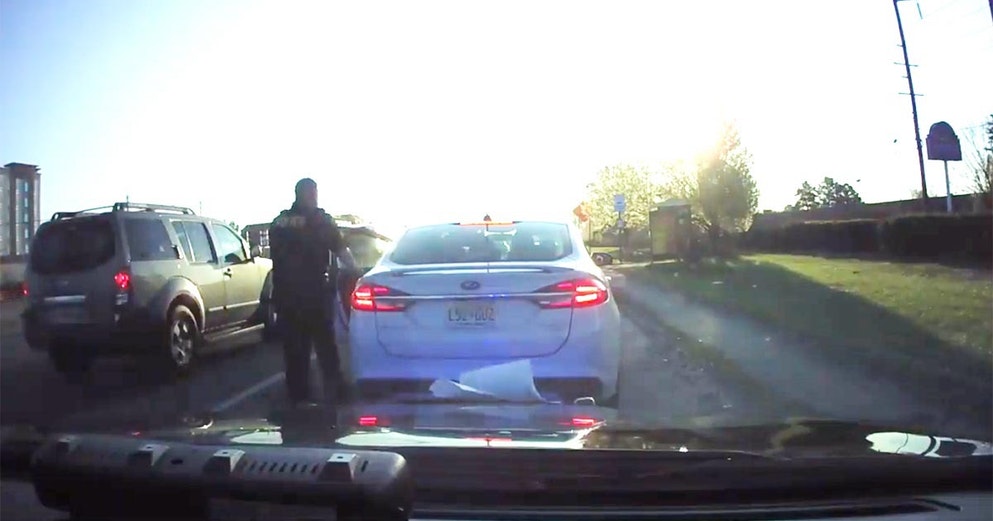
As the deputy watched, a blue Dodge passed the signs and quickly cut across both of the eastbound lanes, failing to signal twice before taking the exit. “Gotcha” the deputy thought.
“Blue Dodge, failure to signal two times,” he called into his radio. “White male driver, California tags.”
At the bottom of Exit 52, which motorists couldn’t see before committing to the exit, several deputy sheriffs in full uniform waited for the blue Dodge from the radio transmission.
As the courier exited, he realized he had been duped. A deputy signaled him to pull over, told him he had been stopped for failing to signal and asked to see his license and insurance.
A cardboard sign, stapled to a nearby tree read, “Johnson Family Reunion” and had an arrow pointed down the road.
The courier blurted out, “I’m going to the Johnson Family Reunion.”
“Great,” the deputy said as he smiled at Captain Steve Johnson, standing nearby. It was great because there was no such family reunion. The cardboard sign was another ruse.
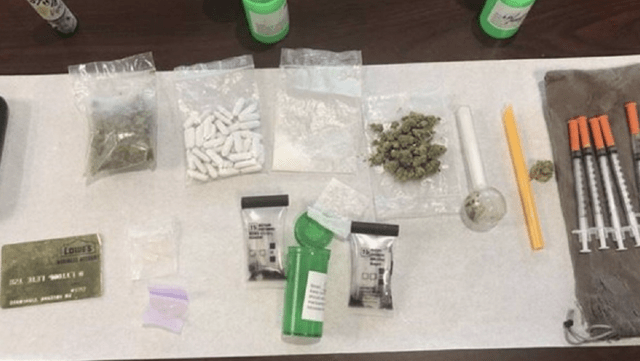
Noting several indicators of drug trafficking, the deputy asked for consent to search the Dodge, and, as most couriers inexplicably do, the driver gave consent. In the trunk of the car were 60 kg. of cocaine. The courier was arrested and transported to jail.
Eventually, the courier hired a defense attorney, who obtained a copy of the arrest report. The attorney argued that the sheriff’s department had clearly violated the 2000 U.S. Supreme Court decision of Indianapolis v. Edmond, which ruled roadblocks conducted for criminal interdiction unconstitutional.
The officers involved in the case were aware of the ruling, but had not violated it because this operation was not a roadblock or checkpoint at all; it was a “mock block,” a way to trick drug traffickers into avoiding a fake roadblock, only to drive right up to officers in waiting.
Mock Blocks
The practice of using mock blocks was ruled to be constitutional in the 2004 case of United States v. Orlando Martinez, a scenario almost identical to the fictional one above. This case provides an innovative and constitutional way for departments to apprehend drug violators.
A thorough understanding of legal precedence, care, supervision, training and knowledge of the principles of criminal interdiction are essential to conducting a mock block.
Most departments choose not to stop every vehicle that comes through a mock block. Only drivers who commit actual violations are stopped in keeping with a 1996 Seventh Circuit case, United States v. Smithand and the well-known U.S. Supreme Court case which quickly followed, Whren v. U.S.
Some courts have ruled that stopping every vehicle would violate the Edmond decision because the officers involved would be conducting a de facto roadblock. In fact, the Phelps County, Missouri Sheriff’s Department, the department that was successful in the Martinez case, lost a 2002 case, United States v. Yousif, because the defendant was stopped at the end of the ramp without having committed any traffic violations.
In the 2005 case of Illinois v. Caballes, the Supreme Court ruled the use of a canine to sniff the exterior of a vehicle lawfully stopped for a traffic violation does not violate the Fourth Amendment. If a canine indicates the presence of narcotics within the stopped vehicle, officers may conduct a warrantless search. See the ruling on the 1925 case of Carroll v. U.S..
In United States v. Brugal, the court ruled despite the decoy signs on the interstate, establishing a license checkpoint at the end of the ramp was constitutional.
In a 2005 Fourth Circuit case, the court ruled “Evasive behavior by a motorist approaching a police roadblock may contribute to a reasonable suspicion of criminal activity” and, combined with other factors, may justify an investigatory stop. See United States v. Dennis Deon Smith.
In addition to understanding the legal precedence for conducting a mock block, officers should observe a few practical considerations.
Officers must also consider the proper wording, placement, and visibility of signage used in a mock block. To be effective, one must be able to read the signs and have just enough time to take a selected ramp. Some agencies choose to use one sign in English and another in Spanish.
Departments have experienced the most success when choosing exits that few people would naturally exit, which lead to few or no restaurants, motels, or gas stations.
Commanders must also consider numerous safety concerns and ensure safety essentials are available.
Officers should be thoroughly briefed about pursuit policies because offenders frequently flee once they realize they will be stopped.
Administrators will want to consider, in addition to the illegal substances located, vast sums of illegal drug money, vehicles, and property are often seized at the scene of the operation or in subsequent controlled deliveries. Some departments completely fund operations with forfeited funds from earlier seizures.
Law enforcement officials experienced in criminal interdiction know there seems to be no limit to drug traffickers’ imagination when concealing contraband, but officers also have the ability to use imagination to develop creative ways to detect and apprehend criminals legally. The use of the mock-block is an example of this imagination and is also a highly effective and constitutional method to interdict illegal substances flowing through this country daily.
References
Albrecht, S. & Morrison, J: Contact & Cover: Two-Officer Suspect Control. Thomas Publishing: Springfield, Ill., 1992.
Carroll v. United States, 267 U.S. 132 (1925).
Illinois v. Caballes, U.S. (2005).
United States v. Brugal, 209 F. 3d 353 (4th Cir. 2000).
United States v. Dennis Deon Smith, No. 04-4311 (2005).
United States v. Orlando Martinez, (8th Cir. 2004).
United States v. Smith, (7th Cir. 1996).
United States v. Yousif, 308 F.3d 820 (8th Cir. 2002).
Whren v. United States, 517 U.S. 806 (1996).