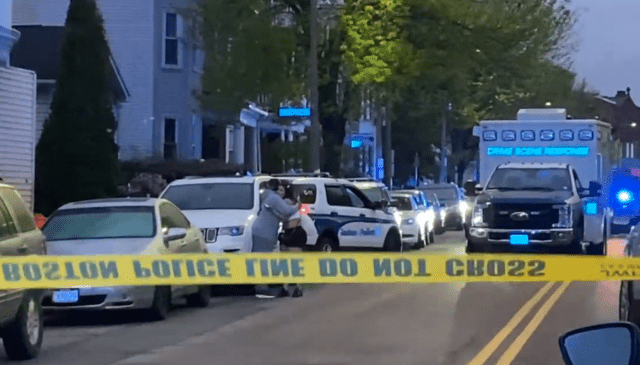
Boston, MA.: A mental health crisis call in Boston turned violent this week, when a man armed with a sword stabbed a police officer and knocked an EMS clinician to the ground, raising questions about whether mental health co-response models are placing officers and civilian responders in avoidable danger.
The incident unfolded at an apartment on Hemenway Street, near Northeastern University’s campus. At approximately 10:44 a.m., officers responded to a distress call from a man who reportedly believed four people with guns were attempting to harm him. Officers could not locate anyone matching that description but spoke with the caller through his door, then requested EMS and a mental health clinician through Boston’s Emergency Services Team (BEST) after concluding he needed immediate psychiatric attention.
First responders spent approximately 45 minutes talking to him through the apartment door before he came out, wielding a sword and stabbing a Boston officer in the arm, and knocking the clinician to the ground. Officers fired a Taser and a firearm to stop the attack. The suspect later died from injuries at the hospital.
The officer received a tourniquet at the scene before being transported for treatment. Several officers and two EMS clinicians were also taken to the hospital with non-life-threatening injuries, according to Suffolk District Attorney Kevin Hayden. The Suffolk County DA’s office later identified the man as Jacob Graves, 29, of Boston.
The BEST clinician present was part of a co-response model that pairs law enforcement with behavioral health professionals on psychiatric calls, a framework that Boston has used since 2011 but significantly expanded in the years following the George Floyd protests and the national push to reduce police involvement in mental health emergencies. In April 2021, Boston launched a pilot explicitly aimed at increasing the role of mental health workers and decreasing the role of police in crisis calls.
The results of that expansion are now facing public scrutiny as officers described the scene as “chaotic.”
Boston EMS issued a statement following the incident: “Today serves as a reminder of the dangers inherent in this work and the sacrifice our members make every day. Members of Boston EMS show up to save lives — not to be assaulted. No one should face violence for simply doing their job.”
The broader debate over mental health co-response programs is not new. Cities across the country, many drawing inspiration from Denver’s Support Team Assisted Response program, known as STAR, have spent the years since 2020 moving civilians into crisis response roles previously handled by officers. Denver’s STAR program now operates citywide with eight vans and 16 responder teams on a base budget of $7.2 million, nearly double its 2022 funding.
But what works on low-level, clearly non-violent calls is a different proposition than what officers encounter when a person in crisis is behind a closed door with an unknown threat level. The Boston incident exposed that distinction in real time.
Is This Training The Answer?
Dr. Travis Yates developed the first research-based framework designed to help first responders predict pending violence. The research for FOCUS Certification entailed reviewing hundreds of body camera videos over the last five years, and Yates tells us that the majority of attacks on law enforcement could be avoided.
“Assaults on law enforcement have doubled in the last decade, and it’s ironic that this is the same time period that there has been an acceleration of these so-called reforms, but no one seems to be evaluating the effectiveness,” Yates said.
When Yates and his team conducted their research, he said it was clear that the reforms were affecting how officers react to violent behaviors.
“What we saw over and over was a suspect displaying threat cues and in some instances even telling the officer what they were going to do, and the officer continued their verbal de-escalation and hesitated rather than taking the appropriate caution to avoid the attack,” Yates said.
Calling it a crisis in the profession, Yates encouraged leaders to take a serious look at their policies and training and to ensure they aren’t placing their officers in greater danger.
“The truth is, I think many leaders know their officers are in more danger in an attempt to comply with the latest reform, but they are more concerned with the opinions of those on the sidelines than with what could actually save the lives of both officers and suspects,” Yates told us.
Yates said the research revealed what can mitigate the use of higher levels of force.
When officers acted upon early signs of pending violence, such as placing handcuffs on the suspect or immediately controlling the suspect’s hands, higher levels of force were avoided, according to Dr. Yates.
Yates said that the research was clear, and his team saw no evidence that the standard de-escalation tactics being pushed to the profession today did anything but create deadly force situations that often hurt and kill suspects and officers.
Yates is currently providing FOCUS certifications to officers across the country.