A Leadership Portrait Inside the NYPD’s Historic 44th Precinct
Statement of Record
On July 10, 2026, I had the privilege of returning to the NYPD’s historic 44th Precinct in the South Bronx as the Department’s Honorary Law Enforcement Motivational Speaker. Throughout three roll calls and numerous one-on-one conversations across the command, I offered words of affirmation, encouragement, appreciation, ethical leadership, emotional resilience, and protecting the protector, while emphasizing the importance of suicide prevention. The privilege of serving more than one hundred officers assigned to one of America’s busiest and most demanding police commands was both professionally humbling and personally meaningful.
The evening coincided with heightened operational activity surrounding a major concert at nearby Yankee Stadium, bringing additional officers from commands throughout the NYPD to assist the 44th Precinct with its already demanding mission.
For me, however, the visit carried a deeply personal significance.
I grew up in the Bronx, just a short distance from the 44th Precinct. Although I passed the command many times over the years, I vividly remember one bicycle ride as a fourteen-year-old, riding beneath the elevated train on my way to Yankee Stadium. As I rode past the precinct that day, I could never have imagined that decades later I would return to stand before its officers, offering words of affirmation, encouragement, and appreciation to the men and women protecting the very streets that helped shape my youth.
During three roll calls and numerous one-on-one conversations throughout the command, I met with more than one hundred officers serving one of America’s busiest and most demanding police commands, offering words of affirmation, encouragement, appreciation, ethical leadership, emotional resilience, and protecting the protector, while emphasizing the importance of suicide prevention.
The evening coincided with heightened operational activity surrounding a major concert at nearby Yankee Stadium, bringing additional officers from commands throughout the NYPD to assist the 44th Precinct with its already demanding mission. For me, however, the visit carried a deeply personal significance. I grew up in the Bronx, just a short distance from the 44th Precinct.
Although I passed the command many times over the years, I vividly remember one bicycle ride as a fourteen-year-old, riding beneath the elevated train on my way to Yankee Stadium. As I rode past the precinct that day, I could never have imagined that decades later I would return to stand before its officers, offering words of affirmation, encouragement, and appreciation to the men and women protecting the very streets that helped shape my youth.
Coming Home
Life has a remarkable way of bringing us home, often in ways we could never have imagined.
As I emerged from the 161st Street–Yankee Stadium subway station and began walking toward the 44th Precinct, memories of my childhood came rushing back.
The neighborhood had changed in many ways, yet its unmistakable character remained. The elevated train still stretched overhead. Nearby, Yankee Stadium still stood as one of baseball’s most iconic landmarks. Some places never completely leave us. They quietly become part of who we are.
This, however, was no ordinary evening.
Thousands of concertgoers were making their way toward Yankee Stadium, creating an atmosphere of heightened activity throughout the surrounding neighborhood. Uniformed officers from the 44th Precinct worked alongside officers assigned from commands throughout New York City, providing additional security and maintaining public order before, during, and after the event.
Before I even reached the command, it was evident that this precinct never slows down. The operational tempo reflected both the everyday demands of policing the South Bronx and the extraordinary responsibilities associated with a major event at nearby Yankee Stadium.
One of America’s Most Demanding Police Commands
Inside the 44th Precinct, the pace was relentless.
Officers reported for duty while others completed their tours. Patrol vehicles continually entered and exited the command. Prisoners were being processed. Supervisors coordinated assignments. Radios crackled with constant activity, telephones rang, and officers moved with the calm professionalism that accompanies experience.
Few police commands are called upon to balance the daily demands of neighborhood policing while simultaneously supporting the public safety requirements associated with one of the world’s most recognizable sports and entertainment venues. The 44th Precinct accomplishes both, often under extraordinary operational demands requiring careful coordination, adaptability, and unwavering professionalism.

Everywhere one looked, there was movement.
Yet despite the constant movement, there was no sense of confusion. Experience, preparation, and disciplined leadership transformed relentless activity into coordinated purpose.
Yet amid the operational demands, there remained something equally important—a commitment to investing in the people behind the badge.
That commitment was reflected in Inspector Pulgarin’s decision to dedicate time during one of the command’s busiest evenings to conversations centered not on tactics or procedures, but on leadership, character, emotional resilience, and protecting the protector.
It was a powerful reminder that even within one of America’s busiest police commands, exceptional leadership never loses sight of the human dimension of policing.
Listening Before Speaking
Before addressing the officers, I had the privilege of spending time one-on-one with Inspector Pulgarin in his office. Although the evening was exceptionally busy because of the increased operational demands surrounding the concert at nearby Yankee Stadium, he graciously set aside time to discuss his command, his officers, and the challenges they encounter each day.
Before every NYPD presentation, I try to begin with one important question.
“Inspector, what do your officers need to hear tonight?”
His response shaped everything that followed.
Before speaking to officers, leaders should first listen to those who lead them every day.
Every police command has its own personality. Every neighborhood presents unique challenges. The officers serving those communities experience pressures that are often understood best by the leaders who work beside them every day. Taking time to listen before speaking demonstrates respect—not only for the commanding officer, but also for the men and women entrusted to that leader’s care.
Our conversation centered on ethical leadership, morale, emotional resilience, protecting the protector, and the importance of affirming officers who faithfully serve under demanding circumstances. Those themes became the foundation for each of the three roll-call presentations that followed.
During our discussion, we also reflected upon the Departmental Unit Citation the 44th Precinct had recently received from Police Commissioner Jessica S. Tisch. Proudly displayed in a prominent location within the command, the citation recognizes the precinct’s outstanding accomplishments in reducing crime, strengthening public trust, and serving the people of the South Bronx with exceptional professionalism.
I congratulated Inspector Pulgarin on this well-deserved recognition and later acknowledged the award during each of my presentations to the officers. His response, however, revealed something equally noteworthy. With genuine humility, he quickly emphasized that the recognition belonged not to one individual, but to the entire command. He described the achievement simply as a team effort—a reflection of the collective dedication, professionalism, and daily commitment of the men and women serving the 44th Precinct.
That brief exchange spoke volumes about the character of the command’s leadership. The finest leaders understand that while responsibility ultimately rests with them, success is always shared with those who make it possible. Inspector Pulgarin’s humility reflected a leadership philosophy that values people above personal recognition and understands that lasting organizational excellence is built together.
As I left the Inspector’s office and made my way into the roll-call room, I was reminded once again that leadership begins long before the first word is spoken from a podium. It begins by understanding the people we hope to encourage and by recognizing the leaders who quietly invest in them every day. That conversation shaped not only the message I would deliver that evening, but also the spirit in which it would be delivered.
Three Roll Calls…One Mission
The evening unfolded through three separate roll calls, each offering a unique opportunity to speak with officers preparing to begin another tour of duty. Collectively, the presentations and the many one-on-one conversations that followed allowed me the privilege of meeting with more than one hundred members of one of America’s most demanding police commands.
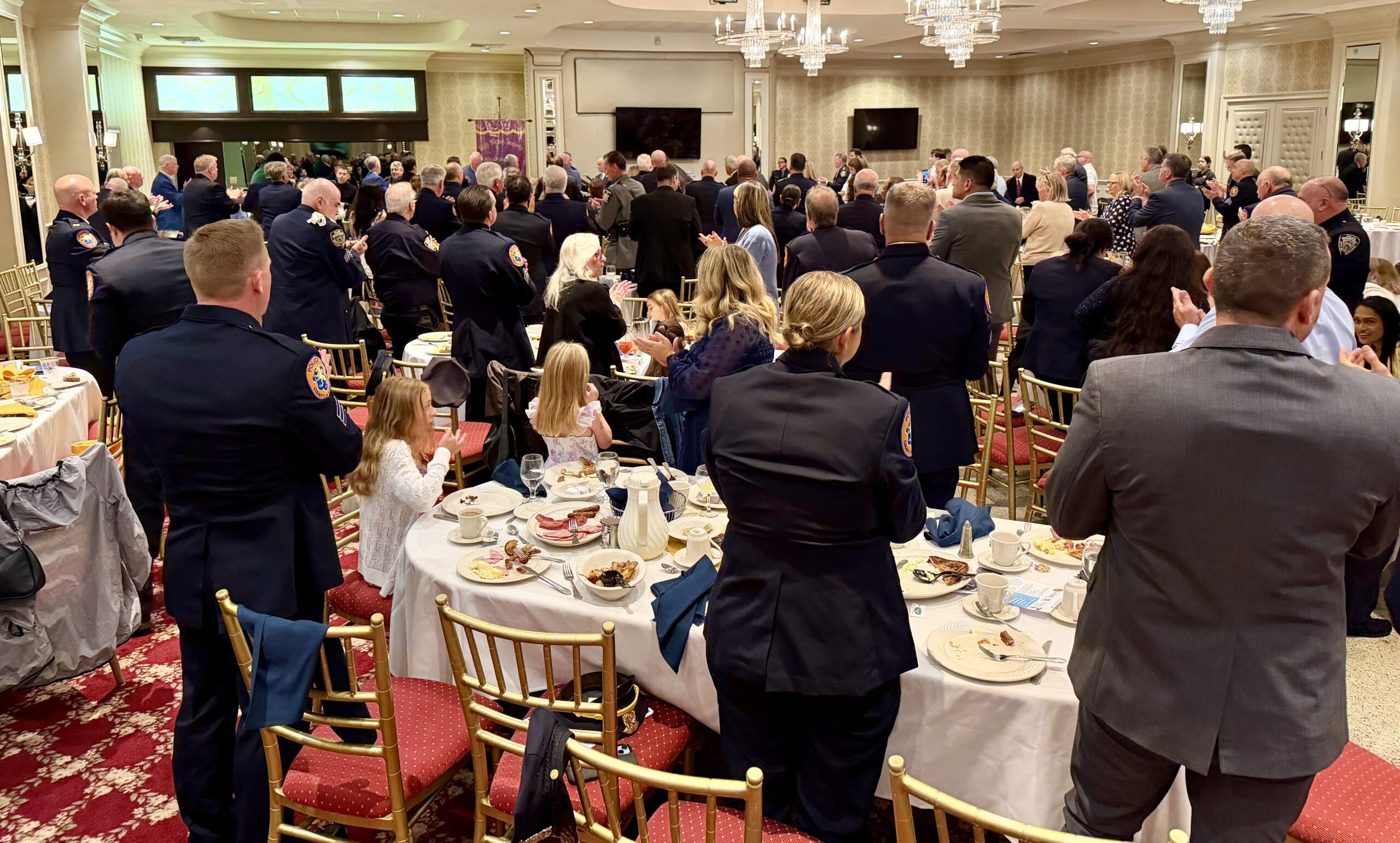
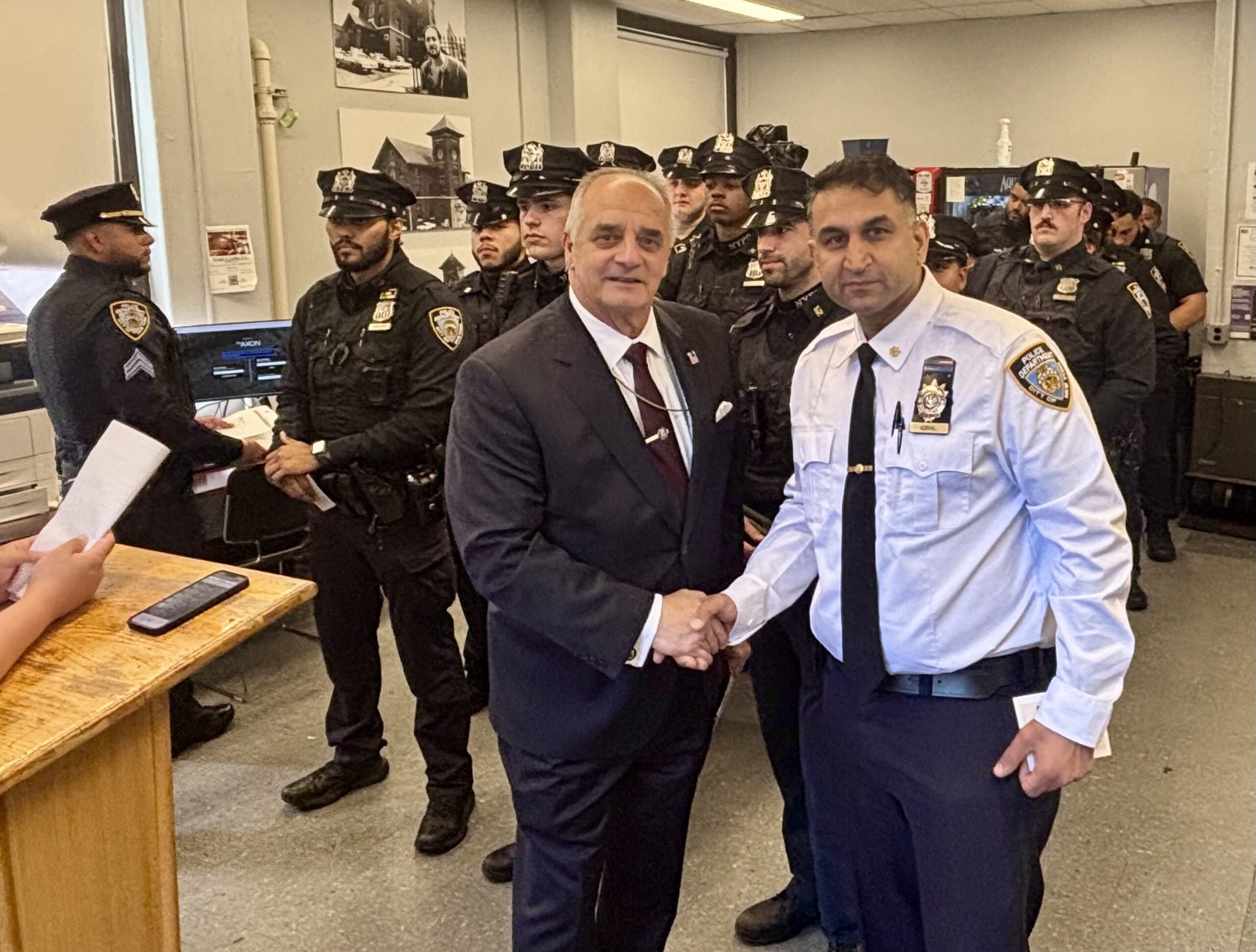
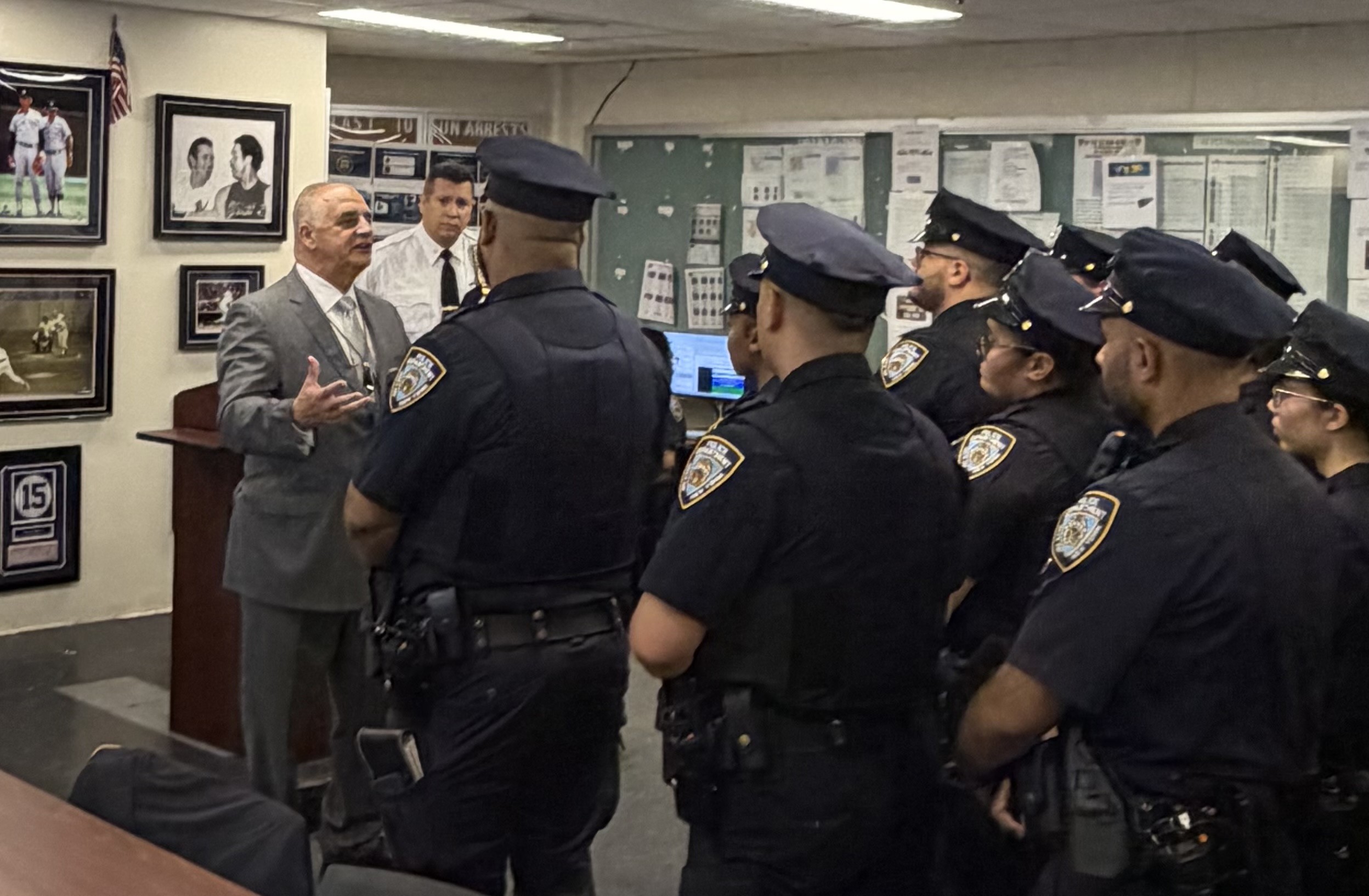
Standing before nearly seventy officers at the outset of the evening was both inspiring and deeply humbling. Looking across the room, I realized I was addressing the next generation of NYPD leadership alongside officers whose years of experience had already helped shape the command.
The second and third roll calls provided additional opportunities to encourage officers preparing to begin their tours. Although each group was different, the atmosphere remained remarkably consistent—professional, attentive, and fully engaged.
One characteristic distinguished every presentation.
The attentiveness was extraordinary.
That attentiveness would soon give way to something equally memorable. At the conclusion of the first presentation, the room erupted in enthusiastic applause and resounding cheers that seemed to energize not only those assembled, but the entire precinct. It was a spontaneous expression of appreciation that set a positive tone for the remainder of the evening and naturally opened the door to countless conversations that followed.
Officers maintained exceptional eye contact throughout each presentation. There were no side conversations, no unnecessary distractions, and no indication that anyone wished to be anywhere else. Despite the demanding operational tempo of the evening, every officer present demonstrated quiet professionalism and genuine respect. They listened with the discipline, maturity, and focus that have long distinguished the finest traditions of the New York City Police Department.
Looking across the room, I found myself studying the faces before me. Some officers were only beginning careers that would shape the rest of their lives, while others carried the quiet confidence that comes from years of experience and countless encounters with the unpredictable realities of police work. Although their individual journeys differed, they had all embraced the same calling—the solemn responsibility of protecting others, often under circumstances demanding physical courage, moral courage, sound judgment, and personal sacrifice.
As I reflected upon those assembled before me, I was reminded that while the badge symbolizes authority, it is character that gives authority its legitimacy. Public trust is not earned by rank, equipment, or title alone, but by the integrity with which authority is exercised each day. Character influences decisions when no one is watching, guides conduct during moments of extraordinary pressure, and enables officers to treat every person with dignity, fairness, and respect, even during the most difficult encounters.
Ethical leadership is rarely measured solely by the difficult decisions that occasionally make headlines. More often, it is revealed through the countless ordinary encounters that occur throughout every tour of duty—the respectful conversation with a concerned citizen, the measured response during a tense situation, the compassionate gesture toward someone in crisis, and the disciplined exercise of authority under demanding circumstances. Those seemingly routine moments ultimately shape public confidence in the profession and become the foundation upon which lasting trust is built.
For that reason, I reminded the officers of a principle that has become a cornerstone of my presentations throughout the New York City Police Department:
“Badges shine only when the character behind them shines first.”
Character is the quiet strength that gives enduring meaning to the badge. It is the unseen foundation upon which ethical leadership, professional excellence, and public trust are built. While the badge identifies an officer’s authority, character ultimately determines how that authority will be exercised. In the final analysis, the policing profession will always be judged not simply by the authority entrusted to it, but by the integrity, wisdom, compassion, and humanity with which that authority is exercised in service to others.
Protecting the Protector
One of the evening’s central themes was protecting the protector—a subject that has become increasingly important throughout my work with law enforcement agencies across the country.
While the public often witnesses the physical demands of policing, the emotional and spiritual burdens carried by officers remain largely unseen.
They witness violence, tragedy, grief, and human suffering with a frequency experienced by very few professions. While extensive training prepares officers to confront external threats, the cumulative emotional effects of repeated exposure to trauma often remain far less visible.
The concept of the Wounded Protector™, which I have addressed extensively in my presentations and memorialized in numerous Law Officer articles, reflects this reality. Those who dedicate their lives to protecting others are not immune from life’s hardships. They experience personal loss, disappointment, fatigue, family responsibilities, and the cumulative effects of serving in environments where uncertainty is a constant companion.
Recognizing this reality is not an acknowledgment of weakness. It is an acknowledgment of humanity.
A profession devoted to protecting communities must remain equally committed to protecting those who faithfully serve within it.
Throughout the presentations, I encouraged the officers to view emotional resilience, peer support, and the courage to seek assistance when needed not as signs of weakness, but as hallmarks of professional maturity. The strongest officers understand that preserving their own physical, emotional, and spiritual well-being ultimately strengthens their ability to protect others with wisdom, compassion, sound judgment, and unwavering professionalism.
Protecting the protector is not separate from the mission of policing; it is essential to its long-term success.
The Power of Affirmation
As the first presentation concluded before nearly seventy officers, something occurred that I will never forget.
The room erupted in resounding applause and enthusiastic cheers.
For several unforgettable moments, the precinct was filled with an unmistakable spirit of appreciation and encouragement. The response was both humbling and deeply moving. It was never my objective to receive applause. Rather, my hope had simply been that the officers would leave feeling affirmed, encouraged, and appreciated for the extraordinary responsibilities they willingly shoulder every day.
Their response reminded me of an enduring truth.
Even those who dedicate their lives to protecting others need to know that their own service is recognized, their sacrifices are appreciated, and their commitment matters. Authentic affirmation does not weaken a profession built upon discipline and accountability. On the contrary, it strengthens the profession by reminding dedicated men and women that their work possesses lasting dignity, profound purpose, and immeasurable value to the communities they serve.
Much of my understanding of authentic affirmation has been shaped by the pioneering work of Dr. Conrad Baars, whose writings profoundly influenced my philosophy of leadership. Dr. Baars recognized that every human person possesses a fundamental need to know that his or her life has meaning, dignity, and worth.
His insights remind us that authentic affirmation is not flattery or indiscriminate praise; rather, it is the truthful recognition of another person’s inherent dignity and intrinsic worth. That principle applies no less to policing.
Behind every badge stands a human being—someone who serves not only as a police officer, but also as a husband or wife, father or mother, son or daughter, friend, neighbor, and fellow citizen. Before they are officers, they are people. Their humanity should never be overshadowed by the uniform they wear or the extraordinary responsibilities they carry.
One Human Encounter at a Time
As officers departed for their patrol assignments, the evening continued in a different—but equally meaningful—way.
Some paused briefly before heading to their sector cars. Others stopped as they made their way through the precinct. What had begun as three formal roll-call presentations naturally evolved into dozens of individual conversations with officers preparing to serve the people of the Bronx during one of the command’s busiest evenings.
The formal presentations had concluded, but the evening’s most personal moments were just beginning.
Before many officers departed, I had the privilege of personally presenting each of them with one of my Liberation Cards.
Each card represented far more than a parting gesture. It symbolized an ongoing commitment to the men and women who serve behind the badge and a reminder that the evening’s message of encouragement would continue long after the final roll call had ended.
The Liberation Card is far more than a keepsake. It serves as an invitation to continue reflecting upon freedom, ethical leadership, resilience, and the enduring dignity of the policing profession. It also includes my personal contact information, reminding every officer that the conversation need not end when the presentation concludes. Should they ever need a word of encouragement, a listening ear, or simply someone who understands the unique burdens carried by those who have dedicated their lives to protecting others, they would know they have someone who genuinely cares about them—not only as police officers, but as human beings.
To me, that continuing availability is every bit as important as the presentation itself. Encouragement should never be confined to a single evening. The challenges of policing do not end when a roll call concludes, and neither should our commitment to those who faithfully serve.
Those brief conversations, many lasting no more than a minute or two, reminded me once again that some of the most meaningful opportunities for leadership occur not from behind a podium, but through quiet conversations between one human being and another. A sincere handshake, a word of encouragement offered before an officer begins a tour of duty, or a few moments spent simply listening often leave a deeper impression than even the most carefully prepared presentation.
Throughout my visits to police commands across America, I have become increasingly convinced that genuine leadership is measured not merely by the number of people we address, but by the quality of the relationships we build. Encouragement offered sincerely, respect shown consistently, and authentic human connection strengthen organizations in ways that cannot always be measured, yet are never forgotten.
Leadership, at its finest, is expressed one human encounter at a time.
Many Backgrounds…One Shield
As I looked across the room during each of the three roll calls, I found myself reading the officers’ nameplates and, whenever possible, addressing them by name. It was a simple gesture, yet one that reflected something I have long believed about leadership. Every officer deserves to be recognized not simply as another uniform in the room, but as an individual whose life, experiences, and service matter.
As I continued speaking, I became increasingly aware that I was standing before a magnificent mosaic of humanity. The officers assembled before me represented families whose journeys had begun throughout the United States and in nations around the world. Together, they reflected the extraordinary diversity that has long distinguished both New York City and the New York City Police Department.
They represented different cultures, different family histories, and different life experiences, yet every one of them had willingly taken the same oath, worn the same shield, and accepted the same solemn responsibility to protect the people of New York City.
The diversity before me was far more than a demographic reality; it was one of the Department’s greatest strengths. Different perspectives, experiences, and traditions converged into a single professional identity grounded in service, integrity, courage, and respect for human dignity.
Looking across that room, I was reminded that the strength of the New York City Police Department has never depended upon uniformity. It has always depended upon unity of purpose. Officers from every imaginable background stood shoulder to shoulder, united by a common mission far greater than themselves.
For a few moments, the room became a living portrait of New York itself—a city where people from every corner of the world come together not only to build lives, but to serve one another.
The Lions and Lionesses of the Bronx
As I continued looking across the room, another thought quietly emerged.
I was not simply looking at police officers.
I was looking at the lions and lionesses of the Bronx.
Some had only recently graduated from the Police Academy. Others possessed years of experience earned through countless calls for service, critical incidents, and difficult decisions made under extraordinary pressure. Within minutes, each would leave the relative security of the precinct and step into one of America’s most demanding policing environments, prepared to confront whatever challenges the evening might bring.
Yet the strength required of these officers extends far beyond physical and moral courage alone.
Modern policing demands men and women who possess the courage of lions when innocent lives are threatened, while demonstrating the wisdom, patience, restraint, emotional intelligence, and disciplined judgment to calm conflict before force ever becomes necessary. The finest officers understand that true strength is measured not only by the ability to prevail in confrontation, but also by the ability to prevent unnecessary confrontation whenever possible. That combination of courage and restraint represents one of the highest forms of professional strength.
The profession calls for protectors who can move seamlessly from commanding authority to compassionate conversation, from tactical readiness to thoughtful de-escalation, often within moments of one another. Such transitions require not only extensive training, but also exceptional character, emotional maturity, sound judgment, and genuine respect for the dignity of every human person.
Watching these officers prepare for duty reminded me that the public often sees policing through the lens of its most dangerous moments. Yet much of an officer’s work consists of preventing violence rather than responding to it, restoring calm rather than creating fear, and resolving conflict before it escalates into tragedy.
This is the paradox of modern policing. The very men and women who possess the courage to confront extraordinary danger must also possess the wisdom to prevent unnecessary force through patience, communication, restraint, and genuine human understanding. They are called to be guardians who know when to stand firm and when to calm fear, when to act decisively and when to de-escalate with empathy and professionalism. That extraordinary balance is what distinguishes the finest traditions of the policing profession.
The Human Encounter
Throughout my career in law enforcement leadership, I have become increasingly convinced that the future of policing will depend upon far more than advances in technology, improved training, or evolving operational strategies. While each of these remains indispensable to modern policing, none can replace the enduring power of one human encounter.
Every interaction between an officer and a citizen presents an opportunity to shape public trust. Whether responding to a routine call for service, assisting a victim of crime, calming an emotionally charged situation, or simply speaking with a concerned resident, officers communicate far more than information. Through their words, demeanor, and conduct, they communicate respect, fairness, compassion, and the legitimacy of the authority they represent.
Some of those encounters last only a few moments and are quickly forgotten. Others become defining memories that remain with individuals and families for years, sometimes for an entire lifetime. In those moments, officers are not simply enforcing the law; they are representing the character and values of the community they have sworn to protect.
As I watched the officers of the 44th Precinct leave the command that evening, I found myself reflecting upon the hundreds of encounters that awaited them before their tours had ended. Some would be routine; others would demand exceptional judgment, extraordinary patience, immediate courage, or profound compassion. Each encounter would present a new opportunity to exercise not only professional competence, but also wisdom, restraint, empathy, and integrity.
For that reason, ethical policing begins long before an officer is confronted with a difficult decision on the street. It begins with the daily formation of character—the quiet and often unseen process of developing habits of integrity, humility, compassion, self-discipline, and respect for the inherent dignity of every human person. Those virtues are cultivated over time, becoming part of an officer’s character long before they are tested in moments of crisis.
Ultimately, the future of policing will be determined not only by the effectiveness of its equipment or the sophistication of its technology, but by the quality of the human encounters that occur every day between officers and the communities they faithfully serve.
The Quiet Nobility of Service
As the evening drew to a close, the pace within the 44th Precinct never diminished. Officers continued preparing for patrol, supervisors coordinated assignments, radios remained active, and the constant rhythm of one of America’s busiest police commands continued uninterrupted. There would be no pause simply because the presentations had concluded. The mission of protecting the Bronx continued exactly as it had before I arrived and would continue long after I departed.
Watching the officers leave for their assignments, I found myself reflecting upon the quiet nobility of their profession. Much of police work is performed far from public recognition and rarely receives headlines or applause. The overwhelming majority of an officer’s career consists of ordinary moments carried out with extraordinary faithfulness—answering calls for service, comforting victims, resolving disputes, assisting those in crisis, protecting children, safeguarding neighborhoods, and making countless decisions requiring sound judgment, compassion, integrity, and unwavering professionalism.
Extraordinary professions are ultimately defined by extraordinary faithfulness in ordinary moments.
It is within those seemingly ordinary encounters that the true character of policing is revealed. Public confidence is seldom built through dramatic events alone. More often, it is earned gradually—one respectful conversation, one thoughtful decision, and one compassionate act at a time.
Trust is built through consistency. It grows as officers repeatedly demonstrate fairness, professionalism, restraint, and genuine concern for the people they serve. These daily encounters, though often unnoticed, become the foundation upon which lasting relationships between law enforcement and the community are built. It is through these quiet acts of faithful service that public trust is earned, strengthened, and sustained.
Coming Home
As I began the journey back to New Jersey that evening, my thoughts lingered in the Bronx.
I found myself reflecting upon the remarkable ways in which life sometimes comes full circle. As a young teenager, I had ridden my bicycle beneath the elevated train on my way to Yankee Stadium, passing the 44th Precinct without the slightest notion that one day I would walk through its doors. Years later, I had the privilege of serving as a chaplain to players on two New York Yankees World Championship teams, forming friendships that continue to this day. During my visit to the precinct, photographs of many of those same Yankees legends adorned the walls of the roll-call room, quietly reminding me of another season of service in the very neighborhood where my own journey began.
Now, decades later, I had returned once again—not to Yankee Stadium, but to encourage the men and women who faithfully protect the streets that had shaped so much of my own life.
The mission never stopped. Even as the presentations concluded and our conversations came to an end, patrol cars continued rolling into the streets of the Bronx, radios maintained their steady cadence, and officers assigned to Yankee Stadium remained vigilant while others answered calls for service throughout the command. The work of the 44th Precinct continued exactly as it had before I arrived.
It always does.
Perhaps that is what impressed me most about the 44th Precinct. Certainly, its rich history, its location beside one of America’s most iconic sports and entertainment venues, and the extraordinary pace of its daily operations make it one of the New York City Police Department’s most recognizable commands. Yet those characteristics alone do not define its greatness.
Its greatest strength has always been the men and women who walk through its doors every day.
Throughout the evening, I witnessed professionalism tempered by humility, confidence balanced by compassion, seasoned officers mentoring those just beginning their careers, and a shared commitment to ethical leadership that transcended rank, assignment, and years of service. I saw officers eager to learn, attentive to one another’s needs, respectful in their interactions, and united by an unwavering commitment to protect complete strangers whom they may never meet again.
Those are the qualities that strengthen communities, inspire public trust, and elevate policing to its highest calling.
As I departed the Bronx that evening and began my journey home to New Jersey, I carried with me not only a renewed appreciation for one of America’s most demanding police commands, but also a profound gratitude for the remarkable men and women entrusted with serving there.
My thoughts returned once more to that fourteen-year-old boy riding his bicycle beneath the elevated train on his way to Yankee Stadium. He could never have imagined that decades later he would return—not to watch a baseball game—but to encourage the officers protecting those same streets.
Life has a remarkable way of bringing us home.
And on this unforgettable evening, home reminded me that the true measure of the 44th Precinct is found not in its history or reputation, but in the character, courage, and quiet faithfulness of the men and women who answer the call to serve each day.
The Bronx is well served by its vigilant protectors.
Selected Law Officer Articles by Vincent J. Bove
Respect Is the Badge: The Heart of the 21st-Century Ethical Officer
Respect remains the defining standard of ethical policing and the enduring foundation of public trust.
https://www.lawofficer.com/respect-is-the-badge/
The Ethical Compass for 21st-Century Policing
An examination of the enduring principles of ethical leadership, officer resilience, and public trust that guide modern American policing.
The Vigilant Protector™: Ethical Leadership for 21st Century Policing
Exploring vigilance, moral courage, ethical leadership, and the enduring responsibility to protect constitutional freedoms in the 21st century.
The Vigilant Protector™: Ethical Leadership for 21st Century Policing
Vincent J. Bove Chronology – Law Officer
A comprehensive collection of Vincent J. Bove’s published articles examining ethical leadership, officer wellness, resilience, violence prevention, public trust, constitutional policing, and leadership in 21st-century law enforcement.
https://www.lawofficer.com/author/vbove/