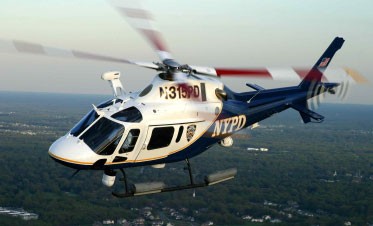
Over the last ten years, the advancement in airborne law enforcement aircraft has been remarkable. Only a few years ago aircrews navigated to an emergency scene using paper maps and their knowledge of the response area. Today, with the help of GPS and moving maps, an aircrew can enter an address three jurisdictions away and immediately given a heading to fly and how long, down to the second, it will take to get there!
The modern law enforcement aircraft
Today, it is almost standard to have an aircraft equipped with a searchlight, forward looking infra-red (FLIR), GPS, moving maps and in many cases a camera downlink system. In addition, night vision goggles, license plate recognition and computer aided dispatch may be part of the aircraft's onboard gear.
These tools, in the hands of a skilled police aviator, can dramatically improve their efficiency. For example, using a moving street map, the aircrew can instantly transmit the exact street location of an observed incident. This is particularly important in vehicle pursuits, especially when it moves into an unfamiliar jurisdiction. Safety is greatly enhanced for all parties involved and even if the suspects bail out and begin a foot pursuit, the aircrew knows exactly where they are and can transmit this information to the ground units.
Camera downlink systems
Many aircraft are now capable of transmitting real-time images to command centers and ground receivers. This capability is valuable to ground commanders in deploying personnel. During the Republican National Convention in 2004, the NYPD Aviation Unit was specifically tasked with monitoring splinter groups that broke off from the main demonstration. In years past, ground commanders, unsure of the group's intentions, would have to commit significant ground units to cover these splinter groups. What appeared to happen at the RNC in 2004 was that the so-called splinter groups were merely people that were no longer interested in protesting and were headed to the subway or train station to depart the area. Since the ground commander could watch the group via a transmitted image, they did not have to commit the resources away form where they really were needed. Down-links today produce amazing quality images and many skilled operators know exactly how to maneuver the aircraft and cameras to get exactly the image that is needed. Hollywood beware! Many aviation units are filming incredible stuff!
Computer-aided dispatch
Just like their counterparts on the ground, the CAD system has worked its way into the law enforcement aircraft. Aircrews are now afforded the additional notes, comments and information that are not always transmitted over the radio. This allows them to have the same advantage as a ground unit without unnecessarily taking up valuable air time asking for a repeat of a call location or a description of a subject. In one eastern city, they are exploring uplinking the gunshot software that pinpoints the location where shots have been fired. The hope is that the aviation unit can instantaneously respond to the location. At least the bad guys would know that if they fire a round, a police aviation unit might be there in seconds!
Night-vision goggles
Long a tool of the military aviator, night vision goggles or NVGs are exploding on the airborne law enforcement and the helicopter emergency medical services scene. Many police aviators now consider NVGs as an absolute necessity and will not fly at night without them. It not only gives the aircrew an advantage in police missions, it gives them a tremendous advantage in safety and the flying mission.
Too much information?
Naturally, all this technology comes at a price, both literally and figuratively. Some critics argue that the police aviator is absolutely overwhelmed with information and flight safety suffers. Admittedly, today's flight crews do have systems that are flashing audio warnings, visual warnings and flashing lights and ringing whistles. It does require significant cockpit discipline to safely and effectively manage all the information.
The future?
Most of the technology over the last ten years has greatly increased the airborne law enforcement unit's effectiveness. What can we expect to see in the future? Naturally, we can expect refinements to the existing technology and advanced models that will address any shortcomings. Already, head-up displays or HUDs are being used. These systems display vital flight information onto the windshield of the aircraft, allowing the pilot to monitor this information without having to look down to the control panel. Flight safety is greatly enhanced. Virtual reality systems are currently under development in which pilots fly an approach to an airport while watching their computer screen and having terrain, obstacles and the airport environment all displayed on the screen. It is the ultimate video game, albeit with much higher stakes.
Perhaps the "whisper mode" of a helicopter made famous in the movie Blue Thunder isn't that far fetched after all!