Having studied traditional martial arts for nearly a quarter century, I've been exposed to more ways to block a punch than I could possibly remember. Of the dozens of blocks I practiced so diligently over the years, there aren't many I'd bet on when the fists start flying for real. While no one has ever won a fight or taken a suspect into custody with a purely defensive response, it would be foolish to assume there isn't a need for defensive tactics. Clearly, being able to block or parry an incoming strike is a vital skill for any police officer to possess. In our quest to determine the best way to avoid getting hit, we'll consider Bruce Lee's thoughts on the subject as presented in his book, Tao of Jeet Kune Do.
Martial arts blocking techniques
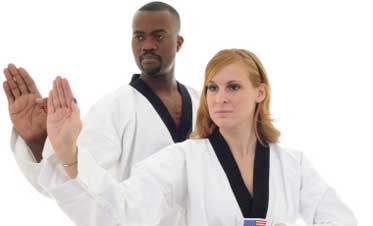
In Karate, the first techniques I learned were the "four basic blocks," which is consistent with the premise that Karate is to be used for defense only. During the first couple of classes, I learned to perform an inside block, in which the bent arm is swung inward to intercept a punch, and an outside block, which relies on the bent arm moving outward in a circular motion to intercept a punch. These blocks were designed to negate a mid-level punch. Against a punch directed to the face, I was taught an upward block, which requires the defender to raise his bent arm upward, above his head to intercept the attacker's arm with the exterior of the forearm. Against a low punch or kick, I was taught a downward block, which is similar in execution to the inside block except that blocking arm is then swung downward in an outward circular motion.
While the four basic blocks provide a foundation for the principles of blocking, they are ill-suited for actual combat. Although these blocks are found in many traditional Kata, or forms, they are rarely seen even during sparring, which is nowhere near as chaotic as an actual fight. Why? Because for most people, they simply don't work! Since these blocks cover such a wide range of motion, they are strong enough to stop even the most powerful blow. However, the large movement makes them too slow to employ against a realistic attack.
Police blocking techniques
I only learned two blocks in the police academy. One was to get to the outside of a right handed punch, while the other was designed to get outside of a left handed punch. Each involved stepping to the outside of the punch and swinging both arms in a circular motion to re-direct the punching arm inward. While this is an excellent strategy, since being on the outside of an attacker's body places the defender in a relatively safe position, getting outside of a punch is easier said than done. This can be attributed to the fact that a typical punch is not linear, like the precise jab of a boxer but rather, arching to some degree.
Visualize an arching right handed punch on a collision course with your melon. Imagine stepping outside of the attacker's arm and redirecting the punch inward. Now find some protective headgear and a training partner wearing padded gloves. Have him try to hit you with an arching right punch while you try to get outside of the punch and redirect the punching arm. Unless you have Ninja-like reflexes or a partner who is taking it easy, you probably got your bell rung more often than not.
Parrying
"Parrying is a sudden movement of the hand from inside or outside onto an oncoming blow, to deflect the blow from its original path. It is a light, easy movement depending on timing rather than force. A blow is never parried until the last moment and always when close to the body."
Bruce Lee (Tao of Jeet Kune Do).
The parry exemplifies Bruce Lee's emphasis on economy of motion. It's much faster than a traditional martial arts block because it is direct, with no wasted motion. While a parry is not as strong as a typical block, it doesn't need to be. All a parry is designed to accomplish is to re-direct the incoming strike enough to miss its intended target. In fact, if you were to redirect the attack to far from your body, you will be vulnerable to follow up strikes.
Footwork
"Mobility is vitally important in defense as well, for a moving target is definitely harder to hit and kick. Footwork can and will beat any kick or punch. The more adept a fighter is at footwork, the less does he make use of his arms in avoiding kicks and blows. By means of skillful and timely sidestepping and slipping, he can get clear of almost any kick and punch, thus preserving both of his guns, as well as his balance and energy for counter."
Bruce Lee (Tao of Jeet Kune Do)
Footwork begins with a stance that provides mobility and stability. For simplicity, consider the position of interview. From a "bladed" position, with your chin tucked and shoulder shrugged to protect your head, hold your hands out in front of you, palms facing the threat. Bend slightly at the knees and stay balanced on the balls of your feet, with your feet approximately shoulder width apart. Whichever direction you, move step with the corresponding foot first. For example, when advancing, your front leg leads and your rear leg trails. This helps prevent your feet from coming too close together, thus compromising your balance. In addition, this prevents you from crossing one leg in front of or behind the other, which leaves you vulnerable to falling or being knocked down.
Conclusion
It's time to put your headgear back on and have your partner try to hit you with that arching right hand, as before. This time, rather than trying to get to the outside of the punch, sidestep to your right and use an outward parry to prevent the punch from hitting its mark. Now, you're in bargain position to deliver a palm strike to the suspect's face with your right hand. From there you can close distance to apprehend the suspect or create distance and draw an appropriate weapon from your duty belt.