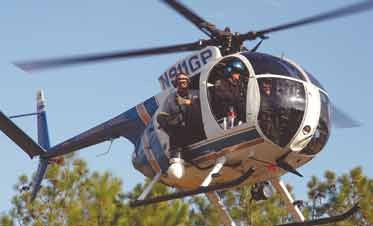
As most police officers' careers progress, they naturally look towards promotion and/or assignment to specialized units. In many of the major departments, the wide range of possibilities are amazing. In the New York City Police Department, which has around 36,000 uniformed members of the service, only around 15,000 are assigned to patrol. The rest are assigned to the many specialized and support units. Some police officers, having worked with the airborne component of their department, often wonder: What does it take to become a police aviator?
The Police Pilot
Thanks to Hollywood, police pilots are often shown as heroic, courageous, crazy and wild. Perhaps police pilots are a little of each, but the reality is that they are remarkably like their ground counterparts. They both share a love of police work and enjoy the challenges. Most police pilots also enjoy a passion for flying, and the combination of the two is a dream come true. In order to become licensed in the United States as a pilot, an aviator must take both a written and practical (flying) test. The first license, known as a "Private Pilot," allows a person to fly, without any compensation, for fun and pleasure. The average flying time to earn a private pilot's license is 60 flying hours. The next step is a "Commercial Pilot." This license now allows an aviator to receive compensation for their flying. The earning of a commercial pilot's license requires 250 flight hours and another written and practical (flying) test. This is commonly the standard required of most police aviation units around the country. Given the high cost of training a police pilot, in some cases a department could spend up to $100,000 to train a police aviator. The candidate that comes with a commercial pilot's license shows the managers of the police aviation unit that they have the passion, skill and dedication to succeed in the department's training.
The Skills to Succeed
Since most applicants come to the table already licensed as a commercial pilot, what are the factors that help a police officer get the coveted police flying assignment? Just as with any assignment, the applicant's reputation precedes them. Is the officer known as hard working, mature, of sound judgment and responsibility? What is the applicant's sick and disciplinary record? What is the officer's police activity like? Does the officer stand out, or are they simply passing the tour and looking to another assignment in which they can skate? The reality is that an officer's "interview" begins on the date they are hired. Undoubtedly, many of the decision makers in an aviation unit have friends and associates throughout the department and all it takes is a simple phone call to find out the "real deal" about an applicant. The applicant's pilot license is often the ticket to the interview, but sometimes the skills that land the job have nothing to do with flying. Most police aviation units are very small and all personnel are required to take on secondary assignments. Having skills in such fields as computers, light building maintenance and budgeting are just a few examples that could help set the applicant apart and get them the assignment!
Police Pilot Training
Police aviation units are all set up differently in regards to the training of pilot personnel. Some agencies will accept an applicant first as a non-pilot, working in the aircraft as a "tactical flight officer." The tactical flight officer works the "police" side of the aircraft and is responsible for the specialized equipment such as the spotlight, forward looking infra-red (thermal imager) and the police radios. Other agencies begin flight training right away, with the goal of making the officer a pilot-in-command.
The Police Pilot-in-Command
In most agencies, the path to becoming a pilot-in-command is a long one, with a lot of training, testing and flight checks. The time to become designated as pilot-in-command ranges from six months to several years. During this period, the pilot will be tested not only on FAA and flying subjects; they will also have to prove their skills in "police flying" to include patrol operations, searches, medevac operations, pursuits and rescue operations. Many of these missions are high-speed and high-stress, so the standards need to be high. The pilot will have to demonstrate they have the skills needed to perform all these missions safely and successfully. As a famous flying saying goes, "Flying is like sailing on the ocean; neither is inherently dangerous, but both are terribly unforgiving of mistakes." In those agencies that fly with only one pilot the responsibility is even greater. The single pilot does not have the luxury of a second pilot to act as a second set of eyes, and does not have a second pilot to help in making flying decisions.
The Reward
Police flying can be the most rewarding assignment for the police officer. Combining both a love of police work and a love of flying is simply a dream come true. Much like any police assignment, the work is both different and challenging. Derek Jeter, the shortstop for the New York Yankees was once introduced to a pilot from the NYPD Aviation Unit. Upon hearing about his line of work, Mr. Jeter stated, "you have a cool job." If the shortstop from the NY Yankees thinks your job is "cool", you would be hard pressed to find a better one!