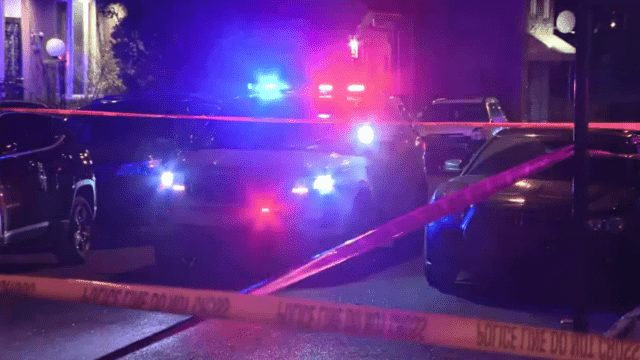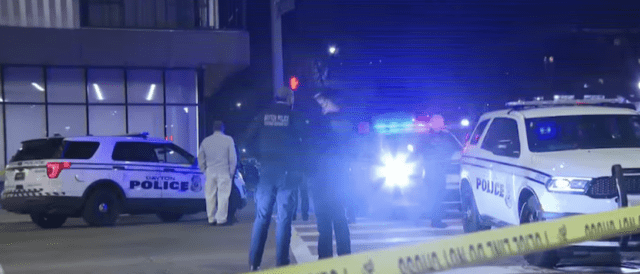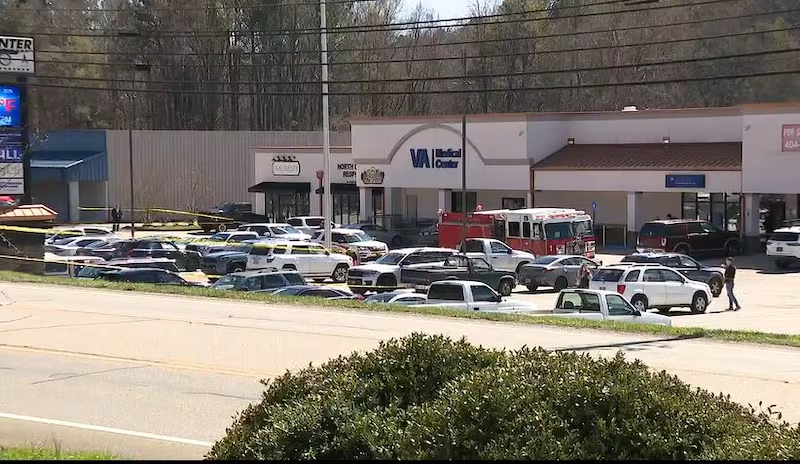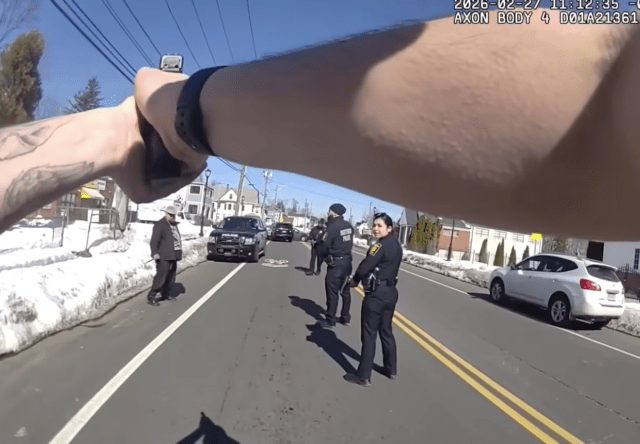
Three Philadelphia police officers were wounded Saturday night in a confrontation that ended with a retired city firefighter dead and renewed questions about how quickly routine crime scenes can turn deadly. The Philadelphia officers’ shooting incident unfolded around 10:30 p.m. near 54th and Arlington Streets in the Wynnefield section of West Philadelphia, according to Police Commissioner Kevin Bethel and multiple law enforcement sources.
Officers were called to the scene after reports that a vehicle had been struck by gunfire. While working to establish a crime scene perimeter, they encountered Eric Franks, 57, who approached and became increasingly agitated, according to a Philadelphia Police Department statement. Police say Franks shoved a sergeant with both hands. As officers moved to detain him, the situation escalated rapidly. Franks drew a firearm and opened fire on the officers, police said.
One officer was struck in the face. Another was shot in the hip. A third took a round to the leg, according to Mayor Cherelle L. Parker, who addressed reporters outside Penn Presbyterian Medical Center in the early morning hours following the shooting. All three were transported to Penn Presbyterian. One officer was released Monday. The others remained hospitalized but were reported in stable condition.
Four officers returned fire. Franks was struck in the chest and leg and collapsed on the sidewalk. He was transported to Thomas Jefferson University Hospital, where he was pronounced dead at 11 p.m., Bethel said.
Franks, identified by family and law enforcement sources, had retired from the Philadelphia Fire Department in September 2025 after nearly two decades of service, according to city payroll records reviewed by the Philadelphia Inquirer. He was also a former United States Marine and, according to his family’s attorney, a licensed firearms instructor.
His family’s attorney, James Funt, told reporters that Franks had been managing a birthday party for a 16-year-old at his nearby event space business when his son called to report the shooting outside. Funt said Franks went to check on the situation and help if he could.
Franks was also identified by community members as a local activist who had recently met with City Councilmember Curtis Jones Jr. to discuss rising drug-related crime in Wynnefield. In a social media statement Sunday, Jones said he was deeply saddened by the shooting without referencing Franks by name.
Bethel said Franks had no connection to the original vehicle shooting that drew police to the block. “Why he elected to come into that scene and engage the officers, whether this was premeditated, we will walk through that process to see,” Bethel said, according to the Philadelphia Inquirer. “But you don’t come to a situation like that to engage the officer.”
The investigation is being conducted by PPD’s officer-involved shooting investigation unit, the department’s internal affairs bureau, and the Philadelphia District Attorney’s Office. Video of the encounter, obtained by the Philadelphia Inquirer, shows Franks in an animated confrontation with officers before the shooting. Additional surveillance and body camera footage are under review, police said. The officers’ names have not been publicly released.

Field Lessons are offered strictly as general, industry-standard reminders drawn from common safety practices and typical policy considerations. They are not based on any inside knowledge of this specific incident, do not presume what actions were taken, and should not be interpreted as commentary on the decisions made at the scene.
- A third-party approach in active scenes carries significant and often unpredictable risk. Individuals who arrive after the fact, even with no stated hostile intent, may be armed, agitated, emotionally escalated, or operating on incomplete information. Officers should maintain positional awareness and control of the perimeter at all times, treating any approach as a potential threat until cleared.
- Crowd and bystander management is a tactical function, not a courtesy function. Establishing clear boundaries, designating a contact officer for incoming civilians, and keeping uninvolved parties behind the perimeter reduce the risk of a secondary confrontation arising from an already volatile scene.
- Escalation cues should be acted on early rather than managed through continued verbal engagement. Physical aggression, such as pushing or shoving, constitutes an assault and is a recognized pre-attack indicator. Officers should treat initial physical contact as a signal to immediately adjust their tactical posture rather than attempt further conversation.
- Concealed carry status of bystanders is a factor that must be considered in every public interaction. Officers cannot assume that individuals approaching a crime scene are unarmed. Hands, waistline, and body language must be continuously observed during any contact with unknown persons at an active scene.
- Dr. Yates’ research identified anger and hostility as sentinel cues in officer attacks. Within context, this must be taken seriously by on-scene officers.
Dr. Travis Yates has pioneered a behavioral risk framework to help officers and leaders identify, assess, and articulate risk in rapidly evolving, uncertain situations. Find out more about the FOCUS Behavioral Risk Framework.