This column was prompted by a recent lawsuit in which inadequate firearms/force training was alleged. Although much of the information discussed in this column may seem old hat, it remains relevant and worthy of revisiting. I’ve combined a lot of information on what a comprehensive firearms training program should encompass.
I’m going to limit this to in-service firearms training for two reasons, the lesser of which is that time and space just don’t allow a thorough discussion of a typical, 80-hour, hands-on, basic academy firearms training program. More importantly, most state POST boards have set their own standards for exactly what must be taught during the basic recruit academy curriculum, and I don’t want to inadvertently add to or delete from those curricula.
The 12 Keys
No. 1: Credentialed trainers
The credentialing of in-service firearms staff is of utmost importance. But too often, in-service instructors don’t have the requisite training credentials to instruct veteran officers in the assortment of firearms officers might have to use in their jobs. Agencies must ensure department instructors keep their state-issued certification current in pistol, shotgun and/or patrol rifle, if officers are issued these. If officers are issued shotguns and/or patrol rifles, those weapons need to be included during the quarterly in-service training. When I was the range master for my agency in upstate New York, all of our firearms instructors were NRA- and New York state-certified, as well as International Association of Law Enforcement Firearms Instructors (IALEFI) members.
No. 2: Safe handling
A comprehensive in-service firearms program must include a classroom presentation of safe firearms handling, including range safety and safety in loading, unloading and cleaning of firearms. We always ran a “hot” range at my department. Although “cold” ranges might be preferable during basic recruit training, in my opinion, hot ranges are safer for in-service officers because all officers know their guns are always loaded. Holstered guns are “topped off” by removing the partially loaded magazine and replacing it with a full mag, without the gun being drawn, holster design permitting.
No. 3: Deadly force policy
Before any live-fire exercises take place, the current policy must be distributed and any changes in the policy thoroughly discussed. It isn’t a bad idea to include copies of both landmark U.S. Supreme Court cases that deal with deadly force( Graham v. Connor and Tennessee v. Garner ) so your officers have some idea of what the courts have to say about force-related matters.
No. 4: Quarterly training
In my opinion, firearms training must be conducted at least quarterly. I know of no court case that mandates that frequency, but the proliferation of semi-automatic pistols means semi-annual range training is no longer adequate. The psychomotor skills needed to operate a semi-auto under stress can’t be taught or reinforced with less than quarterly training, more frequent training if your agency has a tactical team or a SWAT unit or issues select-fire weapons to its officers.
No. 5: Off-duty and back-up weapons
These must be included in quarterly training. If your agency permits back-up (or second) guns, ensure that portion of the policy is distributed during the morning classroom session. For your undercover cops, the live-fire exercise should include the gun of the day. If your deep-cover cops use small, concealable mini-guns in behind-the-back or ankle holsters, that’s where their course starts. Same goes for B-U-G (vest) pockets.
No. 6: Plainclothes training
I used to have what I called my “notorious nine.” These were the dicks that had just gotten through posing for the cover of GQ magazine, and, as a former dick, I say that with true love and affection. They’d show up at the range in their Nino Cerutti suits and Gucci shoes carrying their gym bags, from which they’d remove their sweatshirts or pants, sneakers and Sam Browne. Sorry, Inspector Callahan, your course of fire begins with drawing your weapon from your upside-down shoulder holster and addressing this call for service. As an added bonus, the female dicks quickly transitioned from their purse holsters to inside-the-belt waist jobs after a few in-service sessions.
No. 7: Retention/disarm vs. defense training
I must admit, due primarily to time constraints, I’ve put off weapon retention/disarming training for a few months to perform the defense training refresher. But it was never neglected—in my opinion, it’s six of one, half-dozen of another. Ideally, retention/disarm training should be conducted during firearms in-service training, but if you’re operating in an outdoor setting, you might want to wait until the gym where your defense refresher training will probably be taking place. My gym was the indoor range. It was simpler to move the mats into the range to conduct the weapon retention training. Be that as it may, the training should encompass both holstered and drawn-gun scenarios, as well as tactics on how to get your gun back, should it be taken away by an assailant.
No. 8: Moving/multiple targets
Statistics show that 40% of all police shootings involve multiple suspects—training must reflect that reality. Whether you use “good guy/bad guy” targets or targets on a moving track, ensure range training necessitates the need for saccadic eye movement, which is required in shooting at moving targets. The outdoor range we used during the two or three days of summer weather we experienced in upstate New York had a tall, three-sided berm that permitted 90° shooting, left and right. Whatever design you envision, make multiple-target shooting a priority and, if possible, incorporate some moving target shooting, too. Likewise, address shooting while moving laterally to cover and tactical disengagement.
No. 9: Judgmental training
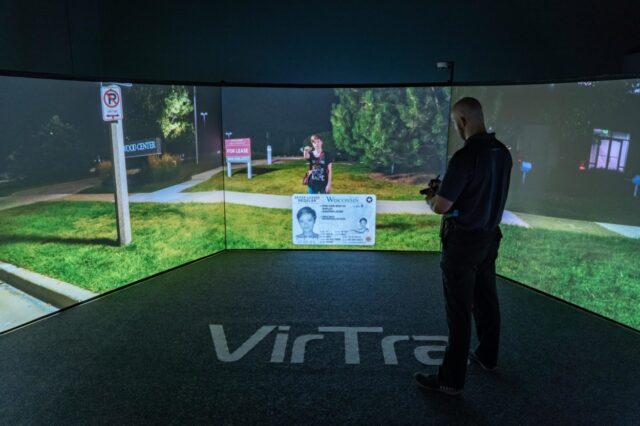
Whether via a menu-driven computerized system, such as IES, AIS PRISim or other FATS-type system, or a simple video-based system, a lack of judgmental shooting training will definitely come back to bite you. I can’t stress this enough—whether you use a live-fire program or laser-driven system, judgmental “shoot/don’t shoot” training develops and tests the officer’s ability to identify and determine threat levels, make proper force decisions under stress, verbalize and/or employ other less lethal force options, and, if deadly force is required, deliver it accurately and quickly. Folks, that’s the heart and soul of making righteous deadly force decisions.
No. 10: Role playing
Role-playing scenarios and simulation (or force-on-force) training round it all out. Any program that doesn’t include force-on-force firearms training is deficient, and I think most courts would agree. Whether its “red handle” gun exercises, airgun paintball, Simunition FX or other marking cartridges, or real high-tech setups like MILES-gear, reality-based simulation training is quickly becoming a mandate for any agency hoping to defend itself against a failure-to-train lawsuit. But more important, it is simply the most valuable firearms training your officers will ever receive. IALEFI has produced a manual titled, “IALEFI Guidelines for Simulation Training Safety.” This 42-page publication is loaded with information and resources for conducting force-on-force training for your officers (see sidebar for contact information). Meanwhile, check out RK Miller’s Train the Trainer column each month in Law Officer for timely training tips.
No: 11 Low/dim light
More than 60% of officer-involved shootings occur in low- or dim-light conditions. The indoor range gave us the ability to conduct night fire firearms training, but if all you have available is an outdoor range, you may be able to adjust your eight-hour training day to begin at 4 p.m. with your classroom, policy discussion and range safety briefings, then move outdoors to get some low-light training in. When I was conducting training for
LaserMax Corp. out in Golden, Colo., we used ambient light from the adjacent rifle range, along with some help from roof-mounted lights on the classroom building, to keep things realistic and safe. As Gunnery Sergeant Tom Highway (played by Clint Eastwood) in Heartbreak Ridge put it: “Improvise, adapt, and overcome.”
No. 12: Emergency action drills:
Comprehensive in-service firearms training must include emergency action drills, such as one-handed and off-handed firing, as well as reloading and malfunction (stoppage) drills. Virtually all IALEFI trainers/members know how to both reload and clear stoppages one-handed. It’s stressed during virtually all of its week-long Annual Training Conferences (ATCs) and many of its two- to three-day Regional Training Conferences (RTCs). Most are weapon specific.
Trying to clear a stoppage one-handed, like a failure to eject/feed, will jack up the heart rate. But the drill must be taught and reinforced in training under simulated stress conditions so it isn’t “panic time” when it happens on the street. That’s where ball-and-dummy drills come in handy. They’re an inexpensive way to simulate misfires or stoppages and can reinforce clearing procedures on the range during training.
International Association of Law Enforcement Firearms Instructors, Inc.
25 Country Club Road, Ste. 707
Gilford, N.H., 03249
603/524-8787
www.ialefi.com
Conclusion
In life there are no guarantees, but if you follow the advice provided above, work to implement as many of the 12 keys I’ve outlined as possible and maybe add in a few of your own, your troops stand a much better chance of winning and surviving—on the street and in the courtroom.
A final note : I wish to extend a heartfelt thank you to my fellow IALEFI members, and especially trainer Manny Kapelsohn, for input in the preparation of this article.