What is StreetCred Software and why did you create it?
David Henderson and I created StreetCred to help police officers manage their warrant and case backload. I had come from the intelligence and technology side and was looking for a way to bring together the data and information that local law enforcement had, but couldn't really use. Dave was working on a federal task force and was a local city marshal, and had a backlog of about 3,000 misdemeanor warrants. I saw all the money going to fusion centers and counter-terror, and nothing going to the actual job of law enforcement. Dave's belief was, "All this paper is stupid: If I could just put these on a map and have it in the car, I wouldn't be going cross-town only to come back to three doors down from where I started." Together we came up with the logic that thinks about the available data like a cop does, to make it easier to handle your cases.
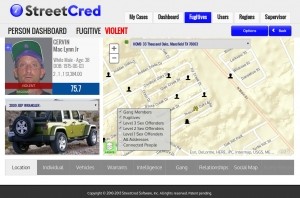
For example, the first question we ask is, 'Is the guy I'm looking for dead?' That's important, and hard to answer without automation. What does the guy look like–most cops actually don't get photos for misdemeanor fugitives, because the pain of downloading them is very high, so we grab pictures from DMV and booking automatically. Then our system asks lots of questions about the living fugitives: do they own the house at the address we have on file? What kind of car do they drive? Does the company they work for have health insurance for part timers, like Starbucks or FedEx? Or does their job require a security clearance, like for a military contractor? About 120 sets of these kinds of questions–we're not doing police work, we're doing the research part that anyone can do, so that the cops can do what only cops can do: contact and interaction.
We're looking to de-prioritize people who look like transients or people who have moved away or people who are likely to be difficult in compliance (like those who can't bond out, so they'll cost us lots of money and effort). That leaves us with people who will be easy to find and compliant.
In this big data? Intelligence-led policing? How do you characterize what you do?
Law enforcement doesn't really have much big data, but lots of data. We use big data techniques on the data we have. We bring together data from federal, state, county and local law enforcement and municipal sources, then mix it with public records and vehicle and DMV information and open sources and put it all together in one place, securely delivered to the MDT. The CJIS records are specially marked and secured internally, so we can present a non-CJIS version to city employees who are not officers. It's not available on the public Internet at all. We describe what we do as identifying and accessing data, then normalizing it, aggregating it, doing data mining and presenting it securely to officers. By the way, once we normalize it we make it available to the agency at no cost. Crime analysts love us.
The important other thing we do is GIS visualization–placing on the map not just fugitives, but also parolees, probationers, sex offenders, gang members and other people of interest, so officers have situational awareness. In Texas we're also layering in crime analysis objects, like serial burglaries, over the map so officers can see context. And we've got an agreement with ShotSpotter to send back information to officers when ShotSpotter detects a gunshot. That is hugely exciting to us, and we hope to test it soon.
What are some trends you see happening in policing? Where do you think we’ll be in 10 years? 40 years?
We're beginning to see law enforcement extending its tecnological vision out of the 1990s, and understanding that there's no task or case that does not involve technology. That's a huge mental hurdle, as this generation of administrators – the ones who say, "I didn't need that in the '70s, so you don't need it now" gets set to retire. This generation of cops lives with tech. There's no reason that the 1990's-era level of data synthesis like what we all use on Travelocity (where asking for a flight to Miami also gets us information about car rentals and hotels in Miami and Miami Beach) should be lacking in law enforcement. If I ask a question, I don't want just the answer, I want the context.
For example, look at public records: ask a question and the product just vomits back 12 pages of everything they've ever heard about the person, when most often what I really want is the most recent three addresses, some relative names and some phone numbers. The cops have to sort through it all, usually printing it all out and shoving it in a folder–too much data and not enough information. We need information, not just data, and information is data that has been curated and presented in the context of my work. Information becomes knowledge. Data gets put in a database. Context is everything: A homicide officer works differently from a warrant officer, who works differently from a motor jock, who works differently from a school resource officer. Most police technology doesn't recognize or cater to that yet, and it soon will.
For departments struggling with a data deluge, what general guidelines would you offer?
Stop looking for the needle in the haystack and start looking at data you do NOT need. The big problem we all have in agencies large and small is too much data, not too little. So you need to start asking questions like, "Of this pile of data here, what don't I need?"
For example, unless you're doing commercial traffic enforcement, when you run a license plate, I bet you don't need the gross vehicle weight; if you're running traffic on patrol you probably just want to know if the vehicle has a hit, and if not, if it's got a valid registration and confirmed insurance. Why, then, must I look through ten screens to get the three nuggets I need? We need to think of the data we present to officers as being related directly to their workflow and responsibilities, and then the data needs define themselves.
For more information on what Street Cred does, visit www.StreetCredSoftware.com