Applied dactylography for the non-technical responder
Not unexpectedly, the economy is down and property crimes are up. However, unlike other financial downturns, this one has nationally affected the police service. Budgets are cut, services restructured, and manpower either let lay fallow through attrition or outright cut. Many agencies have robbed Peter to pay Paul, cutting investigative and criminalistics positions to keep adequate patrol strength. Other agencies have established priorities for their crime scene investigative response, limiting it to major value property crimes, robberies, sex offenses and death investigations.
Meanwhile, patrol faces a rising rate of property offenses—burglaries, auto thefts, shoplifting, and associated thefts. With investigative resources often cut, and time constraints limiting patrol's ability to conduct follow-up, how can patrol make an impact on property crimes?
The answer is a back to basics look at criminalistics. Although procedures, time and budgets may limit some techniques (such as DNA), fingerprint identification is a relatively low overhead process.
Getting Started
First, a quick review of what fingerprints are.
On the soles of our feet and palms of our hands and fingers, humans have skin formed into friction ridges, to aid in walking and handling. These ridges are not smooth flowing, but rather form shapes, come to endings, and are considered to be unique, finger to finger and person to person. Further, from pre-partum development to postmortem decomposition they remain unchanged, unless subject to scarification. Finally, on their summits they bear pores, from which the body exudes perspiration and body waste, which may be left in the image of the ridges.
Fingerprints may be deposited in three manners. The finger may touch a sticky material, such as blood, motor oil or melted chocolate, and deposit an image of the print on a surface. It may touch a soft material, such as cheese, chocolate or putty, and impressions image. The first, called a patent image, and the second, a plastic print, are best documented by photography and careful collection of the item.
The third is the transfer of these exuded body fluids, in the form of the ridge detail, to another surface. This third type is generally an invisible image, called a latent print, which must be visualized to permit documentation and collection.
Photography First
If you have a camera, always photograph first. This provides you a record of what you saw, plus documents the scene for others. There are three basic shots you should take. Distant shots that show overall aspects, such as the house at 1234 Main St. Medium shots help establish items of evidence within an area (the living room, with missing TV, scattered DVDs, etc.). Finally, close-up shots document a specific item, such as the DVD that was obviously handled.
Powder Works
The crime scene investigator and laboratory latent print specialist have a wide array of tools to use. Documenting these can be time consumptive, expensive and bulky—probably not best for patrol to undertake. However, for more than 100 years, the majority of prints have been recovered by the simple method of powder processing.
There are two powder processing systems in use. The oldest consists of finely ground powder, applied to a target area by a brush. The earliest brushes were composed of feathers. Later, brushes made of long, soft animal hair came into use. Today, the most commonly used brushes have bristles of long, soft fiberglass fibers. All of these types are readily available and the ultimate choice is up to the individual.
Powders are very finely ground materials, generally carbon or talc based, which may be dyed to provide contrast or fluorescent properties. For simplicity, a basic black powder can provide all that is needed under normal conditions.
Since fiberglass brushes are most commonly used, this is the tool that will be discussed. Brushes should be kept in their protective plastic tubes when not in use. When you remove the brush, first slip the brush out and rapidly twirl the handle to loosen and fluff the bristles. Next, pour a small amount of powder on a piece of paper or lift card. Slowly and gently rotate the bristle tips in the powder. You want to pick up powder, not cake powder on the bristles.
Since latent prints are usually invisible, this is a search operation. Lightly brush the surface in a circular manner. When rigid details appear, switch from a circular pattern to sweeping with the flow of the ridges. Work a latent by lightly brushing to add powder until it no longer builds contrast.
On some surfaces, black doesn't immediately stand out, so many are tempted to use a colored powder. However, transport is easier, and logistics cheapened, by carrying one color, and black is much easier for a latent examiner to later work with. Instead, use your flashlight and apply sidelight from a 45-degree-or-lower angle—any detail will be easily seen.
The Magnetic Option
The second powder method is magnetic. Here, a finally ground iron material is used as powder.
The "brush" consists of an outer sheath of aluminum with a larger ring extending at a right angle, and inside a rod that controls a magnet inside a tube. To use, slide the rod all the way into the tube. Now dip the tip into the container of magnetic dust. A ball of powder will form around the tip, as if a brush. Search and visualize latents as with a conventional brush. When the ball of powder flattens, go back to the powder jar, pull the magnet up to release the powder, then re-dip to form a new ball.
Magnetic may seem to be limited to nonferrous materials. However, various steel and iron materials may vary in their magnetic properties. Before eliminating a surface, first find an area deemed not to be evidential. Place a test print, and process. If it sucks up powder and is completely covered, without detail, it is a poor surface. However, it is often possible to process a steel surface successfully with magnetic.
Each process has its benefits and drawbacks. Conventional powder works on a wide variety of nonporous surfaces and is not magnetically attracted. It is attracted to greasy materials that will smear the surface and require washing the brush with detergent and complete drying before further use. Magnetic has no bristles which may scratch or damage a latent, may be used on semi-porous surfaces such as slick magazine paper, and produces "cleaner" visualized latents. Note: It may obscure surfaces with magnetic properties, and supplies of magnetic powder may clump and form rusted rocks if not kept dry.
Documenting & Lifting the Print
Once latents are visualized, it's time to document, preserve and collect.
Note the location of each latent. If you have a camera, at least photograph to show the prints location. If your camera permits, place a scale next to the print, position yourself at right angles to it, fill the photo frame with the print and photograph it. You may need natural light, in camera flash or off-camera lighting (your flashlight) to get the best result.
Lifting may well be the most difficult step—a little sloppiness may damage or destroy the print. Most lifting is accomplished with tape and card—tape commonly being 1-½-, 2-, or 4-inches wide and card usually being 3-x-5 or 5-x-8 inches. While in an emergency any clear tape and white card will do, lifting tape is manufactured to prevent bubbles (eyelets) that may damage lifts. Lift cards have a gloss surface to place lifting tape on, preventing powder from being absorbed into the card over time, which will lower contrast and detail sharpness. The most versatile lifting medium is probably 2-inch tape: It's wide enough to cover most developed prints, but not so wide that it becomes difficult to handle while lifting latents.
Look at the developed print and estimate how long a piece of tape is needed. Add a couple inches to this, and in one smooth, continuous action, pull the tape from the role. Don't stop! To stop will place a line across the adhesive, which will obstruct view of any detail it crosses.
Carefully turn the roll of tape under, so that it forms a triangular "buddy tab." You may want to adhere either tab end to a clean surface to provide you a third hand while you cut the adhesive end from the tab on the roll using a knife or scissors. Don't let either end become loose. If it does, it may stick to a surface, scarring the adhesive or even damaging the latent. Now, tack one end of the tape slightly past the latent. While holding tension on the other end, smooth the tape down on the latent, from one end to the other, with the center of the tape out to the edge, until fully tacked down.
Before continuing, lay out your lift card, glossy side up. If a large lift, layout as many cards as necessary, slightly overlapping them. Next, holding tension on the cut end of the tape, use the tab to lift the tape from the surface in one smooth, continuing motion. Lift it, holding both ends. Then adhere it to the lift cards in the same manner it was adhered to the target surface.
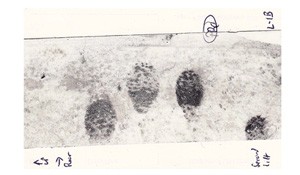
Once on the card, the lift should be finalized. It's good procedure to place your initials across an end of the tape and onto the card, as you would the seal on packaged evidence. You may wish to mark this side of the card with an arrow and notation for up, north or otherwise to help indicate original placement of the latent. On the back of the card, notate your case information—case number, time and date, address or location, your name and identification, in accordance with your departmental protocols. Then place a description of where the lift originated. Often a small sketch helps.
If the lift consists of multiple cards, tape all overlaps on the back to protect against damage. Finally, the "buddy tab" should be carefully cut off to protect from accidentally peeling the tape later.
Conclusion
Conventional powder techniques don't work for everything. Porous items (paper, cardboard and wood being common) most often require chemical treatment. A variety of special processes exist to visualize prints on wet surfaces, on the tacky side of tapes, or in the serum portion of blood. Superglue can be especially useful with old and weathered prints.
Nonetheless, powder processing has proved itself over time and has the benefits of being portable, inexpensive and easy to use while providing quality results. It isn't the latest technology, but it works and provides the street officer with a powerful tool to identify bad guys.