Statement of Record
Memorial Day is not observed—it is upheld. It is the measure of whether a nation, and those entrusted to protect it, remain faithful to the sacrifices that secured its freedom.
It stands as a solemn reckoning with the price of liberty and the responsibility it places upon the living to never forget and always honor.
A Nation Defined by What It Remembers
Memorial Day is the United States’ solemn day of remembrance for those who died in military service to the nation. It is not a general tribute to all who have worn the uniform—that honor is properly observed on Veterans Day. Memorial Day is reserved, with precision and reverence, for those who never returned.
Its origins trace to the aftermath of the Civil War, when Americans began what was then known as “Decoration Day,” placing flowers on the graves of the fallen. What began as an act of mourning became a national standard of remembrance—a fixed moment in the life of the Republic when the country pauses to confront a single, unchanging truth:
Freedom is not self-sustaining.
It has been secured, generation after generation, by those who gave their lives in its defense.
This distinction matters.
To blur Memorial Day into a general expression of appreciation is to diminish its meaning. Gratitude is appropriate—but Memorial Day demands something deeper. It is not about service alone. It is about sacrifice.
Not about those who stood the watch—
but about those who gave everything while standing it.
For law enforcement, this clarity carries particular weight. The profession understands, perhaps more than most, the difference between service and sacrifice—between returning home and not. That line is not theoretical. It is real. And it is final.
Memorial Day does not ask for casual acknowledgment.
It demands remembrance with understanding—
and honor expressed through action.
Because in the end, a nation is not defined by what it proclaims,
but by what it refuses to forget.
The Final Salute: A Life of Service, Not Forgotten
Retired NYPD Patrolman Anthony J. Fuoco, a United States Army veteran and Korean War veteran, passed away at ninety-one years old with no known family.
Yet he was not alone.
When word spread that Patrolman Fuoco would be laid to rest at Calverton National Cemetery without known next of kin, members of the law enforcement and military communities answered with remarkable unity and purpose.
The leadership of the NYPD Patrolmen’s Benevolent Association and the NYPD Columbia Association helped ensure that one of their own—and one of America’s own—would receive the dignity and honor his life of service deserved. In particular, PBA Delegate John Fox and Queens South Financial Secretary Joe Rao worked with the Office of the Chief Medical Examiner and the Department of Veterans Affairs to help secure a proper burial with full honors.
Their call for attendance and support spread rapidly throughout the NYPD community and beyond.

I was privileged to assist in sharing information regarding Patrolman Fuoco’s burial through professional contacts and social media platforms, joining many others throughout the law enforcement community in communicating the deeper importance of what was taking place and inspiring attendance in honor of one who had served both nation and community.
What emerged was more than attendance.
It was presence.
Police officers, veterans, retirees, ceremonial units, Patriot Riders, veteran organizations, and supporters stood together at Calverton National Cemetery not out of obligation, but out of conviction. Many who gathered had themselves worn two uniforms—one in defense of the nation abroad, the other in protection of its communities at home.
In that moment, the connection between military sacrifice and the patriotism of policing was unmistakable.
What occurred there was not extraordinary.
It was correct.
It was the visible expression of an enduring standard: that no veteran, no police officer, and no one who served this nation honorably should ever be forgotten or laid to rest alone.
Witness to Honor
On July 13, 2007, I attended the full military interment ceremony of Army 1st Lt. Mark H. Dooley at Arlington National Cemetery at the request of his mother, Marion Dooley, whom I had met while conducting professional development training for the Wallkill school district.
The training focused on character, academics, and violence prevention—principles that, in many ways, reflect the same foundational values later exemplified in Lt. Dooley’s life and service.
Lt. Dooley, a police officer from Wallkill, New York, was killed in Iraq on September 19, 2005, while serving with the 3d Battalion, 172nd Infantry Regiment (Mountain), 42nd Infantry Division, Vermont Army National Guard.
What I witnessed that day has never left me.
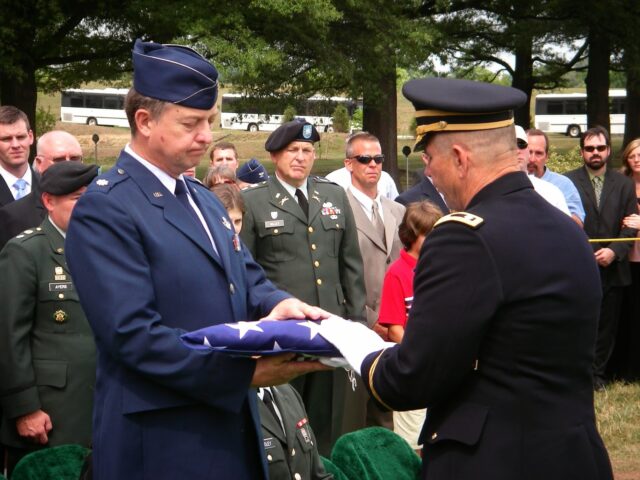
The solemn procession through Arlington. The silence between commands. The precision of military honor rendered without hesitation or excess. And finally, the folded American flag presented to Lt. Dooley’s father—a moment that captured both the unbearable weight of sacrifice and the enduring dignity with which this nation honors its fallen.
There are experiences that become part of your conscience.
For me, Arlington was one of them.
Peter Dooley, Mark’s father and a U.S. Air Force veteran, reflected that his son embodied values too often forgotten but essential to both military and police service: character, honor, truthfulness, discipline, service, and valor.
In speaking with Marion Dooley, it became unmistakably clear that Mark’s devotion to others—to family, fellow soldiers, friends, and country—was not situational, but the defining character of his life.
It reaffirmed something essential: remembrance is not passive. It is an obligation carried by the living. The honor shown to Lt. Dooley was not merely ceremonial—it reflected a national promise that sacrifice will not be forgotten and service will not be abandoned to time.
The experience remained so profound that it inspired my reflections published in The New Jersey Police Chief Magazine in 2007, and later inspired additional reflections published in Law Officer in 2026.
Because some moments are not meant simply to be remembered.
They are meant to instruct future generations in the meaning of duty, sacrifice, and sacred honor.
The Doctrine of Presence
There exists within both military and law enforcement service a principle that is neither written nor optional:
You do not leave your own behind.
Not on the battlefield.
Not on the street.
Not in death.
This is not sentiment.
It is doctrine.
At Arlington National Cemetery, that doctrine was expressed through the solemn military honor rendered to Army 1st Lt. Mark H. Dooley—a police officer, soldier, son, and American patriot whose sacrifice was carried with dignity through one of the nation’s most sacred traditions of remembrance.
Years later, that same doctrine revealed itself again at Calverton National Cemetery, where retired NYPD Patrolman and Army veteran Anthony J. Fuoco, despite having no known family, was surrounded by a larger one. Officers, veterans, and supporters answered the call to stand for a man who had once stood for others.
Though separated by years and circumstance, both moments reflected the same enduring truth:
Service creates a bond that does not end with retirement, distance, or death.
It endures through honor.
Through remembrance.
Through presence.
Such acts are not symbolic gestures.
They are declarations of who we are as a profession and as a nation.
They affirm that sacrifice will not be abandoned to silence, and that no one who served honorably will ever be forgotten or left to stand alone.
Leadership and the Modern Call to Duty
The extraordinary response surrounding the burial of Patrolman Anthony J. Fuoco did not emerge accidentally.
It emerged because leaders within the law enforcement community understood that honor requires action.
The NYPD Patrolmen’s Benevolent Association and the NYPD Columbia Association recognized that a veteran and retired police officer with no known family could not be permitted to make his final journey alone. Their leadership transformed what could have been a forgotten burial into a visible affirmation of duty, loyalty, and institutional character.
And others responded.
Officers. Retirees. Veterans. Supporters. Members of the law enforcement community across multiple networks and organizations joined together to communicate a simple but profound message:
Presence matters.
What unfolded in the days leading to Patrolman Fuoco’s interment also revealed something larger about the responsibilities of leadership in the modern era.
Communication itself has become a form of service.
Too often, social media is associated with outrage, division, vanity, and distraction. But in this case, it became something entirely different: an instrument of honor, remembrance, mobilization, and moral purpose.
The call to stand for Patrolman Fuoco spread rapidly throughout professional and social networks because people understood the deeper meaning behind it. This was never merely about attendance at a funeral.
It was about preserving a standard.
A standard that declares that service matters. That sacrifice matters. That dignity matters. That those who once stood for others must never be abandoned when their own final roll call comes.
This is leadership at its best.
Not performance.
Not slogans.
Not public relations.
But principle translated into action.
And in a time when many institutions struggle to preserve trust, meaning, and continuity, the response to Patrolman Fuoco demonstrated that the values of service, patriotism, loyalty, and sacred obligation still live powerfully within the law enforcement profession.
Sacred Ground, Eternal Obligation
The understanding of sacrifice deepens immeasurably when one stands on sacred ground where Americans who died for freedom rest far from home.
At the Florence American Cemetery in Italy, thousands of white crosses stretch across the hillside in solemn formation, marking the graves of Americans who gave their lives during World War II. Nearby stand the names of the missing—those whose final moments remain unknown, yet whose sacrifice remains permanently engraved into the conscience of the nation.
At the Sicily-Rome American Cemetery in Nettuno, thousands more Americans are buried beneath the flag they died defending.

To walk among these sacred grounds is not tourism.
It is confrontation.
Confrontation with cost.
Confrontation with sacrifice.
Confrontation with the realization that freedom survives only because others were willing to die for it.
And once you truly encounter that reality, it changes you.
It follows you home.
It stays with you.
It deepens your understanding of duty, country, service, and sacrifice.
The same spirit that carried Lt. Mark H. Dooley into military service and Patrolman Anthony J. Fuoco into lives of public duty echoes through these cemeteries. Different generations. Different wars. Different journeys. Yet united by the same enduring willingness to place service above self.
This is why Memorial Day matters.
Because nations survive not merely through power or prosperity, but through remembrance—through the willingness of the living to remain faithful to the sacrifices of the dead.
The Patriotism of Policing: A Foundational Principle
Within the Nine Principles of American Policing stands a truth too often neglected in modern public discourse:
Patriotism is not symbolic.
It is operational.
It is expressed through conduct, discipline, restraint, courage, accountability, sacrifice, and fidelity to something greater than personal interest.
The relationship between military sacrifice and honorable policing is neither accidental nor abstract.
It is foundational.
One defends the nation against external threats.
The other preserves ordered liberty within it.
Both stand between civilization and chaos.
Both require courage under pressure.
Both demand moral restraint in the use of authority.
Both ask individuals to place duty above comfort and service above self.
Lt. Mark H. Dooley embodied those values as both police officer and soldier.
Patrolman Anthony J. Fuoco embodied them through military and police service across the span of a lifetime.
And those who stood for them—whether at Arlington National Cemetery or Calverton National Cemetery—affirmed that these values remain alive within the profession today.
This is the patriotism of policing.
Not political theater.
Not empty symbolism.
Not manufactured rhetoric.
But a living commitment to honor, sacrifice, constitutional order, and the preservation of the American spirit itself.
The American Standard
Memorial Day is not merely a date on the calendar.
It is a national test of conscience.
It asks whether the living remain worthy of the sacrifices made by the dead. Whether the nation still possesses the moral seriousness to remember that freedom is neither automatic nor permanent. Whether future generations will inherit not only liberty, but an understanding of the cost required to preserve it.
The examples before us—Arlington, Calverton, Florence, Nettuno, and the lives of those who served within them—converge into a single enduring truth:
Honor must be lived.
Remembrance must be defended.
Sacrifice must never be forgotten.
And the obligation belongs to all of us.
A Duty Fulfilled
A special note of gratitude is owed to the leadership of the NYPD Patrolmen’s Benevolent Association, the NYPD Columbia Association, and to all who answered the call to honor Patrolman Fuoco.
What they ensured at Calverton National Cemetery was far greater than ceremony.
They ensured continuity.
Continuity of honor.
Continuity of memory.
Continuity of institutional character.
Continuity of the sacred American promise that those who serve this nation faithfully will never be abandoned to silence or forgotten in death.
Their actions demonstrated the profession at its best—not divided, cynical, or detached, but united through principle, gratitude, and reverence for service.
In honoring Patrolman Fuoco, they honored something larger than one individual life.
They honored the enduring moral bond between America and those willing to sacrifice for her.
Final Reflection
Patrolman Anthony J. Fuoco had no known family.
But he was not alone.
Lt. Mark H. Dooley’s sacrifice was carried with solemn dignity through Arlington National Cemetery, surrounded by family, military honor, and the enduring gratitude of a nation.
Years later, Patrolman Fuoco’s final journey revealed that same American spirit still alive within the law enforcement profession.
Different lives.
Different generations.
Different circumstances.
Yet bound together by the same truth:
Service creates a bond stronger than time, distance, or death.
This is Memorial Day at its highest expression.
Not rhetoric.
Not performance.
Not routine remembrance detached from responsibility.
But a sacred promise—kept.
That those who served.
Those who sacrificed.
Those who carried the burdens of freedom and public safety for others—
will never be forgotten, abandoned, or left to stand alone.
No veteran. No officer. No one who served should ever be laid to rest alone.
Law Officer Selections by Vincent J. Bove
The Principles of American Policing for 21st Century Law Enforcement
A foundational framework outlining the ethical, professional, and patriotic responsibilities of modern law enforcement.
Principles of American Policing™ for 21st-Century Law Enforcement
American Military Sacrifice: A Sacred Place in the Heart of American Policing
A reflection on the enduring relationship between military service and law enforcement in defense of freedom.
American Military Sacrifice: A Sacred Place in the Heart of American Policing
Lessons from World War II for American Policing
An examination of the moral, historical, and leadership lessons drawn from World War II policing and their continuing relevance to modern law enforcement and the preservation of democratic society.
Vincent J. Bove – Law Officer Chronology
A comprehensive collection of published works reflecting a sustained commitment to ethical leadership, American principles, and the enduring connection between service, character, and national identity.
https://www.lawofficer.com/?s=vincent+j.+bove
Florence American Cemetery (WWII)
Florence American Cemetery, Italy, where 4,393 U.S. service members are laid to rest and 1,409 missing in action are memorialized. Maintained by the American Battle Monuments Commission, these sacred grounds stand as a lasting tribute to those who gave their lives in World War II.
https://www.abmc.gov/Florence
Sicily-Rome American Cemetery (WWII)
Sicily-Rome American Cemetery, Nettuno, Italy, where 7,858 U.S. service members are buried and over 3,000 missing in action are honored. Overseen by the American Battle Monuments Commission, this site reflects the enduring cost of freedom and the nation’s commitment to remember.
https://www.abmc.gov/Sicily-Rome
Additional Memorial Day Resources
U.S. Department of Veterans Affairs – Memorial Day History
https://www.va.gov/opa/speceven/memday/history.asp
Arlington National Cemetery – Memorial Day Traditions
https://www.arlingtoncemetery.mil/Memorial-Day