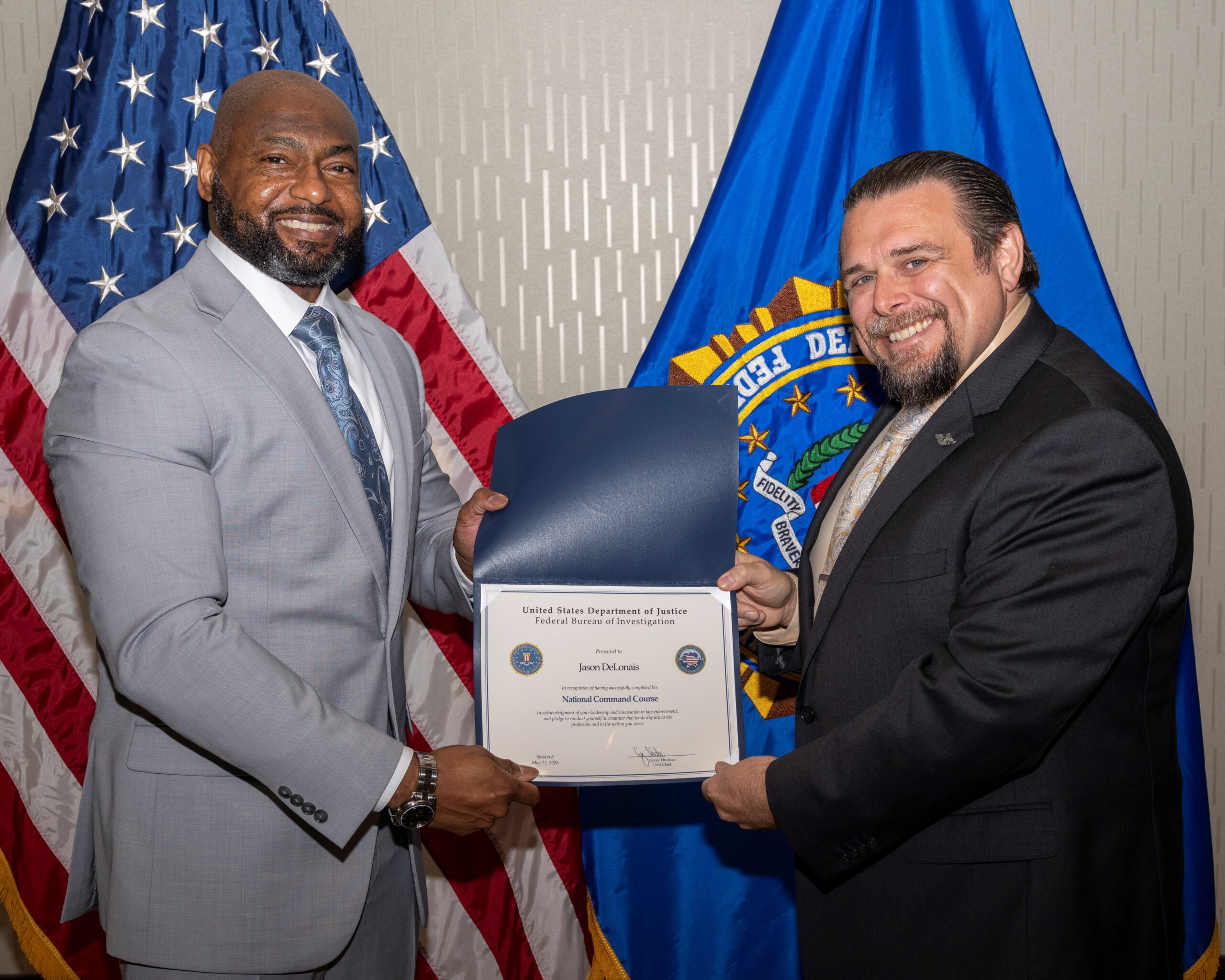
For leaders of smaller law enforcement agencies, programs such as the National Command Course offered by the Federal Bureau of Investigation can be especially valuable. Designed specifically for executives from law enforcement organizations with 50 or fewer officers, the National Command Course is an executive leadership development program focused on strategic leadership and organizational effectiveness through immersive, national-level instruction. I recently had the opportunity to attend National Command Course Session 8 in Quantico, Virginia.
Small-agency executives are often required to manage a wide range of responsibilities simultaneously, including administration, budgeting, personnel issues, policy development, public relations, emergency response, and day-to-day operational oversight. Unlike leaders of larger departments with extensive command staff and specialized divisions, small-agency leaders frequently make critical decisions with limited personnel and resources. Given those realities, executive leadership development is not a luxury for smaller agencies; it is essential.
 I have always believed that small-agency chiefs and directors are blue-collar law enforcement executives, carrying executive-level responsibility while remaining closely connected to the daily realities of policing. The National Command Course provides a rare, first-class executive development experience that recognizes that reality and invests in it accordingly.
The National Command Course gives leaders the opportunity to step away from daily operational demands and focus on long-term organizational strategy and leadership development. Exposure to modern leadership concepts, emerging policing trends, crisis management strategies, and national-level law enforcement perspectives helps smaller agencies strengthen their operations despite limited staffing and budgets. The course reinforces that professionalism and organizational excellence are not determined by agency size. Smaller departments can still build strong cultures, implement effective leadership practices, and operate strategically within their communities.
The program is highly interactive and immersive rather than strictly classroom-based. Participants engage in leadership discussions, tours, and practical learning experiences designed to connect leadership principles to real-world decision-making.
This includes training and presentations at the FBI National Academy and FBI Academy, where attendees gain exposure to national-level law enforcement training, leadership concepts, organizational strategies, and contemporary issues affecting modern policing. In addition to executive leadership instruction, participants also explore officer wellness initiatives, organizational resilience strategies, and emerging operational and safety considerations affecting law enforcement agencies today.
Participants also visit the United States Holocaust Memorial Museum, where guided tours and professional lectures are paired with What You Do Matters: Lessons from the Holocaust and Defining Moments in Policing: Ethical Decision Making During the Holocaust. These nationally recognized, discussion-based courses draw direct connections between historical events and modern policing while challenging participants to critically examine leadership, choice, implicit bias, and the responsibility to protect civil and human rights.
Attendees also visit Mount Vernon, where they receive a guided tour of President Washington’s Mansion and Grounds and participate in coursework and leadership exercises at the George Washington Leadership Institute. Through guided discussion, historical analysis, and interactive leadership scenarios, participants reflect on ethics, crisis leadership, organizational responsibility, and the complex decisions George Washington faced during pivotal moments in history.
Because travel, lodging, and meals are provided throughout the program, participants can focus entirely on the training and professional development at hand without the usual distractions or logistical concerns that often accompany executive education. Every detail is anticipated by the facilitators, creating an environment where the sole focus is learning, leadership development, and professional growth.
One of the most valuable aspects of the course is the relationships formed during the week. That genuinely caught me off guard. Spending an entire week with true peers who fully understand the unique challenges small-agency executives face creates an almost immediate bond among classmates. The conversations extend far beyond the classroom because everyone in attendance understands the realities of leading organizations with limited personnel, constrained budgets, and significant responsibility. Those professional relationships and support networks become just as valuable as the formal instruction and, for many small agencies, continue long after the course ends.
Another striking element of the course was how much heart was packed into the experience. Small-agency executives are often overlooked and underappreciated within the profession, so having a cadre of facilitators and national-level instructors invest so much genuine effort, attention, and care in developing attendees was truly impressive. The course did not feel transactional or routine; it felt authentic and personal.

I have attended several national-level police executive leadership programs throughout my career, but the National Command Course stood apart because of how genuine the staff and instructors were in both their effort and their belief in the importance of the participants’ mission. Throughout the week, participants are consistently reminded that selection for the program reflects recognition that they are among the most trusted professionals in their field. By the conclusion of the course, they leave with a renewed sense of responsibility and confidence in their role as organizational leaders.
The program is brief, but it punches far above its weight in quality and impact. Facilitators are intentional in their course design, anticipating every need and eliminating distractions to allow participants to focus seamlessly on learning. From breakfast until participants retire for the evening, the experience becomes a continuous cycle of learning, networking, and professional engagement.
Ultimately, executive education helps leaders return to their agencies with new perspectives, renewed motivation, and practical ideas that can positively influence both officers and the communities they serve. By removing nearly all financial barriers that might otherwise prevent small agencies from participating in executive-level leadership development opportunities, the NCC has leveled the playing field and made high-quality, national-level training accessible to even the smallest agencies.
For small-agency leaders committed to improving themselves and their organizations, the National Command Course is an opportunity not to be overlooked.