STATEMENT OF RECORD
On August 21, 2026, I spent approximately three hours at the NYPD’s 47th Precinct in the Bronx, beginning at approximately 3 p.m. Serving the northern portion of the Bronx, the 47th Precinct encompasses Woodlawn, Wakefield, Williamsbridge, Baychester, Edenwald, Olinville, Fishbay and Woodlawn Cemetery—communities whose police officers carry the daily responsibility of protecting a broad and diverse section of the borough.
The precinct has also been identified by New York City as one of six priority communities in its Blueprint for Community Safety, underscoring the importance of sustained, wide-reaching engagement among police, residents, community organizations and other local partners. [i]
The engagement, made possible through the gracious hospitality and leadership of Inspector Muhammad J. Ashraf, Commanding Officer of the 47th Precinct, included two roll calls, time with detectives, sergeants and lieutenants, and extensive interaction throughout the precinct and surrounding community. By the time the afternoon was over, there had been well over 100 individual encounters, including more than 70 officers gathered for the larger roll call.
The hospitality of Inspector Ashraf’s command, evident from the moment I walked into the precinct, was profoundly impressive. The openness of the command created the opportunity for an afternoon defined not simply by formal remarks, but by personal encounters, recognition, affirmation and gratitude.
WHERE MEMORY STILL WALKS THE HALLS
There are moments when a place speaks before anyone says a word.
That happened to me almost immediately upon entering the NYPD’s 47th Precinct.
The station house was alive with the unmistakable movement of police work—officers coming and going, conversations at the desk, assignments unfolding, and another tour preparing to carry the responsibilities of the badge onto the streets of the Bronx. Yet amid all that activity, something in the vestibule caught my attention and caused me to stop.
It was the tribute to Detective First Grade Didarul Islam.
Assigned to the 47th Precinct, Detective First Grade Islam was killed in the line of duty [ii] on July 28, 2025, while working a department-approved security assignment in uniform at 345 Park Avenue in Manhattan, where a gunman opened fire. His sacrifice while protecting others made him one of the NYPD’s fallen heroes, and his memory now stands visibly within the precinct he served.
His memorial stood prominently near the precinct’s memorial wall honoring members of the NYPD who had given their lives in the performance of duty. I was profoundly impressed by the dignity of the tribute and by the simple fact that remembrance occupied such a visible place in the everyday life of the command.
Officers walked past it on their way to assignments. Others returned through those same doors after serving the community. Visitors entered beneath the watch of memories that belonged not only to the 47th Precinct, but to the larger history of the NYPD.
There was something deeply moving about it.
The precinct was looking forward because it had work to do. Yet it had not forgotten those who came before.
And perhaps that is where any serious reflection on the badge should begin.
THE INHERITANCE OF THE BADGE
A police badge carries extraordinary authority, but it also carries inheritance. Every generation of officers receives something entrusted to it by those who served before—the reputation of the department, the confidence of the community, the responsibilities of public service, and the memory of those who gave everything while answering the call.
Standing before that memorial, gratitude was not an abstract word. It had a name.
Detective First Grade Didarul Islam.
Soon I would be standing before the officers of the command. Later would come the detectives, the conversations throughout the station house, the sergeants and lieutenants, and a roll-call room filled with more than 70 officers. But before any of that happened, the memorial offered its own silent lesson.

Credit: Vincent J. Bove for RALLC
Character matters because the badge will eventually ask something of everyone who wears it.
For some, it will ask patience when patience is difficult. For others, courage when fear is real. It will demand judgment when circumstances are confused, restraint when emotions are high, compassion when another human being is suffering, and integrity when nobody appears to be watching.
And sometimes the badge asks everything.
I carried that thought with me as I walked farther into the 47th Precinct.
There was another dimension to the afternoon that I could not ignore. Only a few blocks away stood Mount St. Michael High School, where I had graduated decades earlier. As a young man walking those Bronx streets, I could never have imagined the journey that would eventually bring me back to the same neighborhood to spend an afternoon with members of the NYPD.
Life has a way of completing circles we never knew we were drawing.
Decades later, I was back—not to reminisce about the Bronx of my youth, but to encounter another generation of men and women whose lives were now intertwined with these streets.
And I had one message that would find its way, in different forms, into nearly every encounter that followed:
The badge carries extraordinary authority, but what makes it shine is the character behind it.
That was the beginning of an extraordinary afternoon at the 47th Precinct.
But before the day was over, several officers from the command would unexpectedly see that message carried beyond the station-house doors and onto the streets of the community itself.
THE FIRST ROLL CALL: THE HUMAN BEING BEHIND THE BADGE
The first roll call gave me my first opportunity to speak directly with officers of the 47th Precinct. As I looked around the room, I was reminded again that every roll-call room contains individual human stories—different experiences, different responsibilities, different journeys—but a common commitment to serve.
Officer Jorge Cuevas generously documented my remarks with photographs during the first roll call, preserving moments that became part of an extraordinary afternoon; his kindness and hospitality, together with that of his colleagues throughout the 47th Precinct, will always be appreciated.
My opening remarks began with something more fundamental than programs or procedures. They began with the person.
I spoke about affirmation.
That word can sound simple, but its meaning is anything but simple. In a profession that routinely asks people to be strong for others, there can be remarkably little time to consider the person who is doing the carrying.
Dr. Conrad Baars’ work has deeply influenced my understanding of that human need. His emphasis on affirmation speaks to something fundamental in every person: the need to know that we possess dignity and worth, not because of our position, accomplishments or title, but because we are human beings.
That truth has particular significance for those who wear a police uniform.
The badge gives an officer extraordinary authority. It places tremendous responsibility in the hands of a human being who may, in a single moment, have to make decisions affecting another person’s safety, freedom or even life. Yet beneath all of that authority remains a person with a life, a family, hopes, burdens and a story of his or her own.
That person matters.
When I finished speaking, I did not simply step away from the group. I began meeting the officers individually.
I looked at their name pins and addressed each officer by name.
That small act changed the character of the encounter. I was no longer speaking to a room of police officers. I was speaking to each person.
I gave each officer a Liberation Monument card, depicting an American G.I. carrying a World War II concentration-camp survivor to freedom. I placed the card directly into each person’s hands and took a moment to recognize the individual standing before me.
There was something deeply meaningful about that exchange.

Credit: Vincent J. Bove for RALLC
The card carries a history of liberation, sacrifice and human dignity. In that moment, it also became a personal gesture of recognition. I wanted each officer to know that I had seen him or her—not merely as a uniform, a rank or a number in a roll call, but as a human being who had chosen a life of service.
The name on the pin mattered.
The person wearing it mattered.
And I took the time to make sure each officer knew it.
The conversations were not hurried. A name, a handshake, a few words, a smile, a moment of attention. Each encounter was different because each person was different.
It was one of those moments when the formal boundaries of a presentation quietly disappeared.
There was simply one person meeting another.
That same spirit would follow me throughout the afternoon. When I went upstairs to meet with the detectives, the encounters continued. When the larger roll call assembled, the Liberation Monument cards went into more hands. And as officers moved through the precinct, there were additional opportunities to stop, speak, listen and express gratitude.
The afternoon was beginning to reveal something I have learned repeatedly in working with protectors: sometimes the most important part of the message begins after the formal remarks have ended.
The words open the door.
The encounter is where the relationship begins.
A BRIEF ENCOUNTER WITH THE DETECTIVES
The visit with the detective squad upstairs was brief, but meaningful. Each detective was personally greeted, recognized by name, and given a Liberation Monument card.
There was time for a handshake, a few words, and a genuine expression of gratitude for the work they carried out behind the scenes.
Then it was back downstairs, where the precinct continued its steady rhythm and the larger 5:30 roll call was beginning to take shape.
THE 5:30 ROLL CALL: A MUSTER ROOM FULL OF PROTECTORS
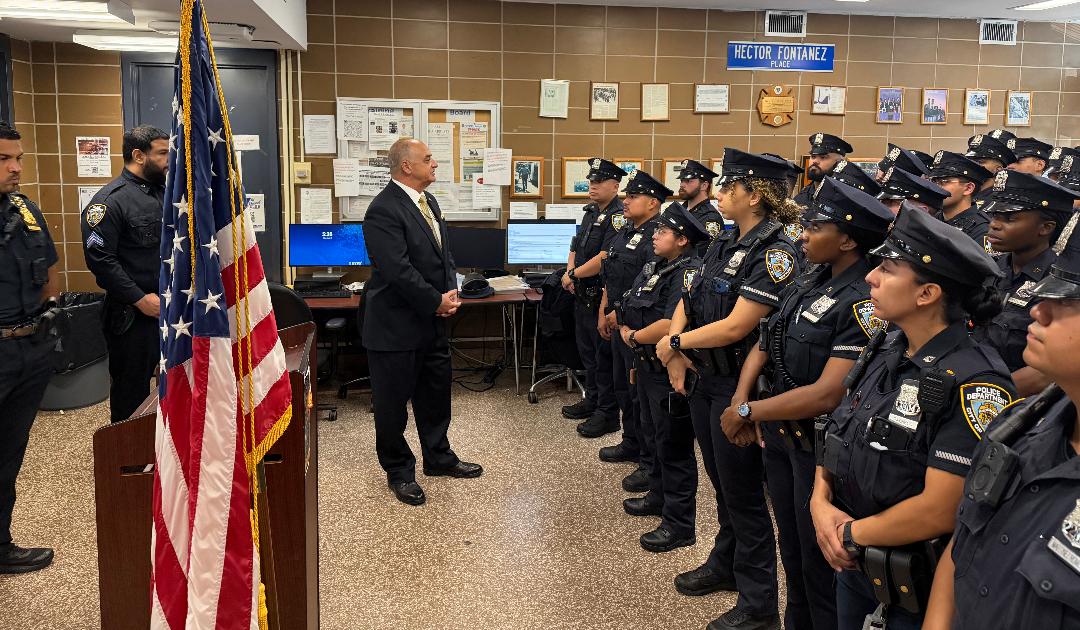
By the time the clock approached 5:30, the atmosphere of the precinct had changed. More than 70 officers had gathered, creating another memorable moment in an afternoon already filled with meaningful encounters.
Veteran Officer Ray Bremen, whose military background was evident in the way he approached the formation, prepared the officers before my remarks. Within moments, the room had been transformed. Hats were on. Officers stood shoulder to shoulder, aligned by height in precise, regimented lines. The formation was orderly, professional and remarkably efficient, accomplished without confusion or repeated instruction.
It was a striking display of preparation.
Then Sgt. Bory Echanique addressed the officers.
His voice was clear, distinct and professional as he prepared those entrusted to his command for the upcoming shift, precisely communicating their posts and details. Each officer knew what was expected and where the evening’s responsibilities would take them.
The room settled.
More than 70 officers now stood together beneath the American flag. From where I stood, the sight was impressive—not simply because of the number of officers, but because of the responsibility represented by every person in that room.
The memorial to Detective First Grade Didarul Islam, which had caught my attention when I first entered the precinct, remained in my thoughts.
Now I was looking at the officers who would carry the mission forward.
I began my remarks.
And in that moment, the afternoon seemed to gather itself—the memorial in the vestibule, the detectives upstairs, the conversations throughout the precinct, the officers who had stopped along the way, and now this extraordinary gathering of more than 70 members of the 47th Precinct.
The room was ready.
And so was the message.
THE BADGE IN THE ROOM
The room was quiet when I stepped forward.
More than 70 officers stood before me, shoulder to shoulder, their formation prepared with the precision of moments earlier. Sgt. Bory Echanique had completed the shift assignments. The American flag stood prominently among them.
For a moment, I simply looked across the room.
Then I began speaking.
The remarks were personal. These officers were preparing for another tour, carrying the responsibilities of their assignments and getting ready to return to the streets of the Bronx. They deserved to hear how deeply their service is appreciated.
Gratitude was at the center of my remarks.
The message returned to the person behind the badge and to the importance of affirmation. The work of Dr. Conrad Baars has influenced me deeply in understanding the dignity of the human person, and that truth resonated naturally in a room filled with people entrusted with extraordinary responsibility.
The badge carries authority. But the person wearing it carries the burden of exercising that authority wisely, humanely and with character.
I spoke to them about that responsibility, but also about the privilege of being entrusted with it.
There was no need to make the moment complicated.
These officers had chosen public service. They had answered the call, and they were preparing to go back into the community.
They deserved to know that their work was recognized.
The Liberation Monument was part of that recognition. After the remarks, each officer would receive the tribute card depicting an American G.I. carrying a concentration-camp survivor to freedom—a powerful image of liberation, sacrifice and human dignity.
But the afternoon was never really about handing someone a card.
It was about looking at a person, recognizing that person, and taking the time to say, in one way or another:
I see you. I appreciate what you do. What you do matters.
The words that had followed me into the 47th Precinct returned once more:
The badge carries extraordinary authority, but what makes it shine is the character behind it.
The formal remarks were over.
The encounters would continue.
AFTER THE ROLL CALL
When the remarks ended, the officers did not simply disperse. They came forward, and the large formation gradually became a series of personal conversations.
The name pins made it easy to begin. I called each officer by name, looked directly at the person standing before me, and took a moment with each one. The Liberation Monument card was placed into each officer’s hand, along with words of recognition and gratitude.
There was a natural warmth to the exchanges. Some officers smiled as we spoke. Others paused over the image on the card. After the precision and formality of the roll call, it was meaningful to meet people one at a time.
That same spirit continued throughout the precinct. Officers moved through the station house, and conversations unfolded wherever our paths crossed. Sergeants and lieutenants remained engaged, and the atmosphere that had welcomed the afternoon from the moment I arrived remained unmistakably present.
The formal gathering had ended.
The human encounter had not.
After nearly three hours inside the 47th Precinct, I walked out into the Bronx.
I had no idea that several of the officers from that first roll call would soon become unexpected witnesses to what happened next.
BEYOND THE PRECINCT DOORS
Outside the precinct, I began walking toward 233rd Street and White Plains Road, making my way to the subway for the journey home to Manhattan.
A fire truck caught my attention, along with several firefighters from the community. What followed was entirely spontaneous—a conversation about resilience, the burdens carried by those who protect others, and the importance of taking care of the people who take care of us. It brought back memories of my earlier work with FDNY peer professionals at the FDNY EMS Academy’s CFR Training facility at Fort Totten.
There was no podium, no scheduled program, and no presentation. There was simply a fire truck, a group of firefighters, and a conversation among protectors.
The firefighters responded with broad smiles.
Only afterward, as the conversation ended, did I notice several NYPD officers from the earlier roll call watching from the corner. One of the officers smiled, and the meaning of the moment became clear: earlier that afternoon, they had heard me speak about affirmation, dignity, character, and the human being behind the badge. Now they were watching those same principles unfold naturally on a Bronx street.
The firefighters were protectors. The police officers were protectors. And the community was where their missions met.
That is Police-Community Partnership™.
I walked over to the officers and spent a few moments with them outside the formal setting of the precinct. The encounter was relaxed and genuine. Then, after speaking with two additional NYPD officers across the street, the journey toward the subway continued.
Nothing had been arranged. Nothing had been rehearsed. Yet the afternoon had somehow brought its message into the very community the officers had been preparing to protect.
The lesson was not delivered from a podium.
It was lived.
SELECTED LAW OFFICER ARTICLES BY VINCENT J. BOVE
Respect Is the Badge: The Heart of the 21st-Century Ethical Officer
Respect as the foundation of ethical policing, professional conduct, and public trust.
https://www.lawofficer.com/respect-is-the-badge/
21st Century Policing: Ethical Leadership Is Nonnegotiable
Character, ethical leadership, and emotional fortitude as essential foundations of modern policing.
https://www.lawofficer.com/ethical-leadership-is-nonnegotiable/
The Ethical Leadership Doctrine™ in Policing: From Silent Wounds to Enduring Moral Authority
A foundational framework for ethical leadership, accountability, and moral authority in 21st-century policing.
https://www.lawofficer.com/ethical-leadership-doctrine/
COMPLETE LAW OFFICER CHRONOLOGY — VINCENT J. BOVE
A comprehensive collection of Vincent J. Bove’s published work in Law Officer, reflecting an ongoing body of work in ethical leadership, moral courage, character, emotional fortitude, officer resilience, public trust, and the protection of those who serve.
https://www.lawofficer.com/author/vbove/
[i] New York City Police Department, “47th Precinct,” official precinct profile:
https://www.nyc.gov/site/nypd/bureaus/patrol/precincts/47th-precinct.page
City of New York, A Blueprint for Community Safety:
https://www.nyc.gov/content/dam/nycgov/mayors-office/downloads/pdf/press-releases/2023/Blueprint-Community-Safety.pdf
[ii] City of New York, Mayor’s Office, “Transcript: Mayor Mamdani Hosts 1st Anniversary Memorial Ceremony for Detective Didarul Islam,” July 29, 2026. The official City account identifies Detective First Grade Didarul Islam, notes his service connection to the 47th Precinct, and states that on July 28, 2025, he was working a security assignment at 345 Park Avenue when the shooting occurred.
https://www.nyc.gov/mayors-office/news/2026/07/transcript–mayor-mamdani-hosts-1st-anniversary-memorial-ceremon
The Detectives’ Endowment Association, “Didarul Islam,” Official Line of Duty Deaths Honor Roll:
New York City Council, Resolution 392-2026, “The Didarul Islam Police Recruitment Act”:
https://legistar.council.nyc.gov/LegislationDetail.aspx?GUID=756822AD-D1F1-41DA-8ED4-319177943808&ID=7961427&Options=&Search=