Author’s Note
This special Independence Day essay is published as a companion reflection to The American Standard: A Six-Part Leadership Series in 21st-Century Policing. While independent of that series, it shares its commitment to honoring America’s 250th anniversary by exploring the enduring principles, character, moral courage, patriotism, and stewardship upon which the Republic was founded.
Statement of Record
Every Fourth of July, Americans gather beneath a common flag. Families assemble for parades, concerts, community celebrations, and fireworks that illuminate the summer sky. We celebrate the birth of a nation and remember the words that forever altered the course of human history.
Yet the Declaration of Independence was far more than a political document. It was a declaration of character.
Its enduring significance rests not merely in the eloquence of its language or the boldness of its assertions, but in the willingness of fifty-six men to publicly bind themselves to the principles they proclaimed, fully aware that doing so would place their lives, their fortunes, and the safety of their families in immediate peril.
As America celebrates the 250th anniversary of the Declaration of Independence, our nation continues to depend upon men and women who understand that freedom is inherited, but it is never automatic. Every generation becomes the steward of a legacy it did not create, yet is entrusted to preserve and strengthen it for those who follow.
That truth remains as relevant today as it was on July 4, 1776.
More Than a Famous Phrase
Most Americans recognize the closing words of the Declaration of Independence, yet few pause to consider their extraordinary weight:
“…we mutually pledge to each other our Lives, our Fortunes and our sacred Honor.”*
Those words have echoed across two and a half centuries of American history, yet their true meaning is easily overlooked. They were not merely eloquent phrases or stirring expressions of patriotism. They were solemn promises, sacrificial commitments, and dangerous declarations of conviction.
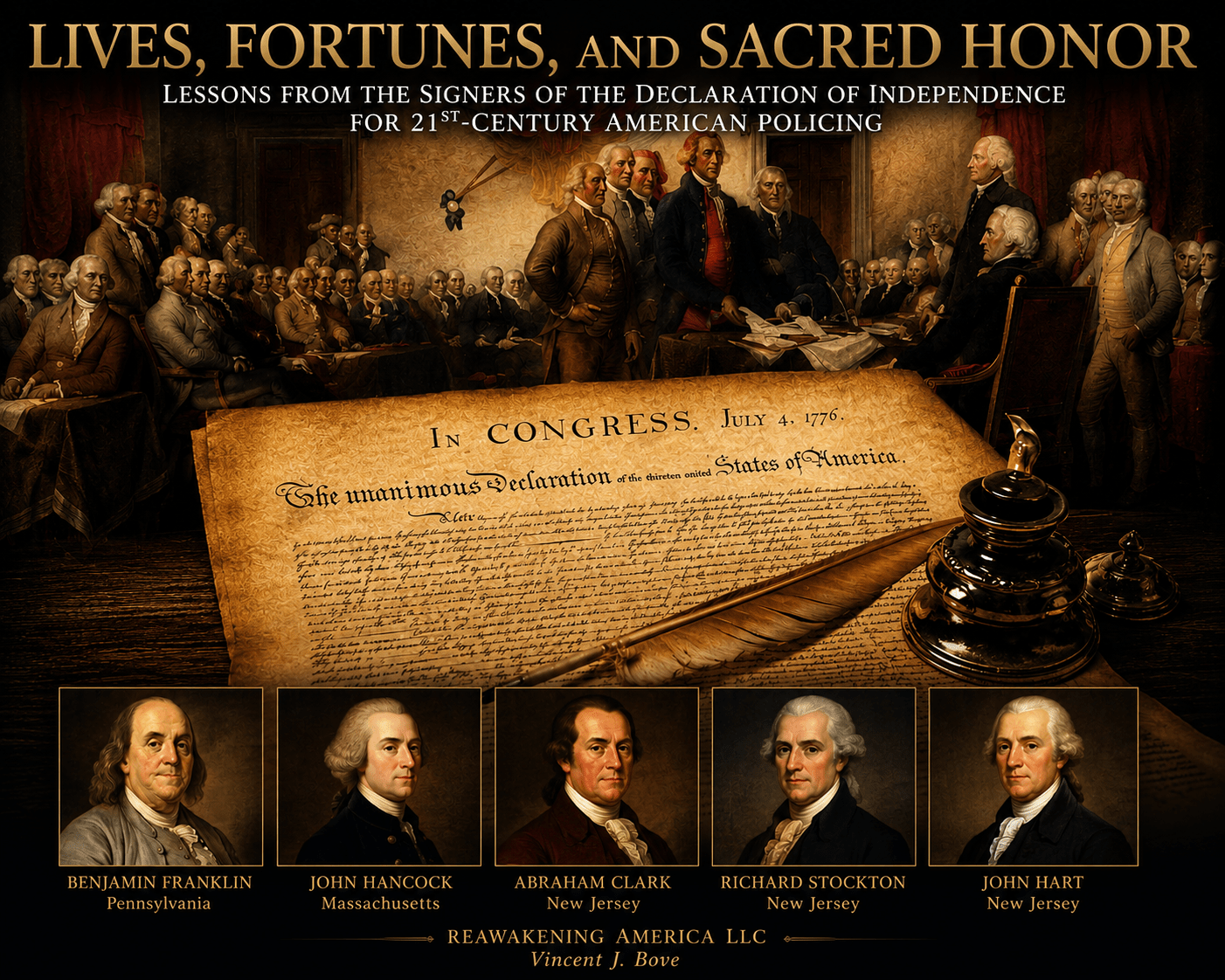
By placing their signatures upon the Declaration, the fifty-six signers publicly bound themselves to a cause the British Crown regarded as treason. Their signatures were not symbolic gestures or expressions of political opinion. They were irrevocable acts of conscience, knowingly placing their lives, their liberties, their fortunes, and the safety of their families in immediate peril for the cause of American independence. If captured by British authorities, they understood that imprisonment, the confiscation of their property, or even death could become the price of their convictions.

(Vincent J. Bove / Reawakening America LLC)
Benjamin Franklin understood those stakes with characteristic clarity. As the delegates prepared to sign, he famously observed, *”We must, indeed, all hang together, or, most assuredly, we shall all hang separately.”* Beneath Franklin’s wit lay a sobering truth. The Declaration demanded far more than agreement. It demanded unity, courage, sacrifice, and an unwavering commitment to one another.
History rightly remembers Thomas Jefferson, John Adams, John Hancock, and Benjamin Franklin as towering figures of the American founding. Their names have become inseparable from the birth of the Republic. Yet the enduring strength of the Declaration also rests in the quieter stories of men whose sacrifices unfolded long after the ink had dried.
Among them was New Jersey signer Abraham Clark. During the Revolutionary War, two of his sons were captured and imprisoned aboard the notorious British prison ship *Jersey*. Despite their suffering, Clark refused to seek special treatment that would have placed personal interests above the larger cause of liberty. His signature had become more than a public act; it had become a covenant of conscience.
Richard Stockton would likewise discover that the cost of independence extended far beyond Philadelphia. Captured by Loyalist forces and subjected to harsh imprisonment, he emerged physically weakened while his estate was plundered and his professional life never fully recovered. The liberty he pledged to defend demanded sacrifices that neither he nor his family escaped.
John Hart’s experience reflected the same reality. Forced to flee his home as British and Hessian forces advanced across New Jersey, he spent months separated from his family while his farm suffered extensive damage. The principles proclaimed in the Declaration were no longer matters of political philosophy. They had become deeply personal trials requiring endurance, perseverance, and faith.
These stories remind us that great moments rarely create character. More often, they reveal it. The Declaration of Independence did not make courageous men courageous; it revealed convictions that had already taken root within their hearts long before they assembled in Independence Hall. When history called, they simply refused to abandon the principles by which they had already chosen to live.
That enduring truth belongs not only to the generation that declared American independence, but to every generation entrusted with preserving the Republic they helped establish.
Whether entrusted with military service, public safety, emergency response, public leadership, or the responsibilities of citizenship itself, moments of crisis seldom manufacture integrity; they reveal the character that has been cultivated long before the moment of testing. Public trust, like liberty itself, is sustained not by authority alone, but by men and women whose character remains steadfast when doing what is right carries a deeply personal cost.
An American Pilgrimage
Some places in America invite more than sightseeing. They invite reflection.
Several years ago, while in Washington, D.C., to speak for ASIS International on school violence prevention, I made my way to the National Archives. Standing before the original Declaration of Independence, I was struck by an unexpected contrast. The parchment itself appeared remarkably fragile. Time had softened its ink and darkened its surface. Yet the principles it proclaimed remained as enduring and compelling as the day they were written.
As I entered the National Archives, I paused before the familiar inscription:
“Eternal Vigilance is the Price of Liberty.”
Those words have remained with me ever since. Whether viewed as a historical reminder or a timeless admonition, they express a truth that every generation must rediscover. Liberty does not preserve itself. It requires vigilance, gratitude, responsibility, and moral courage.
That visit became part of what my wife, Lily, and I often describe as our own American pilgrimage. We have stood within Independence Hall, where principled debate gave birth to a nation; reflected before the Liberty Bell, whose enduring message reaches far beyond the famous crack in its surface; and walked the solemn fields of Gettysburg, where extraordinary sacrifice preserved a Union first envisioned in Philadelphia.
Living in the New York metropolitan area, I have also lost count of the number of times I have looked toward the Statue of Liberty while traveling between New Jersey and New York. Whether standing beside her on Liberty Island or watching her rise above New York Harbor from the Staten Island Ferry, she has never failed to remind me that freedom remains among humanity’s greatest blessings—and one of its greatest responsibilities.
These places are far more than historical attractions. They are enduring teachers. They remind us that liberty has always required sacrifice, that justice demands vigilance, and that history is not preserved merely to be admired, but to shape the character of those entrusted with carrying its principles into the future.
What Is Sacred Honor?
The closing words of the Declaration of Independence remain among the most profound ever written in the cause of liberty:
“…we mutually pledge to each other our Lives, our Fortunes and our sacred Honor.”
Lives could be forfeited. Fortunes could be lost. Both were sacrifices measured in flesh, possessions, and earthly security. Sacred honor reached even deeper.
Sacred honor is the steadfast integrity that remains when applause has faded, recognition is absent, and conviction demands a personal cost. It is the unwavering commitment to do what is right because it is right, regardless of the consequences.

(Vincent J. Bove / Reawakening America LLC)
By describing their honor as sacred, the signers affirmed that their pledge rested upon a moral responsibility greater than themselves. Their commitment was not merely political; it was rooted in conscience, strengthened by their closing affirmation of “a firm reliance on the protection of Divine Providence.”
The Declaration of Independence did not create the character of the signers. It revealed the character they had already spent a lifetime cultivating.
Long before the delegates gathered in Philadelphia, they had already chosen the principles by which they would live. When history called, they simply lived the principles they had already embraced.
Great moments rarely create character. More often, they reveal it.
That enduring truth belongs to every generation.
Whether serving in our Armed Forces, responding as firefighters or emergency medical professionals, wearing the badge in law enforcement, leading public institutions, or faithfully fulfilling the responsibilities of citizenship, moments of crisis seldom manufacture integrity. They reveal the character that has been quietly formed long before the moment of testing.
Public trust, like liberty itself, is sustained not by power alone, but by men and women whose character remains steadfast when the cost of doing what is right becomes deeply personal.
As America commemorates the 250th anniversary of the Declaration of Independence, our nation continues to depend upon men and women who understand that freedom is inherited, but it is never automatic. Every generation becomes the guardian of a legacy it did not create, yet is entrusted to preserve for those who follow.
The Flag Still Flies
Since childhood, the American flag has flown outside my home—not only on Independence Day or other national holidays, but every day of the year. That tradition has continued wherever I have lived, serving as a quiet reminder of the remarkable inheritance entrusted to every American generation.
I do not fly the American flag because I believe America to be perfect. Neither were the men who pledged their lives, their fortunes, and their sacred honor. I fly it because both remind me that greatness is measured not by perfection, but by a continuing commitment to pursue liberty, justice, human dignity, responsibility, and the common good.
Living in the New York metropolitan area, I have spent a lifetime catching glimpses of the Statue of Liberty while traveling between New Jersey and New York. Whether standing beside her on Liberty Island or watching her rise above the harbor from the Staten Island Ferry, I have often been reminded that countless people have looked upon that same horizon with hope, gratitude, and the promise of a better future. During the year my wife, Lily, became an American citizen, those moments carried an even deeper meaning for our family.
The American flag has come to represent those same enduring ideals. It reminds me that freedom is never free, that public trust is never automatic, and that every generation bears the responsibility of preserving and strengthening the blessings it has inherited.
Each time the flag rises outside my home, it quietly reminds me that freedom is both a blessing and a responsibility. It invites each generation to consider an enduring question:
What will we do with the inheritance of liberty entrusted to our care?
The Legacy They Entrusted to Us
As America commemorates the 250th anniversary of the Declaration of Independence, we are invited to do more than celebrate a remarkable moment in history. We are called to reflect upon the extraordinary character of the fifty-six men who pledged their lives, their fortunes, and their sacred honor in support of a cause whose outcome they could not foresee.
They could not know whether the Revolution would succeed or fail, whether they would live to witness the birth of the nation they envisioned, or whether their families would share in the sacrifices their signatures would demand. They knew only that there are moments in history when principle requires commitment, conviction demands courage, and freedom carries a deeply personal cost.
The signers of the Declaration of Independence were not perfect men. History remembers their accomplishments with gratitude and their imperfections with honesty. Neither are we perfect. We, too, are men and women marked by human weakness, striving to live with integrity while recognizing our own limitations.
Character has never required perfection. It requires the humility to acknowledge our weaknesses, the conviction to embrace enduring principles, and the moral courage to rise when history calls.
The greatness of the signers did not rest upon flawless lives. It rested upon their willingness to place enduring principles above personal interests and to accept the sacrifices required to defend the cause of liberty. In doing so, they gave future generations far more than a Declaration of Independence. They gave us an enduring example of principled citizenship, moral courage, and faithful stewardship.
The Declaration of Independence proclaimed liberty. Gettysburg helped preserve the Union. The Statue of Liberty continues to symbolize hope. The American flag reminds us that freedom is both a blessing and a responsibility. Together, they proclaim an enduring American truth: liberty is never self-sustaining. It endures only when each generation chooses to preserve it, strengthen it, and faithfully pass its blessings to those who follow.
That is the enduring legacy the signers of the Declaration of Independence entrusted to us.
For members of our Armed Forces, first responders, law enforcement professionals, public servants, and everyone privileged to call America home, that legacy invites each of us to consider an enduring question:
What responsibilities accompany the blessings of liberty?
The answer cannot be found in monuments alone, nor in documents carefully preserved beneath museum glass. It is found in the daily choices of men and women who choose character over convenience, principle over popularity, service over self, and faithful stewardship over complacency. In the end, freedom is preserved not only by what we commemorate, but by how we live.
May we honor the enduring principles, faithfully preserve the precious inheritance of liberty, and prove worthy of the sacred honor that the signers of the Declaration of Independence entrusted to our care.
Selected Related Works by the Author
The American Foundation: Founding Principles and the Standard of Leadership for 21st-Century Policing
The opening article in The American Standard series explores the enduring principles that shaped the American Republic and examines how the Founders’ vision of liberty, constitutional government, and moral leadership continues to guide ethical leadership and public service in the twenty-first century.
https://www.lawofficer.com/the-american-foundation/
The First Test of the American Promise: Constitutional Authority, National Expansion, and the Strain of Principle in 21st-Century Policing
Building upon America’s founding principles, this article examines the nation’s first great constitutional challenges, demonstrating how leadership rooted in character, stewardship, and fidelity to enduring principles strengthened the Republic during periods of extraordinary growth and uncertainty.
https://www.lawofficer.com/the-first-test-of-the-american-promise/
D-Day, Protectors, and the Enduring Chords of Service
Commemorating the eighty-second anniversary of D-Day, this reflection honors the courage, sacrifice, and unwavering commitment of those who defended freedom, while drawing timeless lessons for today’s protectors entrusted with preserving liberty and public trust.
https://www.lawofficer.com/d-day-protectors-and-the-enduring-chords-of-service/
Complete Chronology of Published Works
Explore Vincent J. Bove’s complete collection of Law Officer articles on ethical leadership, American history, officer wellness, emotional fortitude, organizational resilience, and the enduring principles of twenty-first-century policing.
https://www.lawofficer.com/author/vbove/