Flock Safety was founded in 2017 by Garrett Langley, Matt Feury, and Paige Todd following an unsolved property crime in Atlanta, Georgia. Traditional home security cameras captured video footage of the incident, but law enforcement lacked actionable evidence – specifically, vehicle identifying markers – necessary to identify a suspect.
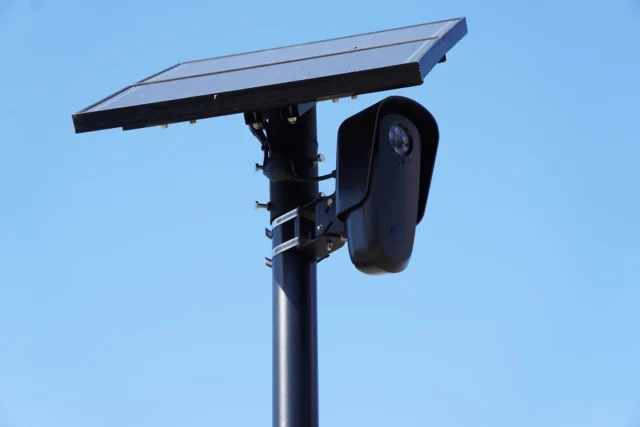
Recognizing a market gap, the co-founders designed a low-cost, solar-powered, automated license plate recognition (ALPR) platform. Initially finding product-market fit within Homeowners Associations (HOAs) and gated neighborhoods, Flock deployed a “Safety-as-a-Service” subscription model ($2,500/camera/year). By providing initial network density through private communities, Flock created network effects that catapulted its adoption into public law enforcement agencies. By 2021, Flock achieved “unicorn” status, valued at several billion dollars, expanding its infrastructure to cover over 6,000 agencies and thousands of private developments nationwide. To comprehend how this rapid expansion altered public safety operations, one must first examine the core technology powering these devices in the field.
Machine Vision in Action: How Flock Operates
Flock Safety utilizes computer vision and machine learning cameras mounted on infrastructure to capture vehicle “fingerprints” rather than relying exclusively on license plate reader algorithms.
- Captured Metrics: License plate number, state, vehicle make, model, color, body style, and distinguishing visual characteristics (e.g., bumper stickers, roof racks, alterations, or damage).
- Operational Model: Solar-powered, cellular LTE-connected nodes stream metadata into a centralized cloud database (“Flock OS”) with a standard 30-day rolling data retention window before deletion.
- Practical Examples:
- Real-Time Violent Crime Response: A stolen vehicle linked to an armed robbery passes an ALPR camera. Within seconds, the system alerts local dispatch with the vehicle’s location and direction of travel.
- Investigative Leads: A hit-and-run occurs where a witness only remembers a “red pickup truck with a ladder rack and a missing rear license plate.” Detectives query these visual parameters to isolate suspect vehicles operating in the area during that timeframe.
While these public safety deployments form the core of Flock’s brand identity, similar optical recognition systems are routinely deployed far beyond municipal law enforcement.
Silent Observers: ALPR Beyond Law Enforcement
Automatic License Plate Recognition is not exclusive to public policing. Commercial and private entities utilize ALPR across multiple sectors:
- Gated Communities & HOAs: Automated gate entry verification for residents and logged auditing of visitor vehicles.
- Commercial Automated Car Washes: Subscription-based customer access where cameras read tags to trigger automated car wash bays without physical passes or cash.
- Private Repossession & Asset Recovery: Towing agencies deploy mobile ALPR vehicles to continuously scan parking lots, automatically cross-referencing vehicle tags against lender default databases.
- Commercial Parking Management: Automated entry/exit tracking, dynamic pricing, and digital tolling in private parking structures and airport facilities.
Although these private applications serve narrow, localized entry and logging functions, law enforcement deployments feature a dual-capability architecture that operates on a vastly broader scale.
Real-Time Alerts vs. Retrospective Audits
To understand the legal and ethical friction surrounding Flock Safety, one must distinguish between its two primary operational modes:
- Hot List Alerts (Passive/Real-Time): Operates on an active watch list synced with local, state, or national databases (e.g., NCIC for stolen vehicles, missing persons, or active felony warrants). When a tagged vehicle passes a node, an automated alert flashes to officers. The system operates passively until a match occurs, closely aligning with exigent circumstances standards.
- Historical Searches (Active/Retrospective): Allows an officer to execute manual, relational queries across historical location databases. An officer can type in a tag or descriptor and retrieve a complete, timestamped, geographic map of where that vehicle traveled across hundreds or thousands of nodes over the past 30 days.
This capacity to rebuild a vehicle’s historic movements places the system directly in the crosshairs of constitutional privacy litigation.
Constitutional Boundaries and Mass Surveillance
The Fourth Amendment protects citizens against “unreasonable searches and seizures.” The integration of mass surveillance technologies like Flock tests traditional jurisprudence by shifting police work from targeted observation to mass location tracking.
While public street monitoring traditionally carries no reasonable expectation of privacy for single sightings, cumulative grid tracking triggers distinct legal thresholds over time. Understanding how courts evaluate this intersection requires analyzing established legal precedents regarding public movements and modern digital footprints.
Public Roads, Expectation of Privacy, and the Mosaic Theory
Public Streets and Vehicle Markers
Traditionally, courts hold that individuals do not possess a reasonable expectation of privacy in their movements on public thoroughfares (United States v. Knotts, 1983).
- Public View: Vehicles operate in plain sight on public roads.
- State Property: License plates are government-issued identity tags required by law to be exposed publicly.
- Descriptor Anonymity: Vehicle color, make, and model do not explicitly identify an individual person without cross-referencing external driver registry databases.
Landmark Case Law
- ** Katz v. United States (1967):** Established that the Fourth Amendment protects people, not places. Justice Harlan’s concurrence created the two-prong test: (1) whether the individual demonstrated an actual (subjective) expectation of privacy, and (2) whether that expectation is one that society is prepared to recognize as reasonable. The Court famously held that what a person seeks to preserve as private, even in an area accessible to the public (such as a public telephone booth), may be constitutionally protected.
- ** Carpenter v. United States (2018):** Addressed historic Cell-Site Location Information (CSLI). The Supreme Court recognized the “Mosaic Theory”: while a person may not have an expectation of privacy in a single public movement, aggregated retrospective location tracking over time provides an “intimate window into a person’s life” revealing political, religious, medical, and romantic associations. The Court ruled that accessing continuous historical location data constitutes a Fourth Amendment search requiring a warrant based on probable cause.
When technology makes retrospective mosaic creation effortless, the line between legal investigation and personal abuse becomes dangerously thin.
Data Breakdown: Anatomy of ALPR Misuse
While real-time “hot lists” function as intent-based public safety tools representing the overwhelming majority of legitimate utility, empirical records demonstrate that the retrospective historical research function is the primary vector for law enforcement misuse. Because historical searches allow unrestricted lookups across millions of records without prior judicial authorization, officers can conduct personal, unconstitutional surveillance.
Documented investigative reports, including audits published by the Electronic Frontier Foundation (EFF) and news organizations, highlight cases where officers utilized historical search features to track former romantic partners, monitor interpersonal rivals, or execute out-of-jurisdiction inquiries outside legitimate criminal investigations. Personal and romantic tracking accounts for roughly half of documented historical search abuses, followed by out-of-jurisdiction checks, non-official curiosity lookups, and political or protest profiling. Recognizing these vulnerabilities, developers sought to build technological guardrails directly into the software platform.
The Inadequacy of Post-Hoc Audit Loggers
In response to rising reports of officer misconduct, Flock built internal compliance tools, including mandatory “Reason for Search” text boxes, “Audit Assistance” algorithms, and public-facing Transparency Portals.
However, these mechanisms represent an attempt to engineer a solution to a structural governance defect. Post-hoc logging and voluntary reason entry do not prevent unauthorized searches; they merely document violations after an individual’s spatial privacy has already been breached. Because these retroactive logging systems fail to prevent overreach, community skepticism has rapidly spilled over into direct public pushback.
Grassroots Resistance and Physical Backlash
Unfettered surveillance growth has ignited significant community pushback. Citizens across various jurisdictions have engaged in direct mitigation actions:
- Physical Disabling & Vandalism: Nodes have been blinded with paint, oriented away from roadways, had power cables severed, or been felled entirely.
- Community Petitions: Neighborhoods and city councils face public campaigns demanding the immediate non-renewal or cancellation of Flock contracts.
This grassroots hostility has quickly migrated from local street corners into state capitols and legislative halls.
The Legislative Threat to ALPR Networks
The loss of public trust has escalated to state legislatures and municipal governments.
- Multiple state assemblies have drafted or enacted legislation (e.g., Washington State SB 6002) restricting retention periods, banning cross-border data sharing for non-criminal matters, and prohibiting ALPR installation near sensitive sites like healthcare facilities, places of worship, and schools.
- Municipalities are introducing ordinances mandating explicit warrant requirements for historical queries or banning municipal ALPR usage altogether.
Organized advocacy groups have channeled this legislative momentum into sophisticated, technology-driven resistance movements.
Mapping Surveillance: The “DeFlock” Movement
Civic technological pushback has organized into formal movements such as DeFlock. DeFlock utilizes crowdsourced, open-source mapping to locate, verify, and publish the exact spatial coordinates of ALPR cameras. These platforms empower citizens to map surveillance blind spots, demand local accountability, and challenge the unchecked expansion of regional monitoring networks.
While historical querying sparks fierce public pushback, real-time alerting relies on an entirely different legal footing that aligns neatly with standard police procedure.
Hot Lists and the Exigent Circumstances Standard
Legally, real-time “hot list” alerts align with established Fourth Amendment warrant exceptions:
- Exigent Circumstances: Real-time tracking of a fleeing violent felon or an active kidnapping/Amber Alert satisfies the immediate threat standard.
- Plain View / License Check: Automated identification of an active felony warrant or stolen status on a public road serves as an extension of a police officer visually identifying a wanted vehicle in real time.
Because hot lists respond to existing, judicially verified warrants or immediate emergencies, they rarely infringe upon constitutional boundaries, highlighting precisely where software developers and law enforcement must focus their reform efforts.
Strategic Editorial & Executive Proposal
Unfettered Retrospective Searching as the Primary Vulnerability
To police executives and the founders of Flock Safety: Your operational and legal liability stems from a single design choice: unfettered, warrantless retrospective searching.
The overwhelming majority of public controversy, officer terminations, civil rights lawsuits, and legislative bans do not stem from catching stolen cars in real time. They stem from officers utilizing historical search features to look up former lovers, monitor personal acquaintances, or spy on individuals without reasonable criminal suspicion. Allowing individual officers unfettered access to 30 days of movement history across a city or state creates a moral hazard that no post-hoc audit tool can fix. Left unaddressed, this design flaw poses a direct threat to the admissibility of evidence in court.
The Constitutional Imperative for Historic Warrants
Under the legal doctrine established in Carpenter v. United States, aggregating weeks of physical location data creates a mosaic of personal life that requires Fourth Amendment protections. A historical search across Flock’s network is the functional equivalent of querying historic Cell-Site Location Information.
Continuing to permit warrantless retrospective historical queries exposes every prosecution relying on this evidence to systemic suppression motions under the Exclusionary Rule. To safeguard criminal cases from dismissal, historical search queries must be anchored to judicial probable cause, a standard that modern technological tools can fulfill in minutes.
Frictionless Judicial Review in the Digital Age
Opponents of strict warrant requirements historically argued that judicial authorization creates unacceptable delays in active investigations. In the modern digital policing era, this argument no longer holds weight.
Virtually every modern jurisdiction utilizes Electronic Warrant (e-Warrant) systems. On-call magistrates and judges review digital affidavits on tablets and smartphones 24/7. An officer can draft, submit, and receive an electronically signed search warrant within 3 to 10 minutes. Implementing this process uniformly begins with a simple, standardized data entry template.
Standardizing the Historical Search Warrant Template
Integrating judicial oversight into Flock OS does not require cumbersome bureaucracy. It requires a standardized digital workflow. Before executing a historical retrospective query, the system should mandate uploading an approved e-warrant containing three mandatory elements:
- CAD / Criminal Case Number: The official agency record identifier (e.g., 2026-CR-09412).
- Target Identifier: The specific license tag or vehicle fingerprint descriptors requested.
- Judicial Probable Cause Statement: The signed e-warrant affidavit attached as a digital document.
To translate this operational standard into daily law enforcement practice, Flock must fundamentally rethink its core product platform.
Architectural Transformation: The Flock Judicial Warrant Portal
Flock Safety must shift its architecture from post-hoc auditing to front-end access control.
Proposed Structural Changes:
- Remove Direct Retrospective Querying: Eliminate the general search bar for historical data from standard officer dashboards.
- Maintain Real-Time Hot List Alerting: Keep real-time notifications for NCIC flags, stolen vehicles, and active violent felony warrants fully operational for field units.
- Deploy the Flock Judicial Warrant Portal: Require all historical queries to be routed through a secure compliance portal. The searching officer inputs the exact same historical search criteria such as license tags, vehicle color, visual descriptors, geographic parameters, and timeframes alongside the uploaded e-warrant and case metadata. However, the system holds and locks this search payload, preventing any results from being returned until a human compliance officer or automated AI warrant verification system validates the authenticity and judicial signature of the uploaded warrant.
- Automated/Streamlined Verification: Automated AI extraction tools or specialized Flock compliance personnel verify the presence of a valid judicial signature, magistrate stamp, and matching case number before unlocking and returning the historical query results for the specified window.
By adopting this front-end gating mechanism, both software vendors and police leadership can rebuild the public trust that current practices have eroded.
Rebuilding Public Trust Through Front-End Transparency
This architectural shift solves the central crisis facing both Flock Safety and law enforcement leadership across four critical dimensions:
- For Law Enforcement Executives: Protects agency leadership from front-page corruption scandals, protects investigators from civil liability, and ensures that evidence gathered via ALPR holds up in court.
- For Flock Safety: Neutralizes the primary argument of anti-surveillance advocates and state legislators attempting to ban the technology. It shifts Flock’s public perception from an unchecked surveillance engine into a constitutionally compliant digital forensics platform.
- For Communities: Provides proof that privacy is respected and that location history cannot be searched without judicial oversight based on probable cause.
- For Judicial Integrity: Insulates prosecutors against suppression motions, solidifying ALPR evidence under established search warrant precedents.
Taking this vital step promises not only to save a business model, but to redefine how public safety technology interacts with constitutional rights.
A Sustainable Blueprint for the Future of Public Safety Tech
Flock Safety created an exceptionally powerful public safety tool. However, unrestricted historical search functionality threatens to dismantle the company’s business model through regulatory bans, community pushback, and judicial invalidation.
By closing the backend historical search loophole and gating historical database access behind a modern, streamlined warrant portal while preserving real-time hot lists for exigent threats, Flock Safety can protect constitutional privacy rights while preserving the technological capabilities that help solve crime. This structural solution secures the company’s enterprise longevity, honors Fourth Amendment jurisprudence, and restores public confidence in modern public safety technology.