As America continues to confront a convergence of violence and a crisis of character, the burden placed upon the police officer is not only physical and emotional—but profoundly moral, challenging the very heartbeat of character as the gold standard of the profession. In such a moment, the preservation of the officer’s moral compass—and the profession itself—requires more than policy or response; it demands a return to enduring principles of moral courage, unflinching character, and ethical leadership.
Enduring Character in the Face of Crisis
Over the past three months, this body of work has examined leaders whose lives continue to offer enduring guidance to law enforcement, calling upon those who serve to preserve their character and hold fast to the dignity of America’s ideals. From George Washington and Abraham Lincoln to Theodore Roosevelt, Franklin D. Roosevelt, Dwight D. Eisenhower, and Lou Gehrig, each reflects the enduring truth that character must rise to meet the challenges of the times.
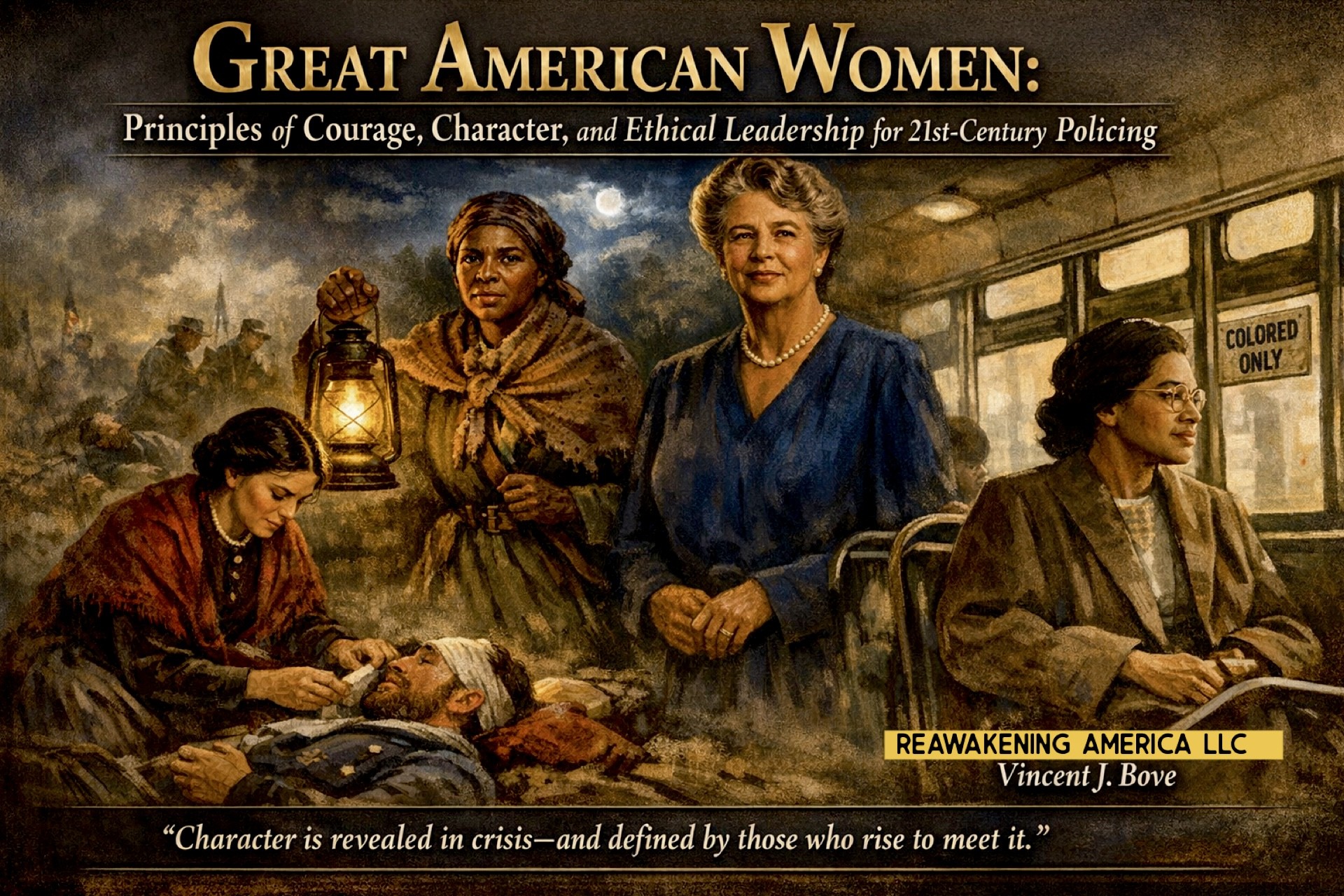
We now continue that tradition by turning to the lives of four great American women—whose courage, conviction, compassion, and leadership remain inseparable from the ideals of American policing and the enduring mission to protect and serve.
Harriet Tubman (c. 1822–1913)
Harriet Tubman was born into slavery, escaped to freedom, and then repeatedly returned to lead others out of bondage through the Underground Railroad. With extraordinary courage and unwavering resolve, she guided men, women, and children to safety while facing constant danger and the threat of capture. During the Civil War, she also served the Union as a scout and nurse, further demonstrating her commitment to mission and service. Reflecting her moral clarity, Tubman stated: “I had reasoned this out in my mind; there was one of two things I had a right to—liberty or death; if I could not have one, I would have the other.”
For today’s law enforcement professional, her life reflects a foundational principle: leadership demands courage under pressure, clarity of mission, and an unwavering commitment to do what is right, regardless of personal risk.
Clara Barton (1821–1912)
Clara Barton was known as the “Angel of the Battlefield” and provided care to wounded soldiers during the Civil War, often working in dangerous and demanding conditions across multiple engagements. She brought supplies to the front lines and tended to the injured with unwavering dedication, standing in the midst of suffering to restore order, dignity, and hope. Reflecting on her service, Barton wrote: “I may be compelled to face danger, but never fear it, and while our soldiers can stand and fight, I can stand and feed and nurse them.”
Her efforts later led to the founding of the American Red Cross, establishing a lasting framework for humanitarian relief in times of crisis. Clara Barton represents the Wounded Protector™—the one who does not turn away from suffering, but moves toward it with purpose and compassion.
For today’s law enforcement professional, her life affirms a critical principle: the responsibility to protect extends beyond confronting danger—it includes caring for those affected by it, recognizing that true leadership requires both strength and compassion.
Eleanor Roosevelt (1884–1962)
Eleanor Roosevelt, as chronicled in No Ordinary Time by Doris Kearns Goodwin, redefined the role of First Lady through active leadership during World War II, engaging directly with citizens and visiting American troops abroad. She demonstrated a consistent presence during a time of national uncertainty, using her voice and influence to promote dignity, service, and responsibility. Her leadership was not rooted in position alone, but in a deep commitment to others. She expressed this clearly: “Do what you feel in your heart to be right—for you’ll be criticized anyway.”

For today’s law enforcement professional, her example reinforces a critical principle: leadership is not confined to rank or title—it is demonstrated through presence, engagement, and an unwavering respect for the dignity of every individual.
Rosa Parks (1913–2005)
Rosa Parks became a defining figure in American history through her quiet but resolute stand against segregation on a Montgomery bus in December 1955. Her refusal was not an act of impulse, but one of disciplined conviction, rooted in a deep commitment to justice and human dignity. As documented in His Truth Is Marching On (pp. 38–40), Parks was arrested, booked, and fingerprinted—her calm resistance carrying real and personal consequences that would ignite the Montgomery Bus Boycott and help shape the Civil Rights Movement. Reflecting her purpose, Parks stated: “I would like to be remembered as a person who wanted to be free… so other people would be also free.”
As I reflected in earlier writing nearly two decades ago in my article titled Rosa Parks: Enduring Icon of Leadership, Rosa Parks was not simply a participant in history—she was a sentinel of justice, demonstrating that true leadership is not loud or reactive, but steady, principled, and unwavering. A photograph from that period captures her alongside Eleanor Roosevelt at a 1956 civil rights rally, revealing more than a shared moment—it reflects a convergence of ethical leadership across time, united by an unwavering commitment to character, dignity, and what is right.
For today’s law enforcement professional, her example affirms a critical principle: ethical leadership requires moral clarity, disciplined restraint, and the courage to stand firm in what is right, even under pressure.
Final Reflection: Character Must Rise
The lives of Harriet Tubman, Rosa Parks, Clara Barton, and Eleanor Roosevelt reflect more than moments in history—they embody enduring principles of courage, character, compassion, and ethical leadership. Though separated by time and circumstance, their lives represent a convergence of moral strength, anchored in an unwavering commitment to what is right.
For the law enforcement profession, this is more than reflection—it is a call. Policing in America is a privileged responsibility, entrusted to men and women who stand at the intersection of order and chaos, justice and humanity. In such a profession, character is not optional—it is essential.
America has faced defining moments before, and in each, character has risen. It rose in the lives of these women, just as it must rise today. To protect and serve is not merely a duty—it is a moral commitment to do what is right for the communities we serve and for the nation itself.
Now, as in generations past, the call is clear: to stand firm, vigilant, and confident that through ethical leadership, moral courage, and unwavering character, the profession will not only endure—but lead.
And in doing so, it will help guide this nation toward the light of an Ethical Renaissance™.
Selected References and Resources
Foundational Works (Author’s Personal Library)
The Soul of America: The Battle for Our Better Angels. Jon Meacham. New York: Random House, 2018.
His Truth Is Marching On: John Lewis and the Power of Hope. Jon Meacham. New York: Random House, 2020. (See pp. 38–40)
No Ordinary Time: Franklin and Eleanor Roosevelt—The Home Front in World War II. Doris Kearns Goodwin. New York: Simon & Schuster, 1994.
Author’s Prior Work
Rosa Parks: Enduring Icon of Leadership. Vincent J. Bove. (Available in public record online)
Related Law Officer Articles
The Soul of the Profession: The Police at America’s Head-On Collision of Violence and Character.
https://www.lawofficer.com/the-soul-of-the-profession-police-violence-character/
The Quiet Police Crisis: Emotional Fortitude and the Strength to Protect the Protector.
https://www.lawofficer.com/quiet-police-crisis-emotional-fortitude/
Principles of American Policing™ for 21st-Century Law Enforcement.
Principles of American Policing™ for 21st-Century Law Enforcement
Complete Law Officer Chronicles by Vincent J. Bove
https://www.lawofficer.com/author/vbove/