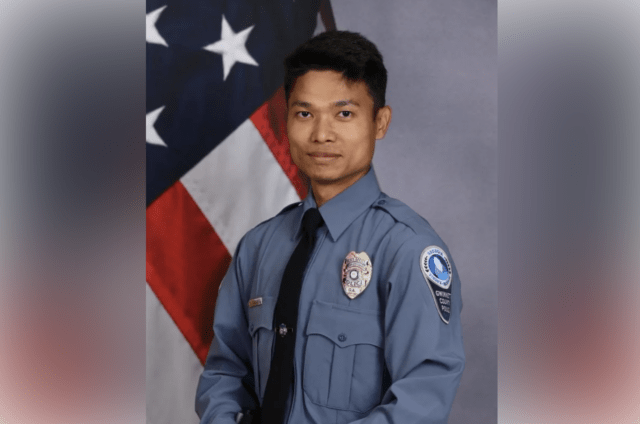
Georgia – The Stone Mountain hotel shooting that killed a Gwinnett County officer began as a report of credit card fraud at a Holiday Inn Express. The Georgia officer killed occurred after the encounter turned violent inside a hotel room on Sunday morning.
According to the Georgia Bureau of Investigation, two Gwinnett County Police Department officers responded on February 1, 2026, to the Holiday Inn Express at about 7:55 a.m. The call was tied to an allegation of credit card theft after a person in South Carolina reported their card had been fraudulently used at the hotel.
Investigators say the officers spoke with the front desk manager, who told them the room was being rented to Kevin Andrews. The officers went to Andrews’ room, made contact, and spoke with him about the reported fraudulent card use. The suspect reportedly greeted the officers and invited them into the room.
 The officers learned Andrews had an active Failure to Appear warrant out of DeKalb County and attempted to arrest him. Investigators say Andrews pulled out a handgun and fired, striking both officers. One officer returned fire, and additional officers responded to the scene.
Both officers were taken to the hospital, where one was pronounced dead, and the other underwent surgery in critical condition. Andrews was also taken to the hospital with a gunshot wound and was described as stable.
Georgia Officer Killed
The officer killed was identified as Pradeep Tamang. A second officer, identified as David M. Reed, was reported seriously injured.
Later the same day, the GBI announced Andrews had been charged with malice murder, felony murder, two counts of aggravated assault upon a public safety officer, and possession of a firearm by a convicted felon.
Investigators have not publicly released a full timeline of the moments inside the room, including precise positioning, the sequence of commands, or how quickly gunfire began after the attempted arrest. Authorities also have not released video evidence, forensic details, or a complete accounting of the weapon involved beyond describing it as a handgun.

Field Lessons are offered strictly as general, industry-standard reminders drawn from common safety practices and typical policy considerations. They are not based on any inside knowledge of this specific incident, do not presume what actions were taken, and should not be interpreted as commentary on the decisions made at the scene.
-
A fraud call in the morning is not a typical call that would involve violence. This is why an understanding of behavior threat detection is vital and applicable in all situations. Predicting violence involves the suspect’s behavior prior to the violence and the actions officers take when that behavior is observed.
-
Prioritize positioning and angles at doorways and thresholds to reduce exposure and crossfire risk.
-
Entering a home or hotel room of another places a disadvantage on officers. The suspect knows the environment, so it’s vital that officers control the suspect within it.
-
One technique to determine the suspect’s motive is to ask them to step out of the room upon contact. Refusal, arguing, non-compliance, etc., should be taken seriously. It is at this moment that pre-incident behavioral cues will surface.
Dr. Travis Yates has pioneered a behavioral risk framework to help officers and leaders identify, assess, and articulate risk in rapidly evolving, uncertain situations. Find out more about the FOCUS Behavioral Risk Framework.