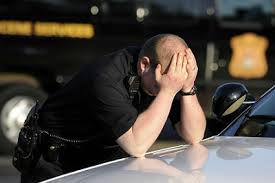
Police suicide is never easy to talk about, but with the two-year anniversary of the Hurricane Katrina-related suicides of New Orleans police Sergeant Paul Accardo and Officer Lawrence Celestine approaching, the issue needs some discussion. Accardo was one of the spokespersons for New Orleans Police Department in the early days of Katrina. Constant press coverage of the 1,500 officer agency and its performance in the days following the storm put a tremendous strain on the sergeant, who had worked with the public affairs unit for roughly four years, according to his chief.
But what the world didn’t know was that Accardo himself was a victim of Katrina, having lost almost everything he owned during the storm, including his home and all his clothes. The emotional end appeared near for the veteran officer while he took notes in preparation for another of his almost constant press appearances, this time at the scene of where an NOPD officer had been shot. Statements of some other officers who were present indicated Accardo seemed distant and detached while on scene. His death from a self-inflicted gunshot wound to the head followed Lawrence Celestine’s suicide by only one day.
Some Facts
Some studies indicate police officers are eight times more likely to kill themselves than to die by felonious assault. Other experts report that police officers have a three times greater chance of taking their own life than to die in a job-related accident, and that they are twice as likely to commit suicide as other municipal workers. The National Police Suicide Foundation out of Pasadena, Md., reports that two to three times as many cops die by their own hand than get killed on the job. We probably all know of at least one cop close to us who took their own life. My former FTO was a victim of suicide.
Police suicides have been the focus of intense study by mental-health professionals for about a decade now. If you ve been on the job for more than a few years, you ll probably remember back in the mid-1990s when more than a dozen NYPD officers took their own lives in one year. A subsequent study commissioned by the NYPD revealed that within the 30,000-plus officer agency, the suicide rate was about 30 officers per 100,000 when the national average among the civilian population was 12 per 100,000. And it would seem this issue remains only a U.S. phenomenon. In London, for example, the police suicide rate is only about six per 100,000.
Experts say there are many reasons for these startling statistics. The most obvious would be easy access to firearms, but cops seem to kill themselves at a greater rate than civilians who own guns. A more accurate cause might be the nature of our jobs. Police officers are exposed to the worst society has to offer child abuse, brutal assaults, violent homicides, death, dying and misery on an almost daily basis. Other experts cite the police bureaucracy and the criminal justice system as a whole, which create excessive stress. Other mental-health professionals note the social strain of the job citizens view us differently because we wear a badge and carry a gun.
Marital difficulties inherent with law enforcement, such as shift work, odd hours and unpredictable overtime must remain near the top of the list, as do alcohol problems. We all know booze and gunpowder don t mix real well. A lack of officer control over the job and their own personal lives has also been cited as a significant cause by officers who have contemplated suicide but didn t follow through.
The negative police image portrayed in the media today with every action (large or small) scrutinized by the 24/7 cable news channels, and the inevitable rush to judgment by talking-head experts, can certainly add to the stress of the street. Many experts list impending retirement from police work and the uncertainty of what the future holds as a significant factor. But perhaps the biggest factor, according to some experts, is that cops very often don t feel they have any place to turn for confidential help with personal or professional problems. Fortunately, in many progressive agencies, that s changing.
Danger Signs
What are some of the danger cues that an officer may be slipping emotionally? Some warning signs might include compulsive drinking or dependency on meds, or distancing or isolating themselves from family, friends and social events. If an officer makes a determined effort to avoid their usual recreational activities or neglects their regular workouts, that can also be a clue. Extreme emotional outbursts both on and off the job or blowing up over nothing could also be a warning sign, along with recent financial problems.
Solutions
First, if you know or even suspect a brother or sister officer is contemplating suicide, be direct and confront that officer face to face. Come right out and ask, Are you thinking of killing yourself? If they aren t, they ll probably deny it emphatically. If they are, you ll probably know it by their response, a shrug or the look in their eyes. If you do receive a positive reply, you ve got a dilemma. If you go to the job, the officer might get transferred and taken off the street, and they will inevitably lay the blame on you. However, if you don t do anything, they may go through with their plan.
The bottom line: You ve got to do something. You have an obligation to do whatever you can to get that officer some professional help. Tell their partner. Tell their spouse or significant other. Go to the job if you have to. Whatever you do, don t keep the secret to yourself. You must let someone else know, and you must call the local suicide hotline, the National Police Suicide Foundation or another resource to get some professional advice. Suicide is an occupational hazard in law enforcement. The numbers don t lie.
The good news is there are a lot of psychological resources for police officers today. The contact information for two of those resources, the National Police Suicide Foundation and the International Critical Incident Stress Foundation, is listed on the right.
That s it folks. I know this month s column is rather short compared to others, but the statistics and numbers really say it all. I urge you to reflect on what those figures represent. With the knowledge we are losing more officers annually from suicide than to felonious assaults or on-the-job accidents, we owe it to the profession to learn the causes, symptoms and solutions to this crisis. Keep the memories alive of Paul Accardo and Lawrence Celestine and all the other brother and sister officers across the country who died in this manner.
Epilogue
Two weeks after I completed this piece on police suicides and sent it in to Law Officer, I received word of another police suicide, this one close to home. Collier County (Fla.) Sheriff s Office Corporal Craig Marshall, age 34, was found at his Naples, Fla., home, dead from what was determined to be a self-inflicted gunshot wound.
Marshall had been under investigation by the sheriff s office for roughly three weeks after he reportedly was shot by a sniper while on duty in his squad car. A subsequent investigation determined the gunshot wound he sustained to his shoulder was, in fact, self-inflicted. A cry for help? Perhaps. We ll never know. But regardless, Marshall was fired for falsely reporting the sniper incident just two days before his body was discovered by family members.
Suicide Prevention Resources
National Police Suicide Foundation
Tel: 866/276-4615
E-mail: [email protected] (Robert E. Douglas, Jr., executive director)
International Critical Incident
Stress Foundation
Tel: 410/750-9600
www.icisf.org