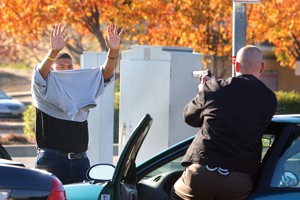

When it comes to engaging in interpersonal conflict, cops want to believe they know how the fight will start and finish, and how their opponent will engage.
Always having a plan of attack is sound. But we all need to remember that the fight will never progress according to plan so we all need to have contingencies. Making assumptions will put you at a disadvantage before the fight ever begins!
Over the years I’ve taught many courses and in these courses, students always share their plan of attack with me. This is true regardless of whether they are law enforcement or armed citizens. Most will say: “If someone kicks in my front door, I’m going to get my gun while my wife calls the cops.” Or, “If I roll on an active shooter call, I’ll clear my carbine from the rack before I arrive on the scene.” These plans will work fine provided that the suspect(s) performs exactly as visualized in the student’s mind. The problem: We have no idea what any criminal will do. As I’ve said many times before in this column, they don’t think like we do!
The truth: Good guys and gals don’t have the experience to “think” like the bad guys. Why? Simple: We haven’t had the same life experiences.
Sometimes I question the tactics and techniques developed during interactive simunitions or airsoft training because the people playing criminals are cops or legally armed citizens, and they’ll behave in scenarios as such—not as a criminal would. In the examples above, what if the suspect comes through the back door instead of the front? What if the officer wrecks his cruiser while responding because his attention was directed at the carbine? It’s been said many times before: No good plan survives first contact with the enemy.
It’s certainly important to “war game” any plan, but it’s also imperative to have several plans. When plan A doesn’t work (and it probably won’t), we move to plan B, and if that fails, plan C is instituted without hesitation. Yes, it’s a tall order, but it’s essential. Attempt to consider all the possible variables in conflict and then plan for the worst possible situation. That way, when things don’t go as planned (they won’t), you’re still prepared with other options.

The Unexpected
It’s always possible something will happen that we never considered. You can think a problem through a million ways—when, where, how and why—and still not come up with all the potential situations that will occur during a fight. The harsh reality: You can’t possibly train for every potential situation you may face. This is why fundamental (I like to call them essential) skills should be practiced and mastered, because the person who will win in armed conflict is the one who can adapt to the threat.
Threats will always be situationally dependent and we need to embrace this reality. Practice the critical skills—movement, communication, accurate shooting, manipulation of the weapon and using cover and concealment—so that you can run on autopilot in any type of attack. If you have to orient to the situation, you might not respond at all. Doing so also prepares us for the unexpected, which is darn near guaranteed in any fight.
You should also never make assumptions regarding how an attacker will respond to your actions. Again, they don’t think like we do, so how could you possibly think such assumptions would be correct? The only control you’ll have over the situation you’re facing is what you will do—there’s no way to know your attacker’s actions.
It would be great if suspects always responded to verbal commands or immediately became incapacitated from one round fired from our service pistol, but all who are reading this should know such things are fantasy. Handguns suck as “man stoppers,” which is why we carry carbines and shotguns in our cruisers. The miss ratio in police shootings is also quite high, so the idea of one round fired and ending a fight might be the biggest fantasy we face in our profession.
Armed conflict is rapidly evolving, ever changing and certainly unpredictable. Even if we do have plans A, B and C, the suspect(s) might do something that makes us skip over plan B to move to plan C and then maybe return to B. Who knows! Clint Eastwood was certainly correct in the movie Heartbreak Ridge: We must be prepared to “improvise, adapt and overcome.”
Train to Win
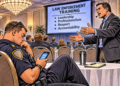
It’s been my experience that a sizeable percentage of officers dread in-service training—in some cases, they even think it’s stupid. But it’s this training that prepares each officer for the conflicts they’re likely to face. Your job as a LEO is to seek out law breakers and place yourself between the criminal and the citizens they prey upon.
With this in mind, what are the chances you’ll become involved in a serious, life-threatening conflict during your career? Will you be ready? The search and introduction of new techniques and the skill building via repetition during in-service training equips all of us to respond effectively in these conflicts. If we haven’t mastered the tactics and techniques needed to fight these threats, it’s very possible we’ll be overcome, injured or even killed—and that’s unacceptable.
There are many aspects of armed conflict that are essential: dynamic but meaningful movement, communicating threats to fellow officers, deciding what to use as cover, accurate shooting as required and instant decision-making skills. If your personal practice or in-service training doesn’t include these critical components, it’ll be all but impossible to perform them under the stress and duress of armed conflict.
Keep in mind: There’s no such thing as a fair fight. The difference between competition and combat is rules. If there are rules governing what transpires, we call that a sport. But in a fight, if you aren’t cheating, you aren’t trying hard enough to win! Use every skill, tactic or technique you possess to your advantage.
In his book The Principles of Personal Defense Col. Jeff Cooper outlined what was needed to prevail in armed conflict: alertness, decisiveness, aggressiveness, speed, coolness, ruthlessness and surprise, the most critical component. Erich Hartmann, the Nazi Ace who killed 352 enemy pilots during 1,000 combat missions, laid out the importance of surprise when he said, “The man who sees the other first already has half the victory!” You can’t fight what you can’t see.
In reality, combat isn’t just about accurate shooting, movement, tactics or techniques. It’s about continuous problem solving under the stress and duress of someone trying to do you serious physical harm, which could result in your death. It’s about one fast, crisis-level decision after another.
• Which tactic or technique should I use?
• Should I move, stay, shoot, reload, take cover, retreat or engage?
• Are there non-hostiles in the area?
• Am I justified in shooting?
• Where are my fellow officers?
• Where is the suspect?
These decisions will arrive in rapid fire and the truth is you won’t move through “observe, orient, decide and act” as smoothly as water being poured from a pitcher. If you can’t see, then you might very well freeze in the orientation phase. Considering all of the information that’s pouring in and colliding with personal bias, reluctance and disbelief, it’s a wonder orientation can occur at all! But it can and does for the truly prepared.
Final Notes
Your tactics and techniques must be “trained in” so that you can run on autopilot during a conflict. Additionally, it’s a very good idea to keep your skill set(s) as simple as possible. Simple techniques might not look as cool as others, but “tacti-cool” seldom wins the fight.
In the end, it’s not about how tight a group you can shoot on the range or if you can win the local shooting competition, it’s about whether or not you can hold yourself together during the most stressful event you’ll ever experience and take the actions needed to prevail—not just survive. A quote I’ve used many times in my column sums it up: “Right now someone is training so that when they meet you, they beat you. Train hard and stay on guard.”