First the Federal Bureau of Investigation brought forth Drugfire. It was a wonderful concept–a computer based system, incorporating video to input images of stria from fired cartridge cases and bullets, with mathematical algorithms to match potential identifications among them. The FBI developed and had Drugfire manufactured and placed among the firearm sections of the nation's crime labs. For cartridge casings, it worked well enough, but for projectiles, it used a complex, time intensive procedure that became self defeating.
At the same time, the Bureau of Alcohol, Tobacco, and Firearms bought into IBIS, an off the shelf system developed by Forensic Technology, Inc., a Canadian firm that had developed a system that was much more user-friendly than Drugfire. IBIS had already become an international standard, being adopted by many crime labs around the world.
When Congress recognized the competition between the two systems, and their inability to interchange information, it entered the fray. Congress acted, choosing to fund IBIS as the National Integrated Ballistics Identification Network (NIBIN). It then split responsibility for the network between the two agencies–ATF providing the hands-on support and placement of units, and the FBI providing national network support, similar to its CODIS network for DNA information exchange.
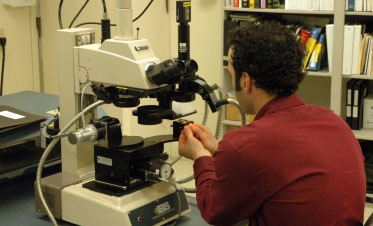
Currently, 174 crime labs across the United States have NIBIN installed. A total of 204 units are installed, as some major labs' workload are more than can be accommodated by a single station. Many labs have established dedicated NIBIN tech positions; usually a firearms-proficient individual who conducts basic firearm examinations (information collection, function and safety testing), and who is further trained at FTI's training facilities in Largo, Florida as an IBIS technician, understanding the proper collection of images and use of the system to compare data and correlate results.
NIBIN's network is organized along regional boundaries. The nation is divided into 15 regions, ranging from a one state region (Florida) through regions made up of five states (the upper mid west and also the Rocky Mountain states). Within any region, there is a control point, a single lab that functions as the nexus for all regional functions. Thus all data generated by each lab is transmitted to the controlling lab, which stores all information in its database. Each lab maintains its own database, downloads its data to the regional hub, and runs regional searches against the hub's database. Should an agency need to compare data across regional lines, the hub can arrange this, so that the Florida region can then compare data with the Georgia-Alabama region, or even communicate with the hub for New York should an investigator have reason to suspect there is an interchange of evidence from there. Because IBIS is installed in 39 different nations, data on cases can even be exchanged internationally–a great tool when facing terrorists, organized criminals, or a criminal with wings on (or under) his feet.
An example of the use of this as a communications system is given at thewww.NIBIN.govweb site. In 1999 North Carolina authorities investigated a homicide, identifying a suspect. Warrants were issued, with special attention in the New York City area. In 2000 NYPD apprehended the individual, and found him to be armed. Once it would have required a test fire to be shipped to North Carolina, comparisons made, and if positive, the evidence then submitted interstate. With NIBIN, NYPD entered the firearm into the system, North Carolina had a comparison effected within NIBIN, an examiner established that the image of the test firing matched the image of the crime evidence, and the evidence could be submitted to North Carolina, saving considerable time and effort, and permitting the prosecutors in North Carolina to know early on that they had an even stronger case.
Local emphasis
NIBIN can only work with the full cooperation of the entire law enforcement community. It is built from bottom up–the street cop, the detective, the crime scene investigator are the basic source of entry material. Most labs attempt to enter all firearms encountered into NIBIN. Whether seized under domestic abuse injunctions, found as abandoned property, agency inventory firearms, or firearms recovered in known criminal circumstances, they will be examined, test fired, and entered into the data base. Similarly, every bullet or cartridge case recovered, no matter what the offense, is entered. Homicides, aggravated assault, drive by shooting, vandalism, hunting and game violations, all would be entered into the database. From this comes the ability to match–match firearms to offenses, and also match offenses together as involving singular firearms.
In the early days, "matches" were counted for any case where two pieces of evidence were matched together. As time has passed, the definition has been changed, so that a match now means evidence from different cases is matched. Where once a bullet from a shooting and the firearm recovered in that shooting would be matched as a database hit, that no longer counts. Instead, when that case is cleared because a firearm recovered in an unrelated matter is matched to the recovered casings on the scene, or when that case is tied to an unrelated case, that becomes a hit.
Mark Chapman is the lead firearms examiner for the Indian River Regional Crime Lab in Ft. Pierce, FL. He emphasizes the need for all evidence–bullets, casings, and firearms–to be submitted to the lab and to then be entered into NIBIN. He notes that, without this being done, major holes appear in the system through which solid hits can disappear. But, as he noted, when it works, it works well.
Chapman related two incidents. In the first, the Ft. Pierce Police Department had submitted evidence from a drive by shooting of a dwelling–no injuries, but evidence recovered. Later, in an unrelated incident, the St. Lucie County Sheriff's Office submitted a firearm recovered during a traffic stop. NIBIN matched the firearm to the previous shooting. In the second case, the Ft. Pierce police had submitted a bullet recovered from another shooting into a structure. Almost 12 months later, that agency submitted a revolver recovered in an unrelated case, and NIBIN matched those two cases together.
The value of NIBIN has, nationally, been two-fold. First, it allows the lab to conduct cold searches of evidence, and identify the responsible firearm, an impossibility before cyber-ballistic investigations came along. Secondly, it allows the matching of cases. This provides investigators the knowledge that they are working cases related, if not by shooter, at least by firearm, and especially when different investigators are involved, allows them to join forces and look for similarities among the cases. It has also been a tool that has shown that a much lower number of firearms have actually been responsible for series of crimes, information later borne out as investigations detailed how gangs pass a firearm about for their shootings.
Atwww.NIBIN.govis related a success story from Boston. In September, 2000 three firearms were seized during an arrest. Through NIBIN, these three firearms were related to 15 shootings that had occurred between 1999 and 2000, with 14 of the cases being connected to a single firearm.
NIBIN is a tool that helps us remove the criminal shooter from the street by both connecting incidents together and by tying firearms to those incidents. Its success depends upon active participation at all levels–the street where patrol, detectives, and evidence specialists can ensure that all firearms related evidence goes to the lab, the lab where all this evidence must be entered into the system, and the administrative level that both encourages continued cooperation and funds the manpower to ensure efficient NIBIN operations.