STATEMENT OF RECORD
On November 4, 2026, Vincent J. Bove and his wife visited Lower Manhattan, encountering places that illuminate the American journey from the birth of the republic to the sacrifices that have shaped its history. From the National September 11 Memorial to Federal Hall, St. Paul’s Chapel, Trinity Church, and the historic courthouses of Foley Square, the visit brought into focus the ideals of liberty, constitutional government, justice, and public service upon which the nation was founded.
Drawing upon his longstanding work in ethical leadership, law enforcement morale, emotional fortitude, and 21st-century policing, Bove reflects on the enduring obligation of the American police profession to uphold these founding principles. The article explores the connection between the nation’s historical legacy and the character, integrity, and constitutional responsibilities of those entrusted with protecting its people.
Remembrance, Sacrifice, and the Human Cost of Service
Our day began at the National September 11 Memorial, where Lily and I paused in prayer for the souls of those who lost their lives. With November marking the Month of All Souls, the visit carried a particular significance, bringing remembrance, gratitude, and reflection into the heart of our encounter with American history.
The experience was deeply personal. On September 11, 2001, I watched the Twin Towers collapse from my office in Hackensack, New Jersey. I also knew people whose lives were taken that day. Returning to the site, standing beside the memorial pools, and reading the names brought the human consequences of that morning into sharp focus once again.

Credit: Reawakening America LLC
Earlier in our visit, the Oculus had offered us an unexpected moment of beauty. A piano stood in the center of its magnificent main floor, inviting visitors to sit and play. I encouraged Lily to take a moment at the keyboard and fill the space with music. She chose Ave Maria. As its melody resonated throughout the Oculus, I walked slowly around the main floor, filming the moment for our family. People passing through on their busy days began to pause, listen, and take photographs. For a few moments, the movement of the city gave way to music, reflection, and a shared human experience. That unexpected encounter helped set the tone for a day shaped by remembrance, gratitude, and our love for America.
For law enforcement, September 11 is not simply a date in our national history. It is an enduring testament to the courage, sacrifice, and commitment demonstrated by police officers, firefighters, emergency personnel, and ordinary citizens who answered the call in the face of unimaginable danger.
It also reminds us that the responsibility to protect does not end when an emergency is over. We must continue to care for those who serve, recognize the burdens they carry, and strengthen the cultures and leadership structures that sustain them.
The legacy of September 11 should challenge every police leader to consider not only how an agency responds to a crisis, but how it prepares, supports, and protects its own people every day. The commitment to those who serve must be enduring, grounded in ethical leadership, genuine human connection, and a recognition of the sacrifices made in the performance of duty.
Federal Hall: The Birth of the Presidency and the Foundations of Public Trust
Standing before Federal Hall on Wall Street, one encounters a defining moment in the American experiment. It was here, on April 30, 1789, that George Washington took the oath of office as the first president of the United States. The location represents more than the beginning of a presidency. It embodies the establishment of a constitutional republic founded upon the principles of liberty, accountability, and the rule of law.
The significance of Federal Hall becomes even more compelling when considered alongside its surroundings. Just steps away stands the New York Stock Exchange, a symbol of American enterprise, commerce, and economic opportunity. The proximity of these institutions reflects the interconnected foundations of a functioning republic: government, economic freedom, and the public trust upon which both depend.
As Lily and I continued our walk toward Trinity Church, the experience became a journey through the enduring institutions that have shaped American life. The financial center of Wall Street, the historic seat of presidential authority, and the spiritual presence of Trinity Church occupy a remarkably concentrated space in Lower Manhattan. Together, they invite reflection on the principles that sustain a free society and the responsibilities that accompany its privileges.
For the law enforcement profession, these principles carry particular weight. The authority entrusted to police officers derives from the constitutional framework established at the nation’s founding. That authority must be exercised with integrity, restraint, fairness, and an unwavering commitment to the public good. The history surrounding Federal Hall reminds us that legitimate authority is inseparable from accountability—and that public trust is not inherited by an institution, but earned through the conduct of those who serve.
St. Paul’s Chapel: A Continuity of Service, Sacrifice, and Remembrance
Following our visit to the National September 11 Memorial & Museum, Lily and I continued to St. Paul’s Chapel, one of the most extraordinary historic sites in Lower Manhattan. Built in 1766, the chapel is closely associated with George Washington, who worshipped there following his inauguration as the first president of the United States in 1789. Its place in the nation’s beginnings would eventually become inseparable from another defining chapter in American history.
After September 11, 2001, St. Paul’s Chapel became a place of refuge and support for the police officers, firefighters, recovery workers, and other personnel laboring at Ground Zero. For eight months, volunteers provided meals, rest, medical assistance, and comfort to those working through exhausting and emotionally demanding conditions. The chapel, located just across the street from the World Trade Center site, became known as “The Little Chapel That Stood,” having survived the collapse of the Twin Towers without physical damage to the building.
The adjoining churchyard carries its own remarkable significance. As Lily and I walked among the historic gravestones, we encountered a sacred landscape of remembrance, surrounded by the unmistakable symbols of Lower Manhattan’s transformation. In the background stood the Oculus, the transportation hub and architectural centerpiece of the rebuilt World Trade Center complex, with One World Trade Center rising nearby. The juxtaposition was extraordinary: the resting places of earlier generations of Americans framed by the structures that represent the nation’s determination to rebuild following the devastation of September 11.
During the Month of All Souls, Lily and I spent time in prayer throughout the cemetery, remembering the early Americans buried there and those whose lives were taken on September 11. We eventually sat together in quiet reflection. The experience brought the history of the chapel, the sacrifices of those who served, and the enduring responsibility to remember the dead into a deeply personal focus.
There is a powerful continuity between these chapters of American history. The generation that helped establish the republic and the generation that responded to September 11 were separated by centuries, yet both were connected by a commitment to service and something greater than themselves. St. Paul’s Chapel stands as a witness to that enduring spirit.
For today’s law enforcement profession, St. Paul’s offers a lesson that deserves continued attention: those who protect others also need places, people, and institutions that protect and sustain them. The chapel’s service to first responders after September 11 was not simply an act of hospitality. It was an expression of the profound responsibility a community bears toward those who place themselves in harm’s way.
Officer wellness, emotional fortitude, peer support, and suicide prevention cannot be treated as secondary considerations. They are essential components of a healthy and effective law enforcement culture. A department’s commitment to its officers must extend beyond the demands of the job. It must recognize the human beings behind the uniforms, acknowledge the burdens they carry, and provide the support necessary to sustain them throughout their lives of service.
## The Administration Of Justice: A Foundation Of Legitimacy
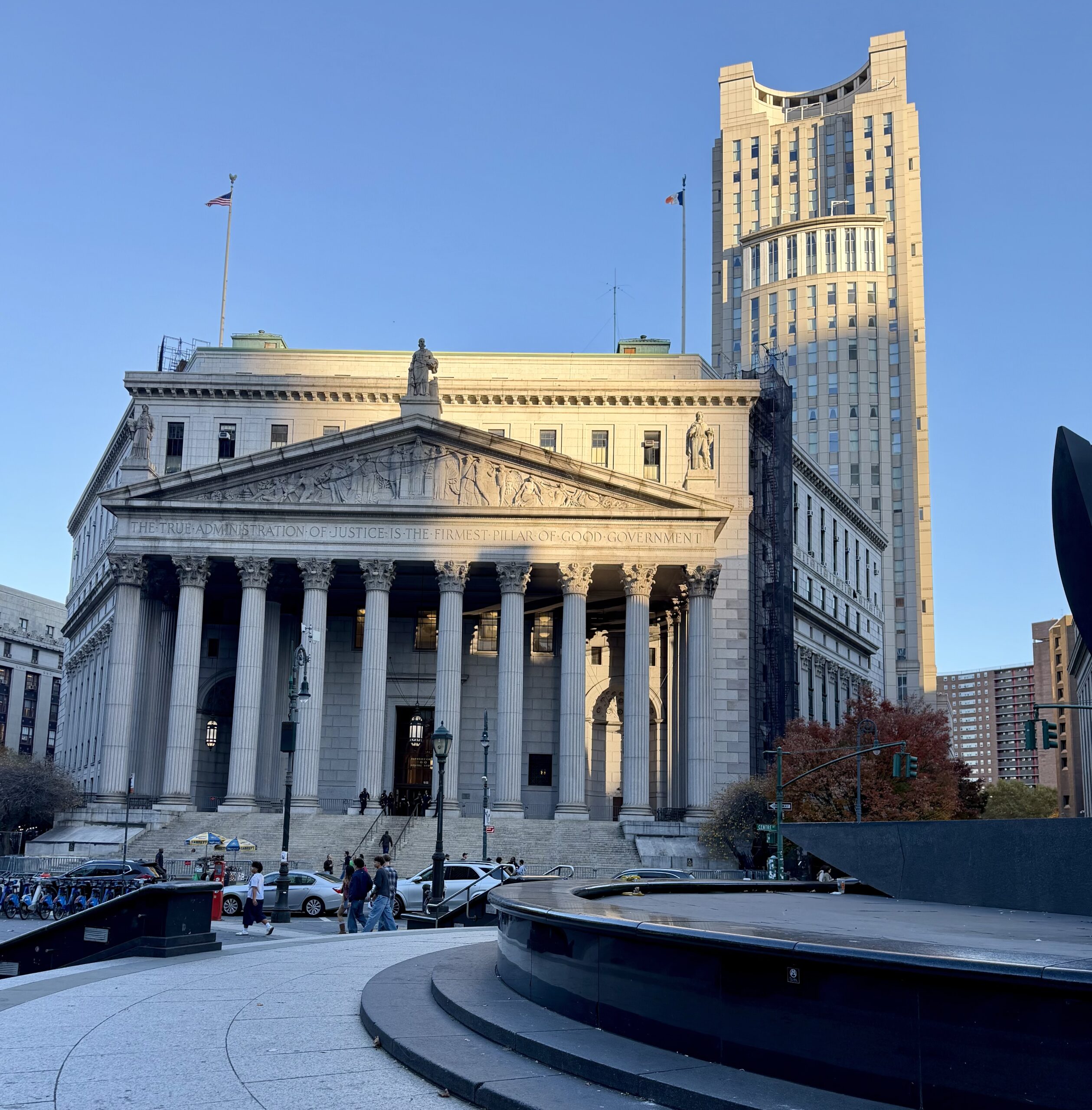
Our walk also brought us to the historic courthouses of Foley Square, where the architecture and inscriptions reflect the enduring principles of American justice. One inscription on the New York County Supreme Court building reads:
*“The true administration of justice is the firmest pillar of good government.”*
These words, drawn from a letter George Washington wrote to the Attorney General in 1789, capture a fundamental principle of constitutional democracy. <Cite refs={[“turn898327search0”]}/>
Law enforcement and the courts occupy distinct roles, but both are essential to the administration of justice. Police officers are entrusted with enforcing the law, protecting constitutional rights, preserving public order, and bringing professionalism and integrity to their encounters with the public.
The legitimacy of policing depends not simply upon the authority granted to officers, but upon how that authority is exercised.
Every encounter matters. A traffic stop, a domestic violence response, an arrest, a conversation with a young person, or an officer’s assistance to someone in distress can influence how an individual views the police and the justice system. The public does not evaluate policing solely through policy statements or institutional announcements. People experience the profession through the conduct of individual officers.
This is why ethical leadership must reach beyond the executive office and become part of an organization’s daily culture. Leadership is demonstrated not only through decisions made at the highest levels, but through the standards, expectations, and conduct reinforced throughout every rank.
The nearby Thurgood Marshall United States Courthouse offered another reminder of the importance of the federal judiciary and the constitutional framework that protects individual rights. Its presence, together with the sculpture *The Triumph of the Human Spirit*, invites reflection on the continuing pursuit of fairness and human dignity. The promise of American justice has not always been equally realized, and its fulfillment remains an enduring responsibility of every generation.
For those entrusted with public service, the historic institutions of Foley Square offer a compelling reminder: the administration of justice is not merely a legal function. It is a moral responsibility that demands integrity, accountability, and an unwavering commitment to the principles that sustain a free society.
The Principles Must Live Through Each Generation
The visit also included Trinity Church, where George Washington worshipped during his presidency, and the New York Stock Exchange, a symbol of American enterprise and economic life.
Together with Federal Hall, the historic courthouses of Foley Square, and the memorials of Lower Manhattan, these landmarks represent important dimensions of the nation: faith, civic responsibility, commerce, justice, and constitutional government.
Yet the enduring strength of these institutions depends upon something more than their physical presence. It depends upon the principles and character of the people who sustain them.
That observation brings us back to the central responsibility of modern policing.
The American police officer is not simply an enforcer of statutes. The officer is a constitutional public servant, entrusted with authority that must be exercised with courage, fairness, discipline, compassion, and restraint.

Credit: Vincent J. Bove for Reawakening America LLC
The profession needs leaders who understand that morale is built through respect, that public trust is earned through conduct, and that accountability strengthens rather than diminishes an institution. It needs officers who recognize that every encounter is an opportunity to demonstrate professionalism and humanity.
These are not new ideas. They are enduring principles that must be renewed in every generation.
In my previous Law Officer writings on George Washington, the Founding Fathers, and the defining periods of American history, I have explored the relationship between the nation’s past and the leadership challenges confronting 21st-century policing. This visit brought those themes together in a particularly personal way.
The places themselves cannot provide all the answers. But they can remind us of the questions we must continue to ask:
Are we exercising authority with integrity? Are we treating people with dignity? Are we preparing our officers to meet the emotional and ethical demands of their profession? Are our leaders setting the example expected of those entrusted with public service?
And perhaps most importantly, are we preserving the principles that give our profession its legitimacy?
An Obligation, Not Just a Legacy
Standing at the September 11 Memorial, walking through the grounds of St. Paul’s Chapel, and reflecting on Washington’s first presidential oath at Federal Hall, one message remained consistent.
America’s history is not simply something to commemorate. It is an inheritance accompanied by an obligation.
Those who established our republic entrusted future generations with the responsibility of preserving its principles. Those who protect our communities today have a particularly important role in that continuing promise.
The badge represents authority, but its greatest meaning is found in service. Its credibility rests upon character. Its legitimacy depends upon public trust.
The American spirit is sustained not merely by monuments, historic buildings, or the words of our Founders, but by the everyday conduct of people who choose to serve with honor.
History gives us perspective. Leadership gives us direction. Character gives our service its meaning.
The principles that helped establish America must continue to inform the character, leadership, and moral responsibilities of those entrusted with protecting it.
That is not simply a lesson from history. It is the continuing obligation of 21st-century policing.
The American Promise: A Responsibility Renewed
Walking through Lower Manhattan with Lily, I was reminded that the American story is not simply a record of historic buildings, monumental events, or the achievements of earlier generations. It is a living testament to the ideals of liberty, justice, sacrifice, and service that continue to shape our nation. From the birth of the republic at Federal Hall to the solemn remembrance of September 11, these places reveal both the extraordinary promise of America and the profound responsibility required to preserve it.
For those of us committed to the future of American policing, that responsibility is especially significant. The authority entrusted to police officers is inseparable from the constitutional principles that established our nation. Its legitimacy depends upon the character of those who exercise it, the integrity of their leadership, and the dignity with which they treat every person they encounter. The American police officer must remain a guardian of the law, a protector of constitutional rights, and a public servant whose conduct reflects the highest ideals of the republic.
The history encountered throughout Lower Manhattan reminds us that the principles of freedom and justice are never sustained by institutions alone. They endure through the courage, character, and commitment of the people who serve within them. Ethical leadership, law enforcement morale, emotional fortitude, and suicide prevention are not separate from this responsibility. They are essential to sustaining the human beings entrusted with protecting our communities.
The places we visited cannot speak, but their history speaks powerfully. They remind us of those who established the nation, those who sacrificed their lives in its defense, and those who continue to carry its responsibilities forward. Their legacy challenges every generation to renew its commitment to the principles that give America its meaning.
The American promise is not preserved by history alone. It is preserved through the choices we make, the leadership we demonstrate, and the humanity we bring to our service.
For those who wear the badge, the responsibility is clear: to honor the sacrifices of those who came before us, to uphold the Constitution in every encounter, and to ensure that the ideals upon which America was founded remain alive in the character and conduct of 21st-century policing.
SELECTED LAW OFFICER ARTICLES BY VINCENT J. BOVE
- The Sacredness of Service: Into the Heart of the NYPD and FDNY — 25 Years After September 11
Twenty-five years after September 11, remembrance becomes more than a ceremony—it becomes a living commitment to those who continue to serve. Through encounters with firefighters, police officers, families, and communities, Vincent J. Bove reflects on sacrifice, gratitude, and the enduring responsibility to protect those who protect us.
https://www.lawofficer.com/the-sacredness-of-service/
- Lives, Fortunes, and Sacred Honor
The Declaration of Independence was not simply a statement of freedom; it was a pledge of extraordinary personal sacrifice. Drawing lessons from the courage and convictions of the Founders, Bove explores how character, moral courage, and stewardship of the American legacy remain essential to ethical leadership and public service today.
https://www.lawofficer.com/lives-fortunes-and-sacred-honor/
- Leadership Principles from George Washington for 21st-Century Policing
George Washington’s legacy offers a timeless lesson: true leadership is measured not by the authority one holds, but by the integrity and restraint with which it is exercised. This reflection connects Washington’s example of duty, humility, and service to the ethical responsibilities of today’s law enforcement leaders.
https://www.lawofficer.com/leadership-principles-from-george-washington/
VINCENT J. BOVE — LAW OFFICER CHRONOLOGY
Explore the full chronology of Vincent J. Bove’s Law Officer articles, documenting an expanding body of work on ethical leadership, law enforcement morale, emotional fortitude, public trust, and the human responsibilities of 21st-century policing.
https://www.lawofficer.com/author/vbove/