Sometimes, leadership is measured by how well someone delivers a prepared speech. At other times, the moments that define leaders happen when information is incomplete and stress hijacks attention. In those cases, the difference between a capable leader and a dangerous one is readiness.
Decision Tactical understands that leadership rests on performance under pressure, which is why the company’s Co-founder and CEO, Remo Eyal, developed a groundbreaking simulator that adapts to the real training officers need, not one that requires trainees to conform to it. He firmly believes that if communities and organizations want better outcomes, they must prepare people the way reality tests them.
Performance under pressure requires decision-readiness training
Eyal argues that traditional approaches fall short because they fail to recreate what stress does to the human mind and body. “We couldn’t find a training simulator that truly put officers in the heat of the moment and made them forget that they were in a simulation,” he explains. “That suspension of belief allows us to see how someone actually performs under pressure and then to improve that performance.”
That statement is a challenge to leadership development as it has long been practiced. Leadership isn’t just what someone knows; it’s what they do and how they behave under stress. Many people have watched critical incidents unfold and wondered why a leader in a high-stakes situation didn’t simply choose the obvious option. That reaction reveals a common misunderstanding in which people sometimes assume the brain functions the same way under threat as it does in comfort. It doesn’t.
 Under stress, people freeze, narrow their focus, miss details, hesitate, or act impulsively. These reactions persist unless people build decision-making muscle memory through realistic repetition. In this context, leadership isn’t just a matter of character, but a matter of conditioning, practice, and preparation.
Decision Tactical’s work centers on decision-readiness: the ability to think, choose, communicate, and act while the nervous system is in overdrive. By adapting to training, the company’s simulator signals a new era of leadership development. It admits that if training isn’t sufficiently realistic to elicit genuine responses, it won’t build real capability.
A founder’s drive to build what matters
Before co-founding Decision Tactical, Eyal practiced law in Washington, DC, and later built and exited two successful businesses. Experience in both law and entrepreneurship developed his natural knack for unpacking complex problems and finding solutions. He obtained several US patents and contributed to research and consulting initiatives for the US Department of Energy and the National Renewable Energy Laboratory.
As someone who says he can’t ignore problems, Eyal has been drawn to innovation since childhood. “When I see something that isn’t working, I want to find out why,” he says. “I keep pulling at strings until I find a solution.”
After Eyal’s second successful exit in 2018, he began looking for a venture that would allow him to have a larger impact on people’s lives. When the nation suddenly ignited in debate around public safety and police encounters, he took on his next challenge.
“We spend a vast amount of time and energy analyzing the aftermath of people’s split-second decisions,” Eyal says, “but what are we doing to prepare them before they make those decisions?”
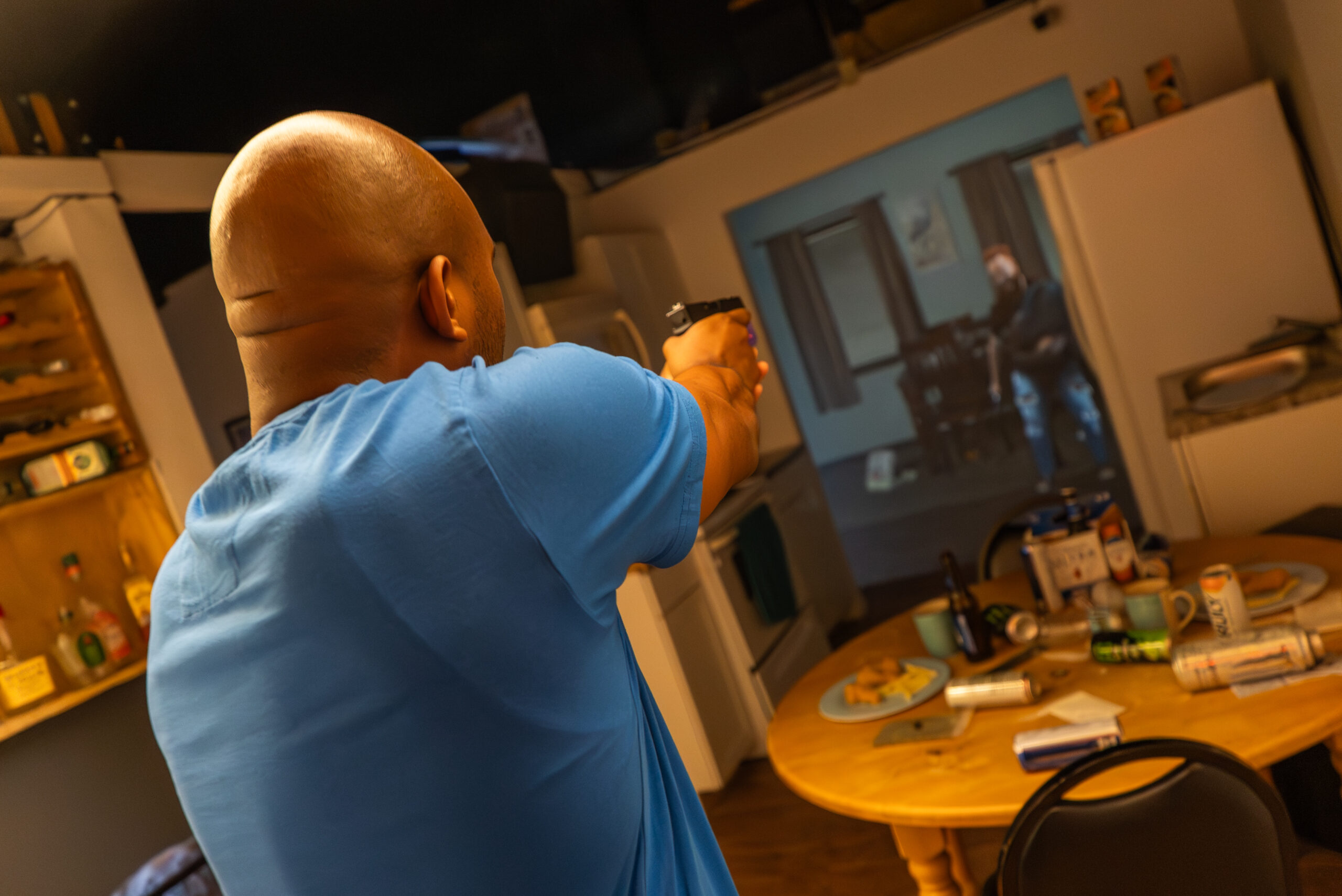
Eyal began listening to officers and looking closely at their training. On a visit to one of the largest law-enforcement agencies in Central Florida, he was surprised to see officers interact with a sophisticated half-a-million-dollar simulator as if it were a game. Some even went as far as to call it negative training because they felt they were practicing behavior they would want to avoid in a real encounter.
The officers explained that although the 300-degree simulator offered a wide range of vision, the camera moved while they stood still. If someone on the screen started shooting, they couldn’t move through the environment or take cover as they would in real life. The limited responses of the simulated characters also made the experience less realistic.
That’s when Eyal became convinced that simulators had to adapt to the training, not the trainee to the simulator. “When we couldn’t find that combination of realism and interaction that would allow officers to suspend belief, we built it,” he recalls. “We scrutinized every detail. Every aspect of the simulated surroundings and interactions had to work together to create a believable environment.”
Immersive decision-readiness training that mirrors real life
Decision Tactical’s approach is immersive, scenario-based training designed to feel like reality, because reality is where leaders are ultimately tested. Instead of forcing trainees to adapt to the limits of a fixed simulator with scripted outcomes, the company builds training environments that evolve and require observation, communication, restraint, and judgment. In that framework, leadership is the ability to make decisions while managing fear, ambiguity, and consequences.
“When officers told us they needed training that would allow them to move and communicate naturally, we took a hard look at what was getting in the way,” Eyal remembers. “Our facility is now a proving ground for solutions that help trainees suspend disbelief enough to become engaged in the scenario.”
 One such solution is Decision Tactical’s green-room system, which allows live actors to show up in the simulation alongside prerecorded characters. Because these actors carry on natural conversations, the trainees take every interaction seriously, enabling communication and de-escalation training that a prerecorded script could never anticipate.
Decision Tactical’s vision will soon bring its groundbreaking, adaptive training into real-world environments such as schools and other buildings. “Our latest solution, called Matrix, is especially exciting because it gives us a way to bring that approach to more people,” notes Eyal. “There are only so many officers who can travel to our facility. Helping agencies bring meaningful scenario training into their own environments is a much bigger opportunity.”
Bridging the trust gap through shared experience and decision-readiness training
Another dimension of Decision Tactical’s work is its potential to reduce the distance between professionals and the communities they serve. The facility opens its doors to civilians after hours, offering a rare opportunity for the public to experience how quickly situations evolve and how complex high-stakes decisions can be.
The company’s community-facing approach replaces assumptions with experience to build legitimacy through transparency and shared understanding. It also builds stronger leadership on both sides of the table.
“More than any title, we define leadership by the decisions people make under pressure and by the discipline to prepare long before the moment arrives,” concludes Eyal. “When the world demands accountability, competence, and humanity from leaders under intense pressure, decision-readiness has to be the standard.”