Statement of Record:
Early warning signs are not conclusions—they are opportunities for prevention. The responsible recognition, evaluation, and response to emerging behavioral indicators remains one of the most critical leadership obligations across education, community life, and the law enforcement profession.
Recognizing the Signals Before Crisis
Across schools, communities, relationships—and within the law enforcement profession itself—warning signs often emerge long before crisis erupts. These early indicators, best understood as “yellow flags,” call for awareness, thoughtful evaluation, and timely intervention before situations escalate into emergencies.
Drawing on more than twenty-five years of work in violence prevention, domestic violence awareness, and police resiliency initiatives, this article examines how recognizing these early signals enables educators, families, community leaders, and law enforcement professionals to respond with sound judgment—before tragedy occurs.
A Moment of Reflection
Before going further, we pause to remember the lives lost—and the families forever changed—by acts of violence in schools and communities across our nation.
Behind every headline are human stories: parents, children, teachers, and neighbors whose lives were taken or irrevocably altered. Their memory reminds us that the study of warning signs is not academic. It is a solemn responsibility.

Violence rarely emerges without warning. The challenge is recognizing the signals early enough to act.
The Warning Signs We Often Overlook
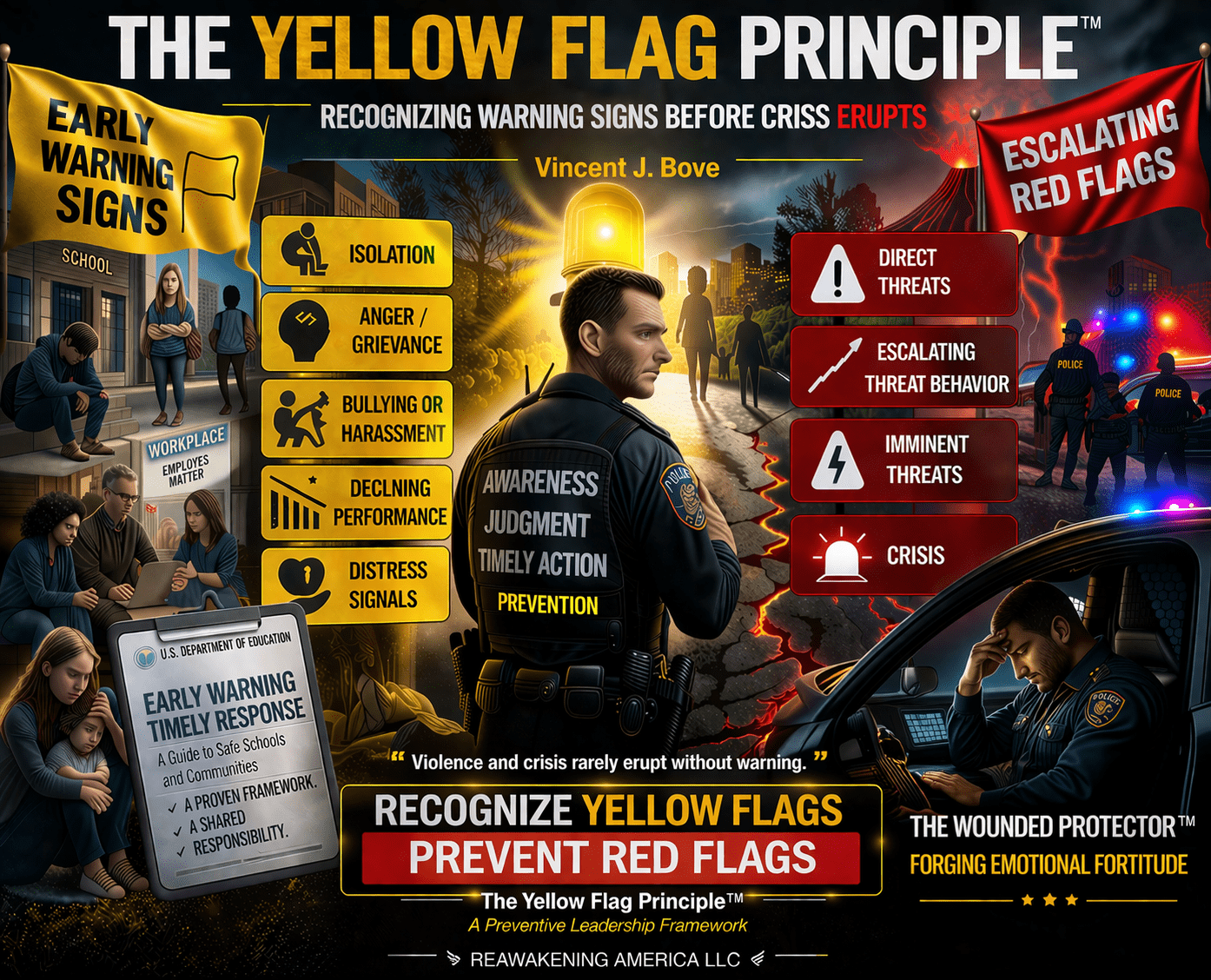
Public discussion frequently centers on “red flags”—clear indicators of serious and imminent danger. But long before those red flags appear, earlier signals often surface.
These are the yellow flags: subtle, developing indicators that something is wrong—signals that call for awareness, evaluation, and responsible attention.
Yellow flags are not conclusions. They are opportunities.
Over time, these signals have been observed across multiple domains: family environments, domestic violence situations, schools, workplace conflict, community tension, and law enforcement stress.
Recognizing them early creates space for intervention—before escalation narrows options.
An Authoritative Framework for Early Indicators
Extensive research on behavioral warning signs is outlined in the U.S. Department of Education guide: Early Warning, Timely Response: A Guide to Safe Schools.
Key indicators include:
- Social withdrawal
- Persistent feelings of isolation or rejection
- Victimization through bullying or violence
- Expressions of persecution or grievance
- Declining performance or engagement
- Violent themes in communication
- Uncontrolled anger
- Patterns of aggression
- Repeated disciplinary issues
- History of violent behavior
- Intolerance or prejudice
- Substance abuse
- Gang affiliation
- Access to weapons
- Threats of violence
No single factor predicts violence. Patterns, context, and leadership response matter.
These indicators extend far beyond schools and apply to domestic violence, workplace conflict, and community safety.
Hard Lessons from Tragedy
Over the past quarter century, a series of devastating acts of violence has repeatedly forced the nation to confront a difficult and enduring question: what warning signs were present before these tragedies occurred, and how were they understood?
From the Columbine High School massacre, to the Virginia Tech shooting, the Sandy Hook Elementary School shooting, the Stoneman Douglas High School shooting, and the Robb Elementary School shooting, each incident has left behind not only profound loss, but also a record—often incomplete, sometimes fragmented—of behaviors, communications, and circumstances that preceded the violence.

In the aftermath of these events, investigations and retrospective analyses have frequently revealed that indicators were present in advance. Yet recognition alone is insufficient. The central issue is not merely whether signals existed, but how they were interpreted, communicated, and acted upon within the structures of leadership responsible for response.
These tragedies underscore a sobering but essential truth: warning signs are often visible in hindsight, but prevention depends on the ability to recognize their significance in real time.
Leadership Responsibility
Warning signs rarely present themselves as a single, definitive indicator. More often, they emerge incrementally—through behavioral changes, expressions of distress, patterns of grievance, or subtle shifts in communication that, when viewed in isolation, may appear inconclusive.
However, when these elements are considered collectively, they may reveal a pattern that warrants careful evaluation.
Leadership, in this context, is not defined solely by authority, but by perception and judgment. It requires the capacity to:
- recognize emerging patterns across fragmented information,
- assess risk within context rather than in isolation, and
- respond in a manner that is both measured and decisive.
The failure to recognize or act upon early indicators is rarely the result of a single oversight. More often, it reflects gaps in communication, uncertainty in interpretation, or hesitation in decision-making. Effective leadership addresses these challenges by fostering awareness, encouraging information-sharing, and establishing a culture in which early concerns are taken seriously and evaluated responsibly.
Hope Through Early Recognition
The examination of warning signs is not intended to suggest that tragedy is inevitable. On the contrary, both research and professional experience affirm that early recognition creates meaningful opportunities for intervention.
When emerging indicators are identified and addressed with clarity and care, there remains the potential to:
- engage support systems,
- de-escalate developing situations, and
- redirect individuals toward safer outcomes.
In this sense, the Yellow Flag Principle™ is fundamentally a framework of prevention. It emphasizes that the period before escalation—when signals are present but conditions remain fluid—is the most critical window for effective response.
The presence of warning signs should not be viewed solely as a precursor to crisis, but as an opportunity for timely action grounded in awareness, communication, and sound judgment.
Lights On Before Crisis Erupts
Across more than twenty-five years of prevention work—beginning in the aftermath of the Columbine High School massacre—one lesson has remained clear: crisis rarely emerges without preceding indicators.
These indicators appear first in the ordinary dimensions of human experience—behavior, communication, emotional distress, and interpersonal conflict. They are the early signals that, when recognized and understood, create an opportunity for intervention before circumstances intensify.
For more than two decades, I have worked to emphasize this principle in schools, law enforcement settings, and communities across the country—encouraging leaders to “keep the lights on” before crisis erupts. That effort has included distributing thousands of copies of the U.S. Department of Education’s Early Warning, Timely Response: A Guide to Safe Schools, a foundational document that remains as relevant today as when it was first published. In many settings, I have held up that guide before audiences—only to find that many professionals confronting these challenges were unaware of its existence. Its message is clear: early recognition, communication, and coordinated response are essential to prevention.
Over time, research and guidance from the United States Secret Service National Threat Assessment Center have further reinforced this approach, consistently demonstrating that targeted violence is rarely impulsive and is often preceded by observable behaviors. Prevention, therefore, depends on the structured recognition of those behaviors and the willingness to act upon them through coordinated, multidisciplinary processes.
Central to this effort is the development of behavioral threat assessment and management teams—multidisciplinary groups designed to evaluate warning signs, share information, and guide appropriate intervention before situations escalate. For more than twenty-five years, I have advocated for the establishment of these teams within school communities, supported by collaboration with law enforcement and informed by professional expertise across disciplines.
Effective threat assessment is not the responsibility of any single individual. It requires coordinated participation from educators, administrators, mental health professionals, and law enforcement partners. Where appropriate, the inclusion of dedicated security leadership within school districts further strengthens this framework—ensuring that safety is addressed proactively rather than reactively.
Importantly, these principles extend beyond schools. Threat assessment models are equally applicable in workplaces, community settings, and public institutions, where early identification of concerning behavior and coordinated response can prevent escalation.
The Yellow Flag Principle™ affirms that prevention begins well before a situation reaches a point of crisis. It begins with awareness, is strengthened through communication, and is sustained through collaboration.
When schools, workplaces, law enforcement agencies, and community leaders work together—sharing information, recognizing patterns, and responding with disciplined judgment—the trajectory of events can be altered.
Recognizing the yellow flags before the red flags emerge is not simply a matter of awareness.
It is a professional obligation.
And it remains one of the most meaningful opportunities we have to prevent tragedy.
Additional Reading and Related Works
The following resources reflect a combination of applied field experience, published leadership work, and foundational federal research on behavioral warning signs, threat assessment, and violence prevention.
- Selected Articles by Vincent J. Bove (Law Officer)
Preventive Leadership & Human Encounter Model™
A foundational article introducing the Human Encounter Model™ and the concept of preventive leadership, emphasizing early recognition of risk, ethical decision-making, and the responsibility to intervene before situations escalate.
Ethical Leadership in a Heightened Threat Environment
An examination of leadership responsibilities during periods of increased societal tension, focusing on situational awareness, disciplined judgment, and professional restraint.
Ethical Leadership in the Threat Environment
A continuation of leadership analysis addressing the role of character, accountability, and ethical clarity when operating in complex and evolving threat environments.
- Law Officer Leadership Series Chronology (Vincent J. Bove)
Law Officer Leadership Series — Complete Chronology
https://www.lawofficer.com/?s=vincent+bove
A comprehensive archive of published articles documenting the ongoing Law Officer leadership series. The chronology reflects the development of key themes including ethical leadership, violence prevention, professional responsibility, and public trust across multiple publications.
III. Foundational Federal Research — U.S. Secret Service & U.S. Department of Education
Threat Assessment in Schools: A Guide to Managing Threatening Situations and Creating Safe School Climates (2002)
https://www.secretservice.gov/sites/default/files/reports/2020-04/ssi_guide.pdf
A landmark guide introducing behavioral threat assessment in schools, emphasizing that targeted violence is often preceded by observable behaviors and best addressed through multidisciplinary teams.
The Final Report and Findings of the Safe School Initiative: Implications for the Prevention of School Attacks in the United States(2004)
https://www.secretservice.gov/sites/default/files/reports/2020-04/ssi_final_report.pdf
A seminal analysis identifying patterns and warning signs preceding school attacks, establishing that such acts are rarely impulsive and often preventable through early recognition and coordinated response.
Protecting America’s Schools: A U.S. Secret Service Analysis of Targeted School Violence (2019)
https://www.secretservice.gov/sites/default/files/2020-04/Protecting_Americas_Schools.pdf
A modern research report reinforcing earlier findings and highlighting the effectiveness of multidisciplinary threat assessment teams in preventing targeted violence.
- Federal Guidance on Threat Assessment & Targeted Violence Prevention
Making Prevention a Reality: Identifying, Assessing, and Managing the Threat of Targeted Attacks (U.S. Secret Service, National Threat Assessment Center, 2017)
https://www.secretservice.gov/sites/default/files/reports/2020-04/ntac_prevention_guide.pdf
A comprehensive guide extending threat assessment principles beyond schools to workplaces and communities, emphasizing structured evaluation and proactive intervention.
Enhancing School Safety Using a Threat Assessment Model (U.S. Department of Homeland Security)
https://www.cisa.gov/sites/default/files/publications/19_0313_cisa_school-safety-guide_508.pdf
A federal operational guide outlining how schools can implement multidisciplinary threat assessment processes to identify, evaluate, and manage potential threats.
- Law Enforcement & Workplace Violence Resources
Workplace Violence: Issues in Response (Federal Bureau of Investigation, Critical Incident Response Group / National Center for the Analysis of Violent Crime)
https://www.fbi.gov/file-repository/workplace-violence.pdf
A foundational FBI resource examining behavioral indicators, risk factors, and response strategies related to workplace violence, providing practical guidance for prevention and intervention.
- Foundational Educational Resource
Early Warning, Timely Response: A Guide to Safe Schools (U.S. Department of Education)
https://files.eric.ed.gov/fulltext/ED418372.pdf
A widely recognized federal guide outlining behavioral warning signs and intervention strategies, serving as a cornerstone resource in school violence prevention efforts and widely utilized in training and awareness initiatives.
VII. Selected Work on Warning Signs and Prevention
Listen to Their Cries — Vincent J. Bove (2008)
A book focused on recognizing behavioral warning signs and responding to individuals in distress, reflecting early contributions to the field of violence prevention. First published in 2008, the work underscores a long-standing emphasis on awareness, communication, and timely intervention. It has been utilized by school districts, law enforcement agencies, and universities, and recognized in national-level professional settings, including the National Conference on Ethics in America hosted by the United States Military Academy, where the publication was sponsored by the Academy for all conference attendees.