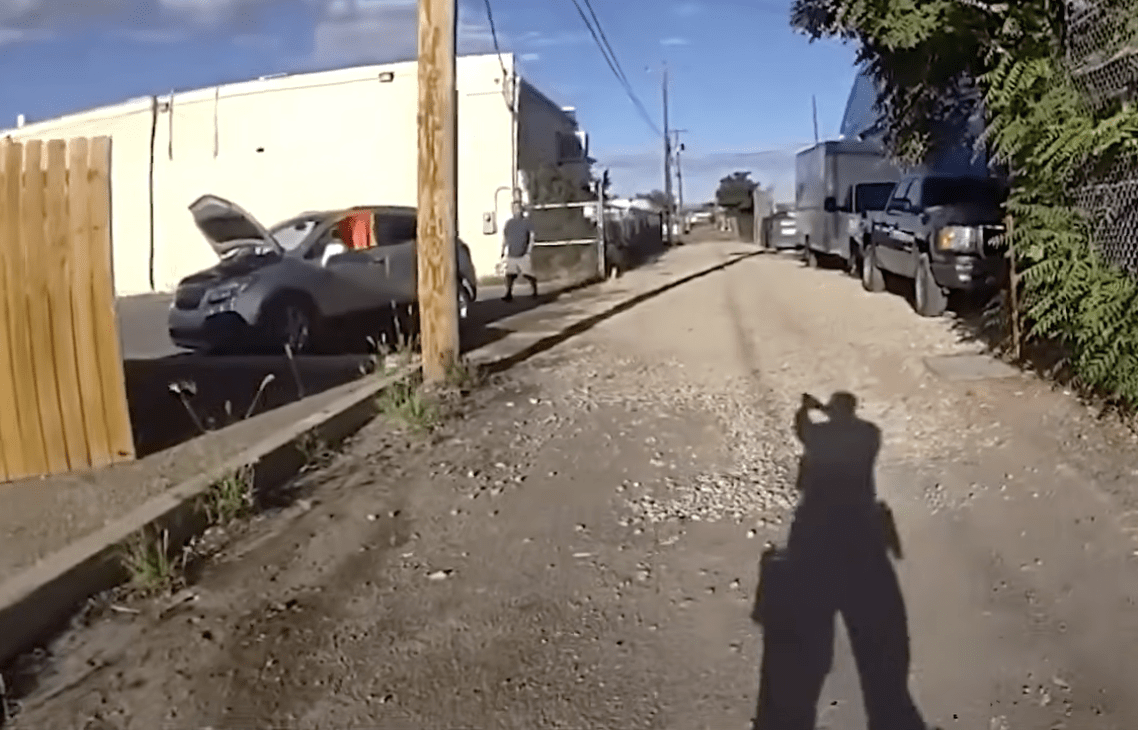
Pueblo, Colorado — On September 14, 2025, at approximately 8:05 a.m., Pueblo Police Department officers were notified of a strong-arm robbery in the 1100 block of Bonforte Blvd. A female citizen exited her vehicle to enter the store. She placed her purse in the cross-body position, but just before entering the store, the suspect, 38-year-old Aaron Vigil, stopped her, grabbed hold of her purse, and violently ripped it away from her as she fell to the ground and was dragged a short distance.
Officers located an individual and a vehicle that matched the description of the robbery suspect near 8th Street and Glendale Avenue. A vehicle pursuit ensued, leading to the suspect’s vehicle crashing in the 700 block of West 8th Street. Upon contact, the male suspect produced a knife.
Officers issued multiple commands for him to drop the knife, but he refused to comply and was subsequently shot. Officers deployed tasers in an attempt to allow officers to provide aid without the risk of being injured. Once the suspect was disarmed, several officers rendered aid, and he was transported to a hospital by medical personnel, where he later succumbed to his injuries.
 Field Lessons are offered strictly as general, industry-standard reminders drawn from common safety practices and typical policy considerations. They are not based on any inside knowledge of this specific incident, do not presume what actions were taken, and should not be interpreted as commentary on the decisions made at the scene.
- Pursuit transitions are one of the most dangerous moments in any law enforcement encounter. When a vehicle pursuit ends in a crash, the threat does not end with the collision. Officers must assume the suspect may be injured, disoriented, armed, or actively escalating. The transition from a moving vehicle threat to a ground-level contact threat requires an immediate reset of tactics, positioning, and communication.
- Edged weapon encounters at close range compress reaction time in ways that are not fully understood by the public or, at times, by oversight bodies. Research consistently shows that a subject armed with a knife within roughly 21 feet can close the distance to an officer before a firearm can be brought to bear and a shot fired. Officers must create distance, establish cover, and avoid the instinct to rush in when a blade is present.
- In this incident, the suspect displayed several behavior cues we found in our research. His declaration, “do it,” sends the message that this incident will not be de-escalated and only escalated by the suspect. 28% of all violent encounters by law enforcement were preceded by a verbal declaration.
Dr. Travis Yates has pioneered a behavioral risk framework to help officers and leaders identify, assess, and articulate risk in rapidly evolving, uncertain situations. Find out more about the FOCUS Behavioral Risk Framework.