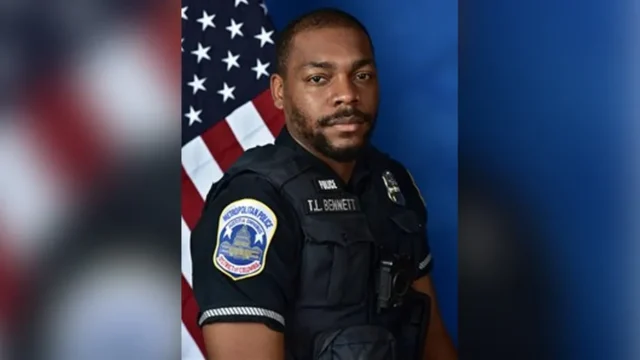
Washington D.C. – Metropolitan Police Department Officer Terry Bennett, 32, died Wednesday after suffering critical injuries in a crash last month while he was helping a stranded driver on Interstate 695.
Bennett was assisting a motorist who had run out of gas at about 10:10 p.m. on Tuesday, December 23, 2025, in the eastbound lanes of I-695 near South Capitol Street when he was struck by a second vehicle traveling at a high rate of speed. Bennett was transported to a local hospital, where he remained for two weeks before succumbing to his injuries.
The driver who hit Bennett remained at the scene and charges have not yet been filed.
Bennett was an eight-year veteran of MPD, serving in the First District after graduating from the Metropolitan Police Academy. A Washington native and Ballou Senior High School graduate, he also earned a degree from Bucknell University. Bennett spent more than a decade mentoring young people, including coaching football, and was known for working to build trust and strengthen relationships between law enforcement and the community.
 Field Lessons are offered strictly as general, industry-standard reminders drawn from common safety practices and typical policy considerations. They are not based on any inside knowledge of this specific incident, do not presume what actions were taken, and should not be interpreted as commentary on the decisions made at the scene.
-
Treat roadside assists as high-risk scenes. Your primary threat may be traffic, not the caller.
-
Position the patrol vehicle to create an upstream buffer and maximize protection for the contact area.
-
Use high-visibility apparel, especially during low-light operations.
-
Keep your body out of traffic lanes whenever possible and avoid turning your back to moving traffic.
-
Use lighting deliberately. Balance scene visibility with the risk of blinding oncoming drivers.
-
Call for an additional unit early for traffic control when the shoulder is narrow, visibility is limited, or speeds are high.
-
Establish clear roles. One officer manages the motorist while another scans traffic and maintains situational awareness.
-
Use cones, flares, or other traffic warning devices when available and appropriate to extend the safety zone.
Dr. Travis Yates has pioneered a behavioral risk framework to help officers and leaders identify, assess, and articulate risk in rapidly evolving, uncertain situations. Find out more about the FOCUS Behavioral Risk Framework.