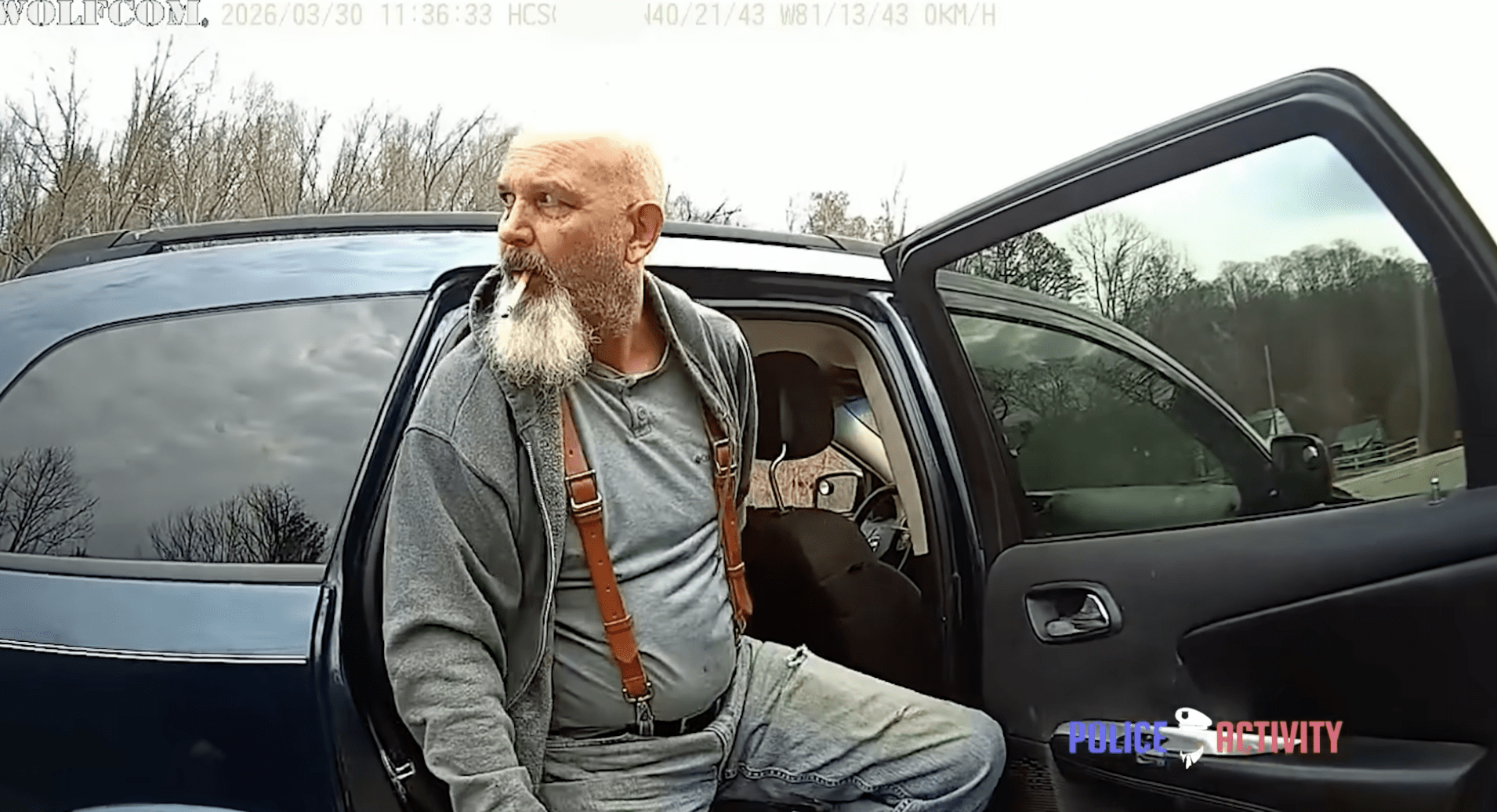
Body camera footage released this week by the Ohio Attorney General’s Office captures the moment a Harrison County Sheriff’s Office deputy was fired upon during what began as a routine traffic stop, setting off a running gun battle, a multi-agency manhunt, and three separate officer-involved shooting incidents that ended with the suspect dead in a wooded field hours later. The Harrison County deputy shot at a traffic stop incident began the morning of March 30 on U.S. Route 250 near Eslick Road in Franklin Township.
According to the Harrison County Sheriff’s Office, a deputy stopped a vehicle for following too closely. Body camera footage reviewed by Police1 shows the deputy speaking with the driver before asking a passenger, later identified as Michael W. Decker, 53, to exit the vehicle. When the deputy asked Decker if he could search him for weapons, Decker refused, then became combative. Moments later, Decker pulled a handgun from his waistband, pointed it at the deputy, and fired.
The deputy was not struck by gunfire. He was transported to a hospital for a shoulder injury that authorities said was a dislocated shoulder unrelated to the shooting. The deputy returned fire but did not strike Decker, who then got back into the vehicle and fled.
The Ohio State Highway Patrol’s Steubenville Post responded and located the vehicle. When troopers attempted to conduct a traffic stop, Decker fled again, and a pursuit followed.
Spike Strips, Gunfire, and a Foot Chase into the Woods
Officers deployed a tire deflation device on U.S. Route 22 near Hopedale in an attempt to stop the fleeing vehicle, according to the Ohio State Highway Patrol. The device worked, and Decker exited the vehicle near Old Hopedale Road. He then fired multiple shots at law enforcement officers, striking an OSHP trooper’s patrol vehicle, and fled on foot into a wooded area, according to the Harrison County Sheriff’s Office and the OSHP.
A shelter-in-place order was issued for the surrounding community. Harrison County Sheriff Mark Touville described Decker at the time as armed and dangerous with a violent history.
The manhunt involved the Harrison County Sheriff’s Office, Cadiz Police Department, the Ohio State Highway Patrol, the Jefferson County Sheriff’s Department, the Jefferson County Drug Task Force, the Belmont County Sheriff’s Department, the Ohio Department of Natural Resources, and the U.S. Marshals Service, according to a statement released by Sheriff Touville.
Hours later, the OSHP Aviation Unit located Decker in a wooded area along Mine Road in Green Township. Officers and a K-9 unit moved in on the position. Aerial units issued repeated verbal commands to surrender, which Decker ignored, according to the OSHP. A third officer-involved shooting occurred during the arrest attempt when Decker brandished his weapon. Decker died as a result of injuries sustained in that shooting, according to Sheriff Touville.
No law enforcement officers were killed. The deputy’s shoulder injury was the only reported officer injury across the entire incident.
All three officer-involved shooting incidents are being investigated by the Ohio Bureau of Criminal Investigation. The Ohio Attorney General’s Office confirmed that once the investigation is complete, it will be referred to the Harrison County Prosecutor’s Office for review.
The release of the body camera footage this week by the Ohio Attorney General’s Office brought renewed attention to the incident and the close-call nature of the initial attack at the traffic stop.

Field Lessons are offered strictly as general, industry-standard reminders drawn from common safety practices and typical policy considerations. They are not based on any inside knowledge of this specific incident, do not presume what actions were taken, and should not be interpreted as commentary on the decisions made at the scene.
- Passengers in a stopped vehicle represent a threat that must be continuously assessed alongside the driver. Officers who focus exclusively on the driver during a traffic stop create a dangerous blind spot. Both occupants require position management, and any request for a passenger to exit should include a heightened level of alertness to physical cues, including hands, waistline, and body language, before and during the exit.
- Refusal to submit to a weapons frisk, combined with behavioral indicators, should immediately elevate an officer’s threat assessment.
- The suspect displayed several sentinel cues identified in our study, including non-compliance, scanning, arguing, and concealed hands.
Dr. Travis Yates has pioneered a behavioral risk framework to help officers and leaders identify, assess, and articulate risk in rapidly evolving, uncertain situations. Find out more about the FOCUS Behavioral Risk Framework.