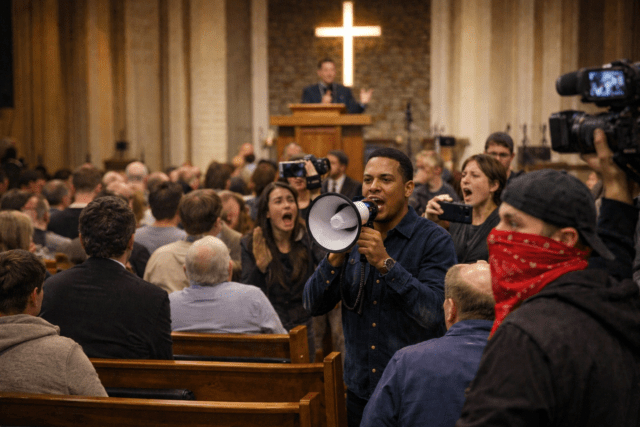
An organized group of anti-ICE activists disrupted a Sunday worship service at Cities Church in St. Paul, Minnesota, forcing a political confrontation into a place where families had gathered to pray, worship, and find peace.
The group entered the sanctuary during the service, created a verbal disruption, and recorded the interaction on video. Organizers later described the action as “nonviolent,” but the label is a distraction. When a coordinated group intentionally interrupts a religious service, confronts congregants, and turns the sanctuary into a stage, it is interference with worship. It also creates an unnecessary safety risk for everyone inside.
This is not “free speech.” This is coercive protest activity aimed at civilians.
And what made this incident more alarming is what happened afterward.
In the days following the disruption, prominent Minnesota officials publicly validated the tactic. State Rep. Leigh Finke called for continued disruptions of churches as a form of political pressure. Minnesota Attorney General Keith Ellison appeared in an interview with Don Lemon and minimized the legal exposure of those involved. Lemon himself amplified the narrative nationally and reportedly took part in the broader protest effort.
Whether these officials intended it or not, their public comments function as a green light. When government figures signal tolerance for targeting churches, activist networks interpret it as permission to repeat the tactic, expand it, and escalate it.
This is how disorder normalizes.
Church Disruptions Are Likely To Continue
Keith Graves is an expert in church security, and his assessment indicates a high likelihood of additional church disruptions in the near term, particularly in Minnesota and other areas where anti-ICE organizing is active. The incident at Cities Church demonstrated that activists can enter a sanctuary, seize attention, generate viral content, and leave before meaningful consequences occur.
Graves said that the “success” will be studied and repeated.
Graves continues: The motive is not operational relevance. Churches are not being targeted because they are immigration enforcement centers. They are being targeted for symbolic pressure. It is narrative warfare: accuse, disrupt, film, provoke, and broadcast.
Even if organizers claim the events will remain “peaceful,” the risk profile is elevated. Churches are crowded. Emotions run high. Children are present. Exits are limited. The potential for confrontation increases immediately when an outside group attempts to force a political conflict into a confined space.
It only takes one person, on either side, to make it physical.
This is also an information operation.
The filming matters. The livestreaming matters. The post-event editing and messaging matter. These actions are not designed to persuade the people inside the room. They’re designed to produce content that can be weaponized online afterward. The goal is pressure through humiliation, disruption, and narrative control.
What The Law Actually Says
Disrupting religious worship is not protected behavior simply because it comes wrapped in politics.
Minnesota law includes prohibitions related to intentionally interfering with lawful assemblies and religious services. At the federal level, the free exercise of religion is protected, and there are criminal statutes that cover conspiracies or actions intended to intimidate or coerce individuals in the exercise of constitutional rights.
In plain terms, activists do not have the legal authority to commandeer a sanctuary because they believe their cause is righteous.
The public framing of these disruptions as “legal” or “no big deal” is not just wrong, it is dangerous. It invites follow-on violations by lowering perceived risk. Even if prosecutors later decide to act, the damage is already done when a mob learns it can storm sacred spaces and face minimal consequences.
Threat Picture: What To Watch For Next
The actors involved are typically decentralized networks that thrive on rapid mobilization. These aren’t always formal groups with clear leadership, which makes them harder to predict and easier to replicate. You may also see media-aligned participants who act as amplifiers, ensuring the incident reaches a national audience within hours.
Common tactics include:
Coordinated entry during the most crowded portion of service
Immediate filming before the disruption begins
Verbal accusations designed to provoke an emotional response
Attempts to bait church leadership into confrontation
Rapid online framing after the event to control the narrative
Calls for repeat actions once the first disruption gains traction
Warning signs often appear online first. Churches and security teams should treat the following as pre-incident indicators:
Social media calls for “direct action” tied to churches
Naming specific churches, pastors, or service times
Messaging that reframes churches as “legitimate protest venues.”
Unknown individuals attending prior services who appear to be observing layout, exits, and routines
On scene, the behavior is usually obvious:
Groups enter together rather than dispersing naturally
Phones up and recording before any “incident” exists
Positioning in aisles or near the front to block movement
Chanting or scripted verbal confrontation designed for the camera
Likely Courses Of Action
Expect repeat disruptions at the same church to normalize the intrusion and condition the congregation to accept it.
Expect expansion to other churches accused of political opposition, even without evidence of any connection to immigration enforcement.
If interior access is blocked, expect exterior confrontations, including protests at entrances, parking lots, and public sidewalks timed to arrival and departure.
And expect narrative escalation. Once activists realize churches can be framed as political targets, the rhetoric will intensify to justify increased harassment and intimidation.
Bottom line: this is not “activism” in any meaningful civic sense. It is coercion aimed at ordinary people during worship, dressed up as virtue.
When elected officials and public figures validate these tactics, they aren’t “supporting a cause.” They are actively degrading public order and endangering innocent people.
Churches are not battlefields. But if society continues to tolerate this kind of intrusion, it won’t stay “nonviolent” for long.
Keith Graves is the founder of Christian Warrior Training.