Crime: Solved
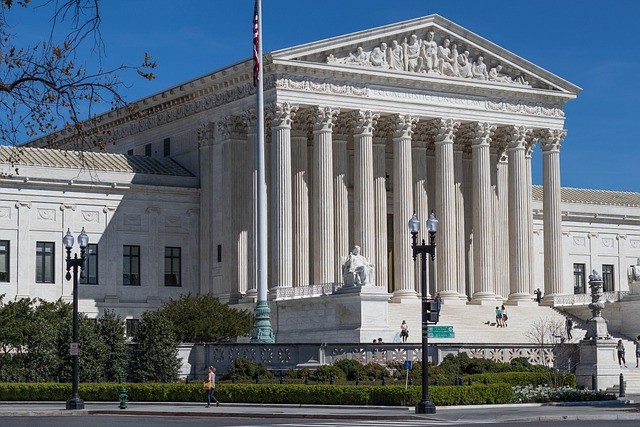
On June 29, 2026, the Supreme Court of the United States ruled that a Google geofence warrant from a 2019 Virginia bank robbery was fundamentally a search under the Fourth Amendment. The underlying geofence warrant led investigators to identify the bank robber and recover roughly half of the $200,000 stolen from the bank.
A geofence warrant is an investigative tool that shows active devices within a specific geographic location for a specific period. Google’s subpoena compliance department would initially provide anonymized device identifiers, and the police would look at the patterns of movement such as entering or leaving a specific location at a specific time. When investigators and detectives identified the pattern of the suspect they were seeking to identify, then they would request user data from Google. Google would initially provide investigators with anonymized device identifiers, but investigators would employ movement patterns and other evidence prior to requesting identifying information for the devices revealed by the initial anonymized filter.
Police legal advisors understood this was a party that would eventually close. It was an ‘as long as they let you’ policy. I’m certain that many investigators were upset when they heard the news. Complaints would vary but essentially include ‘how are we supposed to solve crime after being kneecapped by the United States Supreme Court?’
The current decision, Chatrie v. United States builds upon past cases including Carpenter v. United States and will impact all digital evidence collection on our horizon.
We’ve been there before.
In April 2001, I finished field training my last recruit. Finally in the patrol call all alone after about 60 days of trainees, the call came where I was being transferred to our Criminal Investigation Division tomorrow. Wednesday on patrol, Thursday in criminal investigations forced me to address my wardrobe that night. From the time I had applied for the position, the position had been moved from one section to another, and I wound up in the homicide unit.
The perfect place at the perfect time.
Some of the detectives I was working with were Vietnam and Vietnam-era veterans. Computers have been around since the 1940s, but even in the 1960s, we didn’t know the typewriter keyboard was going to the main computer interface. Watch a 1960s Burt Ward era Batman episode or a William Shatner Star Trek show and no one had a clue that the basic keyboard would unlock basically everything we do today with data and computers. We didn’t train 1970s cops to type. We didn’t require cops to type. That’s why lieutenants and captains had staff assistants to manage memos, transfer documents, promotions, awards, and keep track of staffing statistics.
Despite being in my early 30s, I was the young guy and owning a home computer, was what made me the computing and data guru. The threshold was remarkably low for guru. Mobile phone data was an outlier in 2002 yet was an essential crime fighting tool in 2003.
It was an ideal time to be forced to learn the importance of cell phone identification data and how they could be located based on antenna connections. Except for Nextel and Blackberrys, telephones at that time were primarily verbal communication devices. It would have annoyed many of my friends, but I considered it cool to be called in on cases prior to the unveiling of the inaugural iPhone.
If you think today is the Wild West, you should have been there twenty years ago. We briefly tried a missing persons unit apart from the homicide unit. I was transferred there to help it succeed. The staff in the unit had been uniformed proactive street level enforcement with limited criminal investigative experience. It wasn’t long until we got a case. My new sergeant insisted that I demand exigent information from a carrier on a habitual missing person – which included the obligation that a valid subpoena would be served later.
My advice, which was a push back, was that if we didn’t have reasonable grounds now, after we get the data, unless something unreasonable and tragic happens, we won’t have the reasonable grounds to get a subpoena from the prosecutor’s office to give to the carrier. His reply was that she could be dead in a ditch somewhere – a problem that the exigent demand would never solve. The situation played out in sync with my concerns, and after the missing person resurfaced hours later following a substance abuse binge, we absolutely didn’t have reasonable grounds to obtain an investigative subpoena from the state attorney’s office to provide to the carrier.
My sergeant and I met together frequently as time went on as I was always trying to smooth out the friction between us, but that episode where I tried to save him from himself always came up. He treated my experienced guidance as rebellious and insubordinate. ‘What you need to understand is that we are on a ship, and I’m the captain, and when I tell you to row, you need to row.’ I responded as respectfully as possible, ‘As a loyal crew member, I know that I have a duty to let you know when your oars are not touching the water.’
A blessing in disguise
We should be appreciative for the direction of the Supreme Court. If a detective is stymied that the Supreme Court took away one of law enforcement’s valuable tools, the real issue is a lack of perspective. It may be hard to believe but the Boomer generation had one of the highest clearance rates for homicides. Tech is a Lilypad we jump on and off to get to the solution of a crime. If cases are divided as ‘smoking gun’ or ‘whodunnit’ obviously casting a wide net like a Google geofence will act as an instrument to assist in getting closer to identify the bad guy.
If the pursuit of that grabs the geo-location data of myself, my family, my friend, my dog-sitter, my pastor or even worse, my political community, I will be aware of how intrusive this is. Now let’s change that to your family, your faith, your politics.
The ruling
Part of the ruling is already obsolete with regards to the case Chatrie v. United States. Alphabet, a/k/a Google, has changed its location history architecture. The information that previously resided on Google’s servers are now stored on the devices of their users. This limits the company’s ability to respond the geofence requests that were frequent and common. Does these make everything with Chatrie moot? Absolutely not. Are geofence warrant unconstitutional? No, and it stated that those warrants, and those like in other tech enforcement and compliance are perfectly valid if they meet Fourth Amendment standards for search.
I had limited participation in one of the famous media cases in recent history. Eighteen years ago, the defendant was an uncharged murder suspect in a highly publicized case but was about to get released from jail, and upon release was charged with a non-violent third-degree felony, the lowest level of felony in Florida, and later with bond set at $750,000. I told my wife that day that her Eighth Amendment rights were eroded there that day. So were mine and yours. We didn’t want the defendant to get out of jail but instead be easy to find when they drop the murder charges, but in doing so they didn’t just violate the defendant’s rights. They violated all of our rights.
I know the gut punch in long high-speed pursuits where the plug gets pulled by a supervisor while the suspect is in sight. I’ve solved cases where the detectives let co-defendants go. They let them go because they weren’t criminally responsible or we just didn’t have enough probable cause. My tunnel vision kicks in forgetting that criminals are the gift that just keep on giving.
Decisions like this reset the framework of successful cases without undoing cases in the past. The court did not declare all geofence warrants unconstitutional. Just that these warrants implicate the Fourth Amendment and must satisfy those standards. They didn’t specifically rule on Chatrie, instead sending it back to the lower courts to determine it on the new constitutional framework.
In perspective
While some will perceive this as an impediment to solving crime, we must remember the precepts of the American justice system:
“It is better one hundred guilty Persons should escape than that one innocent Person should suffer.”
— Benjamin Franklin, in a letter to Benjamin Vaughan, March 14, 1785
In 2010 a devastating earthquake struck Haiti. The jailers fled. Like Acts 16, the doors of the prisons sprung open, this time releasing a lot of innocent people as well as a lot of violent predatory people. In Haiti, criminals can be held for four years without even hearing the charges against them.
The American system was and is revolutionary and has maintained the highest standards, which are replicated around the world. Our system of ‘tough to charge’ has resulted in the most efficient and innovative law enforcement organizations on the globe, systems that have benefited organized civilizations around the world.
If we are wise, we will welcome this framework vision cast by the Supreme Court, and let this guidance take us to improved systems that take the worst-of-the-worst off the streets for good.
Please keep all peace officers in your prayers.
Roland Clee served a major Florida police department as a Community Service Officer for more than 26 years. His career included uniformed patrol, training, media relations, intelligence, criminal investigations, and chief’s staff. He writes the American Peace Officer newsletter, speaks at public safety, recruiting and leadership conferences and helps local governments and public safety agencies through his business, CommandStaffConsulting.com.
His work is frequently featured on LawOfficer.com, the only law enforcement owned major media presence in the public safety realm.
For media interviews and podcast appearances, click here: http://bit.ly/40pT3NS
References: