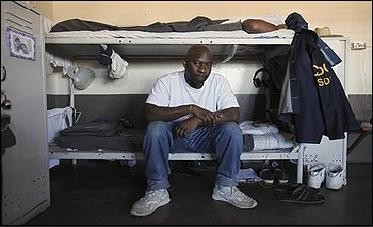
SACRAMENTO, Calif. – The riot that ravaged a Southern California prison and injured 175 inmates began with a fight between black and Hispanic gang members, a stark reminder of the difficulty of race relations behind bars and the challenges of desegregating inmates.
In the nation's largest state prison system, black, Hispanic, Asian and white gangs generally don't mix. When they do, trouble typically follows.
"It isn't that everybody in the inmate population is against integration – they like their teeth," said David Miles, a 46-year-old black inmate at another prison, Sierra Conservation Center.
Mindful of that, California has for decades segregated inmates by race in their cells and sleeping areas. In general, whole cell blocks and open dormitories are mixed race.
But four years ago, the U.S. Supreme Court found the practice discriminatory, citing Brown v. Board of Education. The court said it reinforced a cycle of racial hatred and violence and ordered the state to desegregate its prisons.
At the California Institution for Men in Chino, segregation is still in place. The weekend riot started in a dormitory-style housing wing where many races are in a large room, but the sleeping arrangements are segregated. The exact cause of the riot remains under investigation.
All the state prisons were supposed to be integrated by the end of last year, but the process is far behind schedule.
Last fall, the California Department of Corrections and Rehabilitation began desegregating two prisons in the Sierra foothills, southeast of the state capital. They are not yet fully integrated, and officials haven't started on any other prisons.
The delay is due in part to state budget cuts that have reduced prison staff, corrections department spokesman Seth Unger said. The system has 1,000 vacancies and is to be reduced by 5,000 positions over two years.
The beginning of a desegregation effort also has hit a number of obstacles, many of them coming from the inmates themselves.
Powerful race-based gangs oppose integration and have threatened inmates who participate. That leads wardens, guards and inmates to predict it will take years to fully integrate the state's 33 prisons, which hold 150,000 inmates.
"If I hung out with this black man on the street, that's cool. But in here, the rules are different," Tim Heffernan, a heavily tattooed 41-year-old white inmate at Sierra Conservation Center.
He and Daniel Mabson, a 25-year-old black inmate, sat across from each other on bunk beds as they spoke to a reporter about prison race relations and the halting desegregation efforts.
"How can we comply if it puts our lives in danger?" Mabson said.
California's inmates are racially diverse: 26 percent white, 29 percent black, 39 percent Hispanic and 6 percent of other races.
Under the new policy, inmates are assigned housing based on their compatibility with members of another race, their age, the type of crime they committed and their physical characteristics. They are given a "racial eligibility code" showing their ability to be housed with others.
The department's regulations permit segregating individual inmates if officials can show it is necessary for their safety. For example, members of the Aryan Brotherhood are not housed with members of the Black Guerrilla Family. The divisions even occur within races: Hispanic gang members from Northern California are kept apart from Hispanics from Southern California.
Prisoners also have a long-standing practice of self-segregating.
"If you're a white inmate, you're approached as soon as you get off the bus: Here's where you eat, here's where we stay," said Lt. Jimmy Hurtado, of the Sierra Conservation Center. "It's pretty much at all 33 prisons statewide."
But with integration at the Sierra Conservation Center in Jamestown and Mule Creek State Prison in Ione, inmates have been required to take the first available bed. The approach was patterned after one adopted in Texas 18 years ago.
The two prisons are being integrated first because they were expected to be among the easiest. Both house gang dropouts, homosexuals, child molesters, the elderly, disabled and mentally ill, who were thought to be more amenable because they need protection from other prisoners. Sierra Conservation Center also houses lower security prisoners who hope to win a coveted transfer to one of the state's 19 inmate firefighting camps that can earn them an early parole.
Even there, trouble arose soon after the policy was implemented.
At Sierra, hundreds of white and Hispanic inmates refused to work, eat or leave their cells for up to three days after integration began. Rules violations spiked fivefold.
"To me, this is like using us like lab rats, to see if it works," said Glenn Brooks, a 44-year-old black inmate from San Bernardino. "It ain't ever going to work. All it's going to do is get somebody hurt, get somebody killed."
Attempts to integrate bunk beds inside open dorms, where low- and medium-security inmates sleep, have been as problematic as trying to integrate prison cells.
Blacks, whites and Hispanics were willing to sleep side by side in beds spaced an arm's length apart. But they would rather fight or risk longer sentences than accept an inmate of another race in a bed above or below them in the same bunk.
Inmates consider each tier of bunks like a cell without walls, and that's where they draw an imaginary line.
Inmates who refuse to integrate can lose television, commissary and exercise yard privileges and have their sentences extended up to 90 days. Repeated violations can mean a transfer to a higher-security prison.
Resistance to integration is more about power than it is about race, said Rusty Otto, Sierra Conservation Center's mental health director. The race-based gangs control the flow of contraband and money, who rules each cell house and who gets a share of the profits from crime on the streets.
The number of prisoners, level of racial diversity and extensiveness of gang networks make California's prison system particularly prone to violence, meaning it's a good idea for corrections officials to approach desegregation slowly, said University of North Texas professor Chad R. Trulson, who is advising California on its integration policy.
"Prisoners are known to blow the place up over little things," he said. "And race in prison is not a little thing."