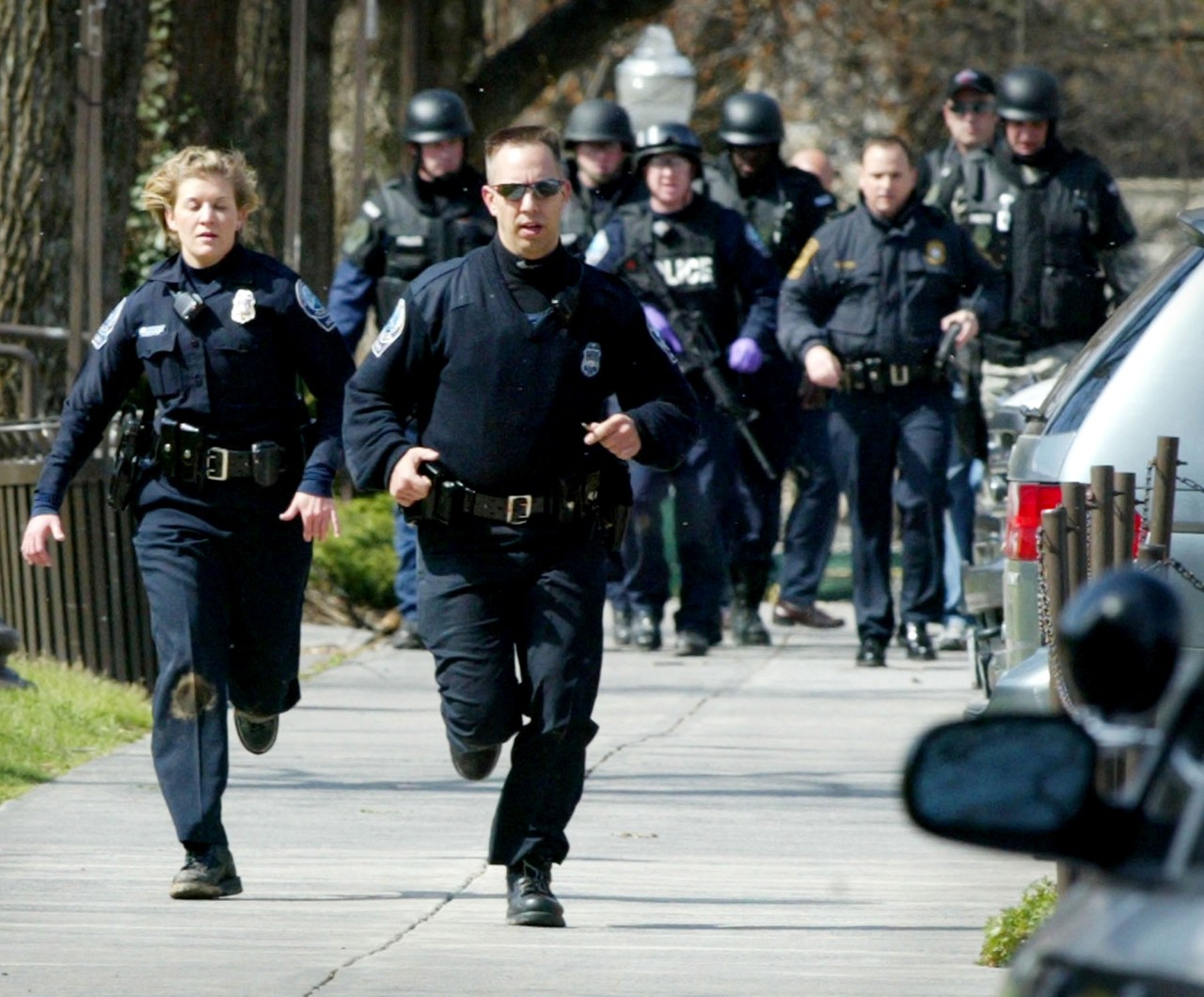

| Blacksburg police officers run from Norris Hall on the Virginia Tech campus in Blacksburg, Va., Monday, April 16, 2007. Multiple shootings occurred at the engineering building on Monday. A gunman opened fire in a Virginia Tech dorm and then, two hours later, in a classroom across campus Monday, killing at least 30 people. (AP Photo/The Roanoke Times, Matt Gentry) |
Editor’s Note: This column is part of a series that features lessons learned from past incidents that are still relevant today. Read more of Eric Dickinson's "Lessons By the Decades."
The Incident
On April 16, 2007, at approximately 0720 hours, the Virginia Tech Police Department responded along with EMS to a co-ed dormitory for a report of a female student who had reportedly fallen out of her loft bed. Upon arrival, they found that two students had actually been shot. One student was dead and the other was in critical condition and would die a couple hours later. Information was gathered and it led to a reasonable belief that the boyfriend of one of the victims was a likely suspect and had left campus. The SWAT teams of both the Virginia Tech and city of Blacksburg police departments were called out in preparation for taking the suspect into custody as investigators continued to work to determine his whereabouts.
At about 0940 hours, 9-1-1 calls began pouring in reporting shots fired at Norris Hall, an academic classroom building on campus. Patrol officers arrived on scene within three minutes, followed closely by the fully equipped SWAT officers who had been staged nearby. They quickly found that the exterior doors of Norris Hall had been chained shut from the inside, slowing the officers’ entry. Officers frantically tried to force entry and were finally successful by using a shotgun to breach a maintenance door.
The officers rapidly approached the third floor, where shots could still be heard. As the officers climbed the stairs they began to find dead and injured victims. The shooting stopped by the time the officers reached the second floor. The officers slowed their pace as they searched the classrooms for any attackers or victims. They eventually found the lone gunman dead of a self-inflicted gunshot wound. The officers immediately transitioned to the grim task of triaging and treating the numerous victims, a process led by two tactical medics who directed other officers regarding which victims to evacuate first to EMS units staging outside. By the time the attack was over, 17 people had been injured by gunfire; at least six additional people were injured through other means, primarily jumping from classroom windows to escape; and another 33 people were dead including the two in the dormitory and the lone attacker.
The Response
Hundreds of personnel from dozens of agencies representing every public safety discipline at every level of government responded in some way, shape or form to the massacre. With only about 40 officers in the Virginia Tech Police Department, law enforcement officers from other agencies were needed early on to assist with crime scene processing, notification of next of kin, scene security and the daunting task of identifying and interviewing hundreds of possible witnesses and victims.
Meanwhile, inaccurate social media reports began to surface and were shared by mainstream media showing images and video of officers arriving and taking cover outside Norris Hall as shots could still be heard in the background. These reports criticized the officers’ response without understanding the overall timeline of events and what actions were simultaneously being taken by officers already inside Norris Hall to end the massacre.
In April 2011, Virginia Tech was fined by the U.S. Department of Education for allegedly failing to warn students and staff of the initial murders and possibility of a further attack in a timely manner. This fine was overturned by a judge in March 2012. In October 2013, the Supreme Court of Virginia overturned a jury verdict in a wrongful death lawsuit against Virginia Tech and the State of Virginia that had been brought by two families of deceased victims who had not accepted an earlier settlement. The Supreme Court ruled, “there was no duty of the commonwealth to warn students about the potential for criminal acts.”
Lessons Learned and/or Ignored
Tactically trained patrol officers: Virginia Tech was a unique incident in which two SWAT teams were already geared-up, staged nearby and able to quickly respond when the first reports of the mass shooting began to come in. Such assets are rarely available rapidly in any significant numbers during the active phase of a mass shooting, even in agencies that have full-time SWAT teams. A two-day course on “active shooter” response is not sufficient for the patrol officers who will likely be first on scene. The Illinois Tactical Officers Association (ITOA) has led the way by developing its Tactical Patrol Officer program. Completion of the basic certification includes training in rapid deployment, patrol rifle, multi-assault counter terrorism action capabilities (MACTAC), and self-aid/buddy-aid. Go to www.itoa.org/tpo.htm for more information.
Tactical emergency medical support (TEMS): Law enforcement needs to increase the number of tactical medics on patrol. Just like rifles, victims can’t wait for SWAT to respond with traditional tactical medics or for the scene to be secure enough that conventional EMS will enter. All patrol officers should be trained and equipped for self-aid/buddy-aid. Additional officers who are trained as tactical EMTs should also be available to provide a higher level of care to victims within the first critical minutes.
Breaching: Virginia Tech, along with incidents at Nickel Mines (Pa.) and Bailey (Colo.), accounted for the third high-profile incident in less than a year in which attackers barricaded doors to prevent a rapid entry by law enforcement. Patrol officers need to be taught basic breaching techniques to defeat all common types of doors and windows for emergency situations.
Citizen action: After Virginia Tech, many agencies began to offer public training programs for their citizens based on the options (run, hide or fight) if they find themselves in the middle of such an attack. Though such concepts were once human nature, Virginia Tech was an important wake-up call for many that training citizens to barricade doors, escape through windows or furiously attack the assailant is required in order to increase the chances of survival.
Below 100: Four of the five tenets of Below 100 apply to this incident.
a. Watch your speed: This doesn’t just refer to slowing down. Once you arrive safely on scene at an ongoing attack, it might mean speed up and get inside to stop the killing instead of waiting for back-up. Officers at Virginia Tech did an excellent job of getting inside and rapidly moving to the threat and victims.
b. Wear your vest: You don’t get to choose when or where an attack occurs. You must be ready to act quickly because you might not have to take time to dig your vest out of the trunk and put it on. That body armor also gives you a protective edge that most attackers lack.
c. WIN (what’s important now?): Prepare before it happens in your jurisdiction. Train, equip and build the necessary relationships. The Blacksburg and Virginia Tech police departments had an excellent relationship that allowed their personnel to work together seamlessly at many levels throughout this incident.
d. Remember—complacency kills: Incidents such as the Virginia Tech massacre will continue to occur, regardless of legislation, security funding or happy thoughts. Many assailants study previous attacks and learn from the mistakes of the past. They each want to outdo the previous body counts. Attacks occur in both large and small communities; at schools, churches and businesses; both day and night; in jurisdictions policed by three officers and jurisdictions policed by 3,000 officers. Yet there are still people in our communities who stick their heads in the sand. It is your job to educate them, prepare them and protect them in spite of their naivety.
About the author
Eric Dickinson is a lieutenant with the Vinton (Iowa) Police Department, an Advanced EMT, a Below 100 core-trainer, and the author of the book, The Street Officer’s Guide to Emergency Medical Tactics, available from www.looseleaflaw.com. He is a lead instructor for SAFETAC (www.safetac.org) and is the 2014 Law Officer Trainer of the Year. Contact him at [email protected].
References
1. CNN. (n.d.) Virginia Tech Shootings Fast Facts. Retrieved on April 15, 2015, from www.cnn.com/2013/10/31/us/virginia-tech-shootings-fast-facts/.
2. TriData Division, System Planning Corporation. (Nov. 2009) Mass shootings at Virginia Tech: Addendum to the report of the review panel. Retrieved on April 15, 2015, from http://scholar.lib.vt.edu/prevail/docs/April16ReportRev20091204.pdf.