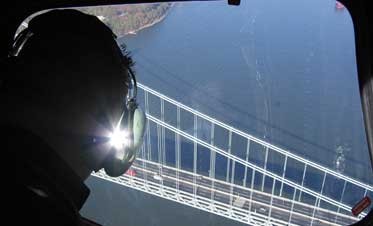
Much like many areas or specialties in law enforcement, the airborne law enforcement sector has its share of "hot topics." A few years back it was homeland security. Airborne use of force was very much a topic of discussion a year ago that has subsided a bit. It seems that video downlinking, in particular when used with the latest high definition cameras, is now one of airborne law enforcement's "hot" issues.
The history of video downlinking
In the not so-distant past, only about 10 or 15 years ago, the idea of utilizing an airborne law enforcement platform for real time vide downlinking was reserved for those agencies with substantial financial resources. That meant mainly the federal government and perhaps a few of the largest cities had the capacity to perform this mission. When Pope John Paul II visited New York City in 1995, the NYPD Aviation leased video downlink equipment for the visit. The leased video equipment was temporarily mounted on the aircraft and it was large, bulky and did not have great reliability. In short, it did not have a significant impact on police operations.
Fast forward to today and many police airborne law enforcement units have this capability. The equipment is usually permanently affixed to the aircraft. The video signal can be transmitted back to "command centers" and/or portable receivers on the ground. The introduction of high definition cameras coupled with the terrific reliability of the equipment gives law enforcement a wonderful tool in dealing with emergencies and disasters.
When a demonstration, parade or tactical situation arises, ground personnel at the scene and senior management back at a command center can view real time, crisp video of the unfolding incident. For example, recently in New York City, a very large demonstration was taking place. Intelligence had indicated that as part of the demonstration, "splinter groups" would break off and head off in a different direction, primarily to tax the police resources. The NYPD Aviation Unit was tasked with staying alert for any splinter groups. When a report of a splinter group came in, the airship would respond to the particular street or intersection and transmit video back to the command center and field command post. Instantly, the situation could be evaluated and assessed, and if necessary, resources could be assigned in order to deal with the splinter group. Ironically, post-demonstration intelligence showed that the protesters were very much aware of the airborne law enforcement presence and it was a major factor in the group not splitting up.
A video downlink can also be used in tactical situations. If a tactical operation is being planned at a particular location, the real-time intelligence can prove invaluable. Are there dogs or other animals in the back yards? Are children present? Where are the exits? What activity is taking place at the location right now? In one instance, the narcotics unit was planning to execute an arrest warrant at a particular location. Airborne video downlinking showed a structure in the rear yard that seemed out of place. The execution of the warrant was delayed to evaluate this structure and determine exactly what it was. It turns out the structure was made of cinder blocks and was heavily fortified. The plan of the dealers was that if a raid took place, all involved would retreat to the "bunker." The structure was laden with heavy weapons and would have proven to be a particularly difficult challenge. The tactical plan was changed and the warrant was executed without any injuries to any officers involved.
When linked to a "moving map" system, the downlink is even more useful. The downlinked video can be split screened with the map so that the exact location the camera is looking is shown on the screen in map view. This greatly enhances situational awareness for the person watching the video. No longer is there a need to ask the aircraft where they are pointing the camera; you simply look at the screen and know exactly where the camera is pointed. The improvement in cameras has also given many units the capability to stand off a considerable distance and provide discreet, yet highly defined video. Most agencies do not release the exact operational distance of their equipment, but a recent documentary showed a camera that provided license plate recognition from at least one mile, (and most likely further) away.
The challenges
With any new technology, there have been obstacles and challenges. In the early stages, most video was sent unsecured and could be intercepted. Although it is highly unlikely that the average criminal could intercept the signal, a much larger and more likely danger was the interception of the signal by a television station that was also transmitting live images. The signal could be inadvertently re-transmitted by the TV station and seen by the general public. Obviously, this could prove fatal during a tactical operation. Today, utilizing encrypted signals and some other countermeasures, signal interception is difficult if not impossible. A second challenge was purely technical. The bandwidth allotted by the FCC for video downlink is very small. The demand by electronic news-gathering (ENG) helicopters, ground-based news teams and airborne law enforcement units have made huge demands on this very small bandwidth. The limited channels available make for some interesting situations. In some markets, there could be up to 15 separate entities fighting for five to eight channels of bandwidth! All segments involved are working together to try and solve this problem.
A final challenge is that some of the leading edge equipment needs a lot of tender loving care and needs to be closely maintained. Naturally, this places a labor and financial strain on many of the operators using this equipment.
An interesting case
Not only is video downlinking being used by law enforcement, the fire service has begun to use this technology in their operations. In particular, when used with forward looking infra-red (FLIR), the downlink can show the progress of a fire, any hot spots and other developing safety hazards.
A few years back, the City of New York Fire Department (FDNY) approached a local news media operator that used an ENG helicopter with a proposal. If the local news operator would allow FDNY personnel onboard their aircraft, they could gain access, as a first responder aircraft, to a scene and transmit the images to FDNY commanders. Of course, the images could also be used by the news operator as they saw fit. This would give the news ENG helicopter access to scenes that were restricted by a temporary flight restriction (TFR). Fortunately, the powers that be saw the huge operational, safety and logistical problems with such a setup and did not allow it to proceed.
Used properly, video downlink gives an agency another tool to effectively and safely conduct their operations. As the cost of this equipment comes down and reliability continues to go up, the use of video downlinking will certainly continue to expand.