Washington, D.C.: The Supreme Court has reversed a lower court decision that took qualified immunity away from a Vermont sergeant in a lawsuit stemming from a 2015 protest arrest.
The case, Zorn v. Linton, No. 25-297, arose from a January 8, 2015, sit-in at the Vermont State House on the day of Governor Peter Shumlin’s inauguration. Approximately 200 protesters attended, and some staged a sit-in inside the chamber to demand universal healthcare. When the Capitol closed for the evening, officers instructed the remaining demonstrators to leave or face arrest for trespassing.
After they refused to leave, officers began removing protesters one by one. When Vermont State Police Sergeant Jacob Zorn approached protester Shela Linton, he warned her that he would eventually have to use force if she did not stand up. Once she refused, Zorn took her arm, placed it behind her back, applied pressure to her wrist in what courts described as a rear wristlock, and lifted her to her feet. Linton later sued Zorn under federal civil rights law, claiming the wristlock left her with arm injuries and psychological disorders.
The case worked its way through federal courts for more than a decade. A federal district court in Vermont initially sided with Zorn, finding he was entitled to qualified immunity. The Second Circuit reversed that decision, holding that a 2004 precedent in Amnesty America v. West Hartford clearly established that using a rear wristlock on a passively resisting protester constituted excessive force.
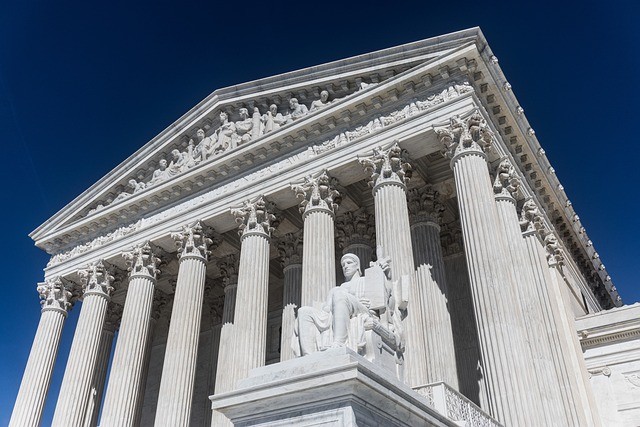
Zorn appealed to the Supreme Court, which agreed to review the case and reversed the Second Circuit in a six-page unsigned per curiam opinion joined by six justices.
The court held that qualified immunity protects government officials from civil liability unless their conduct violates clearly established law. To meet that standard, the majority explained, plaintiffs must identify a prior case in which an officer taking similar actions in similar circumstances was specifically found to have violated the Constitution.
General rules and broadly stated constitutional principles are not enough.
The majority found that the Second Circuit’s reliance on the 2004 Amnesty America case was misplaced. In that case, the majority noted, did not hold that any officer’s specific actions violated the Fourth Amendment, and it failed to establish the particular circumstances under which a rear wristlock crosses the constitutional line. Because no clearly applicable precedent existed, Zorn was entitled to qualified immunity, and the lawsuit was dismissed at the summary judgment stage.
The three dissenting justices, led by Sonia Sotomayor and joined by Elena Kagan and Ketanji Brown Jackson, issued a nine-page rebuttal arguing the majority applied an unreasonably narrow reading of the doctrine. Sotomayor wrote that the ruling gives officers a license to inflict pain on a nonviolent protester even where no threat to officer safety exists. She argued the majority was essentially requiring plaintiffs to find a factually identical case, a requirement the court had previously rejected. Sotomayor characterized the decision as transforming qualified immunity into an absolute shield for law enforcement and warned it was inconsistent with the Fourth Amendment’s requirement that officers use only the force necessary under the circumstances.
Dr. Travis Yates, a court-recognized expert, calls the dissent’s opinion “madness.” Yates said that wrist locks are about as common in police training “as water is to the sea”, and “the idea that any judge would revoke qualified immunity based on such a standardized police practice is chilling.”
“I would like the dissent to tell law enforcement how to move a suspect, committing a crime, who is unwilling to move? Do we lift them up by their arm and risk injuring their shoulder? Do we hug them into submission? Do we keep asking for hours, or do we use the very tool we are trained to use in the basic academy, a wrist lock?” Yates lamented.
Yates said that Justice Sotomayor couldn’t be more wrong in characterizing the decision as transforming “qualified immunity into an absolute shield for law enforcement.”
“Contrary to what the dissent said, this case is exactly why qualified immunity must exist. An officer uses an accepted technique in the correct situation, and in those cases, officers must be protected, or we will no longer have anyone doing the job,” Yates said.