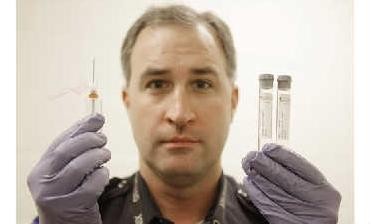
BOISE, Idaho When police officer Darryll Dowell is on patrol in the southwestern Idaho city of Nampa, he'll pull up at a stoplight and usually start casing the vehicle. Nowadays, his eyes will also focus on the driver's arms, as he tries to search for a plump, bouncy vein.
"I was looking at people's arms and hands, thinking, 'I could draw from that,'" Dowell said.
It's all part of training he and a select cadre of officers in Idaho and Texas have received in recent months to draw blood from those suspected of drunken or drugged driving. The federal program's aim is to determine if blood draws by cops can be an effective tool against drunk drivers and aid in their prosecution.
If the results seem promising after a year or two, the National Highway Traffic Safety Administration will encourage police nationwide to undergo similar training.
For years, defense attorneys in Idaho advised clients to always refuse breath tests, Ada County Deputy Prosecutor Christine Starr said. When the state toughened the penalties for refusing the tests a few years ago, the problem lessened, but it's still the main reason that drunk driving cases go to trial in the Boise region, Starr said.
Idaho had a 20 percent breath test refusal rate in 2005, compared with 22 percent nationally, according to an NHTSA study.
Starr hopes the new system will cut down on the number of drunken driving trials. Officers can't hold down a suspect and force them to breath into a tube, she noted, but they can forcefully take blood a practice that's been upheld by Idaho's Supreme Court and the U.S. Supreme Court.
The nation's highest court ruled in 1966 that police could have blood tests forcibly done on a drunk driving suspect without a warrant, as long as the draw was based on a reasonable suspicion that a suspect was intoxicated, that it was done after an arrest and carried out in a medically approved manner.
The practice of cops drawing blood, implemented first in 1995 in Arizona, has also raised concerns about safety and the credibility of the evidence.
"I would imagine that a lot of people would be wary of having their blood drawn by an officer on the hood of their police vehicle," said Steve Oberman, chair of the National Association of Criminal Defense Lawyers' DUI Committee.
The officer phlebotomists are generally trained under the same program as their state's hospital or clinical phlebotomists, but they do it under a highly compressed schedule, and some of the curriculum is cut.
That's because officers don't need to know how to draw blood from a foot or other difficult sites, or from an infant or medically fragile patient, said Nicole Watson, the College of Western Idaho phlebotomy instructor teaching the Idaho officers.
Instead, they are trained on the elbow crease, the forearm and the back of the hand. If none are accessible, they'll take the suspect to the hospital for testing.
In a nondescript Boise office building where the Nampa officers were trained, Dowell scanned his subject and prepared to draw blood. Chase Abston, an officer taking his turn playing a suspect, recoiled a bit, pressing his back deeper into the gray pleather chair.
Dowell slid a fine-gauge needle into the back of Abston's hand. Abston, who had been holding his breath, slowly exhaled as his blood began to flow.
All the officers seemed like they'd be more comfortable if their colleagues were wielding sidearms instead of syringes. But halfway through the second day of training, with about 10 venipunctures each under their belts, they relaxed enough to trade barbs alongside needle jabs.
They're making quick progress, Watson said. Their training will be complete after they have logged 75 successful blood draws.
Once they're back on patrol, they will draw blood of any suspected drunk driver who refuses a breath test. They'll use force if they need to, such as getting help from another officer to pin down a suspect and potentially strap them down, Watson said.
Though most legal experts agree blood tests measure blood alcohol more accurately than breath tests, Oberman said the tests can be fraught with problems, too.
Vials can be mixed up, preservative levels in the tubes used to collect the blood can be off, or the blood can be stored improperly, causing it to ferment and boosting the alcohol content.
Oberman said law enforcement agencies should also be concerned "about possible malpractice cases over somebody who was not properly trained."
Alan Haywood, Arizona's law enforcement phlebotomy coordinator who is directing the training programs in Idaho and Texas, said officers are exposed to some extra on-the-job risk if they draw blood, but that any concern is mitigated by good training and safe practices.
"If we can't get the evidence safely, we're not going to endanger the officers or the public to collect that evidence," he said.
The Phoenix Police Department only uses blood tests for impaired driving cases. Detective Kemp Layden, who oversees drug recognition, phlebotomy and field sobriety, said the city now has about 120 officers certified to draw blood. Typically, a suspect is brought to a precinct or mobile booking van for the blood draw.
Under the state's implied consent law, drivers who refuse to voluntarily submit to the test lose their license for a year, so most comply. For the approximately 5 percent who refuse, the officer obtains a search warrant from an on-call judge and the suspect can be restrained if needed to obtain a sample, Layden said.
Between 300 to 400 blood tests are done in an average month in the nation's fifth-largest city.
During holiday months that number can rise to 500, said Layden, who reviews each case to make sure legal procedures were followed.
Outside of Arizona, some law enforcement agencies in Utah have officer phlebotomists, and police in Dalworthington Gardens, Texas are cross-trained as paramedics and have been drawing blood for about three years. The NHTSA is in talks with Houston, Texas about doing the phlebotomy training there, he said.
They're all attracted by Arizona's anecdotal evidence.
"What we found was that the refusal rates of chemical testing lowered significantly since this program began," Haywood said. "Arizona we had about a 20 percent refusal rate in 1995, and today we see about an 8 to 9 percent refusal rate."
Associated Press writer Bob Christie in Phoenix contributed to this report.