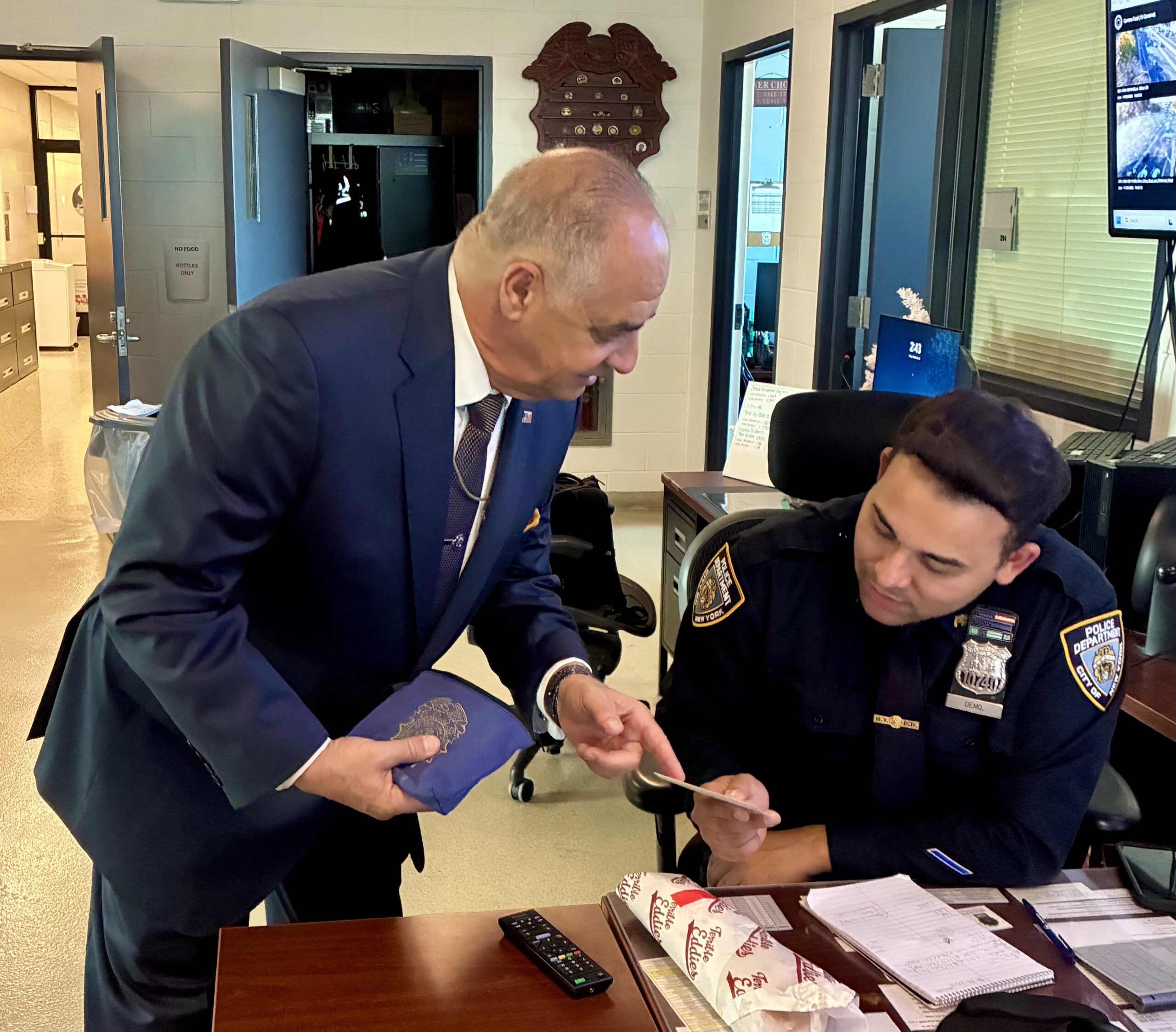
On November 20, 2026, I returned to Staten Island for a memorable day with members of the New York City Police Department, centered on a principal gathering at the 121st Precinct. Approximately 35 members of the department came together for a program about ethical leadership, the human dimension of policing, The Wounded Protector™, and the healing power of affirmation. The invitation to return was particularly meaningful, providing an opportunity to reconnect with personnel I had previously met while meeting additional members of the department.
The day also included a brief courtesy visit to the nearby 120th Precinct, directly across the street from the Staten Island Ferry terminal, where I greeted members of the department. My encounters with NYPD executives, supervisors, and police officers extended beyond these precinct visits. While aboard the Staten Island Ferry and at its terminals in Staten Island and Manhattan, I encountered additional police officers, creating further opportunities to exchange greetings and express appreciation for their service.
Following my remarks at the 121st Precinct, I presented commemorative “Never Will I Falter” tribute cards to those in attendance and continued sharing them during subsequent encounters with NYPD personnel. Inspired by the official creed of the sentinels of the Tomb of the Unknown Soldier at Arlington National Cemetery, the tribute embodies fidelity, discipline, sacrifice, and an unwavering commitment to duty. Its message provided a meaningful connection between the traditions of military service and the responsibilities carried by those who protect our communities.

The journey also offered an extraordinary opportunity for reflection. Passing the Statue of Liberty twice aboard the Staten Island Ferry, I witnessed hundreds of passengers captivated by her presence, taking photographs and preserving their own moments with this enduring American symbol. Seeing so many people drawn to Lady Liberty prompted reflection on the blessings of liberty, the freedoms we inherit, and the responsibility of each generation to protect and preserve them.
Later, walking through Manhattan’s historic Canyon of Heroes, I encountered the commemorative granite sidewalk marker honoring General Dwight D. Eisenhower. Its inscription reads: “Gen. Dwight D. Eisenhower, Supreme Commander of the Allied Expeditionary Force in World War II.”
The marker commemorates the June 19, 1945 ticker-tape parade and recalls a defining moment in American history, providing another opportunity to reflect upon the character of leadership, the meaning of service, and the enduring contributions of those entrusted with great responsibility.
Together, these experiences transformed a return visit to a Staten Island precinct into a broader reflection on public service, American ideals, and the people whose dedication helps preserve them. From the men and women of the NYPD to the sentinels who stand watch at Arlington, and from the blessings of liberty represented by Lady Liberty to the historical legacy commemorated in the Canyon of Heroes, the day reinforced a conviction that continues to guide my work: those who dedicate themselves to protecting others deserve our recognition, our encouragement, and our enduring gratitude.
The Significance of Returning
A return visit carries a responsibility beyond the presentation itself. It asks whether relationships established previously can be strengthened, whether the original message continues to resonate, and whether another encounter can contribute something meaningful to the people involved.
In law enforcement, where professional responsibilities are demanding and institutional priorities constantly evolve, continued contact matters. Personnel deserve more than occasional words of encouragement. They deserve sustained attention to their professional contributions, their personal well-being, and the challenges inherent in protecting their communities.
Returning to the 121st Precinct offered an opportunity to build upon the foundation established during an earlier visit while bringing new reflections to the conversation. The purpose was not simply to revisit familiar themes, but to explore their continuing relevance through the experiences of those serving today.
There is also an important human dimension to returning. A familiar face can renew a connection; a new introduction can begin one. Even a conversation lasting only a few minutes can leave someone feeling recognized and appreciated. These encounters remind us that meaningful leadership is expressed not only through institutional decisions or formal presentations, but also through the attention we give to one another.
Ultimately, the value of a visit is not measured by the number of remarks delivered or the length of a presentation. It is measured by whether people leave with a renewed sense that their service matters, their sacrifices are recognized, and their humanity is never overlooked.
The Three Central Themes
Three interconnected principles informed my message to NYPD personnel: The Wounded Protector™, the healing power of affirmation, and the enduring commitment expressed through “Never Will I Falter.” Each speaks to a different dimension of public service, yet together they reflect the character, humanity, and responsibility required of those who protect others.
The Wounded Protector™
The human being behind the uniform must never be overlooked. Police officers routinely encounter the suffering, vulnerability, and hardships of others. Yet behind their professional responsibilities are individuals who also experience personal struggles, emotional burdens, and wounds that deserve understanding and compassion.
Drawing upon Henri J. M. Nouwen’s The Wounded Healer, The Wounded Protector™ offers a framework for understanding an important dimension of service: our own experiences of adversity can deepen our capacity to understand the suffering of others. The challenges we encounter need not diminish our ability to serve. When approached with understanding and compassion, they can strengthen our humanity and inform how we lead, protect, and care for others.
The Wounded Protector™ calls upon law enforcement leadership to recognize that protecting those who protect us is itself an institutional responsibility. The badge represents authority and duty, but it must never obscure the humanity of the person wearing it.
The Healing Power of Affirmation
Affirmation is more than a compliment or a passing expression of appreciation. It is the deliberate recognition, and promoting a culture, of another person’s dignity, contribution, and worth.
In the demanding environment of policing, sincere encouragement, recognition, and gratitude can reinforce morale and remind personnel that their daily sacrifices and professional commitments are valued. Acknowledgment need not come through formal ceremonies or institutional awards. Sometimes a personal conversation, a sincere expression of thanks, or simply taking the time to recognize someone’s contribution can make a lasting difference.
The responsibility to affirm others belongs to leadership at every level. When recognition becomes part of an organization’s culture, it communicates something essential: people are not defined solely by their assignments, performance expectations, or responsibilities. They are individuals whose contributions deserve to be seen and appreciated.
Never Will I Falter
My commemorative tribute, inspired by the official creed of the sentinels who stand watch at the Tomb of the Unknown Soldier at Arlington National Cemetery, carries a message of fidelity, sacrifice, discipline, and unwavering commitment to duty.
The words “Never Will I Falter” express a powerful ideal of service: the determination to remain faithful to one’s responsibilities, particularly when those responsibilities demand personal sacrifice, perseverance, and courage.
For the men and women of the NYPD, this message offers a reminder that public service is sustained by more than professional obligation. It requires character, dedication, and a steadfast commitment to the communities entrusted to their protection.
The tribute also connects the traditions of military service with the responsibilities of law enforcement, honoring the enduring values of duty, fidelity, and service to others.
The 121st Precinct: Leadership and Collaboration
The gathering brought together approximately 35 members of the precinct, including executive personnel, supervisors, police officers, and civilian staff. Their participation created an opportunity for shared reflection on leadership, service, and the human dimension of policing.
Special recognition goes to Chief Terrence Hurson for welcoming me back and, through his leadership, making this visit with his personnel possible.
My sincere appreciation also goes to NYPD Officer Sean Mondello for his coordination and hospitality in organizing the visit. I particularly appreciated his thoughtful placement of the American flag at the front of the room, establishing a fitting setting for my remarks.
I am grateful to everyone who attended, expressed gratitude for my work, and helped make the gathering a meaningful occasion.
Beyond the Precinct: The Continuing Opportunity to Affirm
The day’s interactions with NYPD personnel continued throughout my journey between Staten Island and Manhattan. While aboard the Staten Island Ferry, I encountered NYPD officers and had additional opportunities to exchange greetings and express appreciation for their service.
At the ferry terminals, I also encountered additional police officers, extending these personal connections beyond the precinct setting.
After exiting the ferry on Staten Island, I made a brief courtesy visit to the nearby 120th Precinct, located directly across the street. There, I had the opportunity to greet members of the department, including Detective Patrick O’Connor, whose gracious gift of his own tie clasp was a particularly appreciated personal gesture. Such courtesies reflect the value of professional rapport and the mutual respect that strengthens them.
These interactions were different from the formal gathering at the 121st Precinct. There were no scheduled presentations or prepared remarks, only the opportunity to meet people, exchange a few words, express appreciation, and recognize the responsibilities they carry. I continued sharing the “Never Will I Falter” commemorative cards, extending the message beyond the precinct gathering.
Some encounters lasted only moments, but their significance was not measured by their duration. They reflected a simple conviction that recognition and gratitude should not be confined to formal occasions. The opportunity to acknowledge someone’s service can arise anywhere, and we should never underestimate the value of a sincere personal encounter.
Passing the Statue of Liberty
One of the most memorable and moving experiences of the day came while aboard the Staten Island Ferry, passing the Statue of Liberty—not once, but twice. On both crossings, I witnessed hundreds of passengers captivated by her presence, taking photographs and preserving their own moments with this enduring American symbol. Regardless of their backgrounds or the reasons that brought them to New York Harbor, people were drawn to Lady Liberty, whose presence continues to inspire generations.
The historical significance of the Statue of Liberty reaches far beyond her place in the New York Harbor skyline. Presented by France as a gift to the United States and dedicated in 1886, she became an enduring symbol of freedom, hope, and the promise of America.
For generations, her image has represented the aspirations of those who came to this country seeking opportunity and a better future. She stands as a reminder of the ideals upon which this nation was founded and the blessings of liberty that must never be taken for granted.
Watching so many people pause to photograph her prompted a deeper reflection. The freedoms represented by Lady Liberty were not simply inherited; they were secured through sacrifice, defended across generations, and entrusted to each succeeding generation to preserve. Liberty carries both a blessing and a responsibility. Its promise depends upon a continuing commitment to protect the rights, dignity, and security of others.
For the men and women of the NYPD, that responsibility is expressed through their daily service to the people and communities of New York City. Their work reflects an enduring obligation to safeguard the freedoms and public trust that make civic life possible. Passing Lady Liberty twice that day offered a powerful reminder that the protection of America’s ideals is not merely a matter of history. It is a responsibility renewed through the service and dedication of those who protect our communities.
The Canyon of Heroes: Remembering Greatness
After disembarking in Manhattan, I walked uptown along Broadway through the historic Canyon of Heroes. Its granite sidewalk markers commemorate the individuals and groups honored through New York City’s celebrated ticker-tape parades, a tradition recognizing extraordinary accomplishments and historic contributions.
Passing these commemorations prompted reflection on the many forms greatness can take. Some achievements receive national recognition and public celebration. Others unfold quietly through years of commitment, sacrifice, and responsibility.
The men and women who protect their communities may never receive a ticker-tape parade, yet their contributions are no less deserving of recognition. Their service is measured not by public acclaim, but by the lives they protect, the communities they serve, and the responsibilities they faithfully carry.
The Canyon of Heroes offered a fitting reminder that a society should recognize achievement while never overlooking the everyday dedication of those who serve the common good.
General Dwight D. Eisenhower: A Historical Encounter
During my walk through the Canyon of Heroes, I encountered the historical marker commemorating June 19, 1945, and the ticker-tape parade honoring General Dwight D. Eisenhower, Supreme Commander of the Allied Expeditionary Force during World War II.
Having previously explored Eisenhower’s leadership in my Law Officer article, “Ethical Leadership Lessons from Dwight D. Eisenhower for 21st-Century Policing,” this historical marker held particular significance. The encounter connected my earlier examination of Eisenhower’s leadership, moral courage, and unity of effort with a tangible reminder of his place in American history.
Eisenhower’s wartime leadership represented an extraordinary exercise in responsibility, strategic judgment, and the coordination of people and resources toward a common purpose. His place in the Canyon of Heroes recalls a defining moment in American history and invites reflection on the enduring demands placed upon those entrusted with leadership.
The encounter provided a fitting historical conclusion to a day devoted to the responsibilities of service, the character of leadership, and the people who dedicate themselves to something greater than themselves.
The Enduring Message
Returning to Staten Island and reconnecting with members of the NYPD reinforced a conviction that has guided my work with law enforcement for over two decades: the strength of policing rests not only in the authority entrusted to its personnel, but also in the character, humanity, and commitment of the individuals who wear the uniform.
The experiences of November 20 extended beyond a precinct presentation. They encompassed meaningful professional relationships, personal expressions of appreciation, spontaneous encounters with members of the department, and reflections inspired by some of America’s most enduring symbols and historical figures. Together, they offered a reminder that service is strengthened when those who protect others know that their contributions are recognized and their humanity is valued.
The responsibilities of law enforcement are considerable, and the demands placed upon those who serve are often unseen by the communities they protect. We must never allow familiarity with their presence to diminish our appreciation of their sacrifices or overlook the individuals behind the badge. Encouragement, ethical leadership, and a genuine commitment to the well-being of personnel are essential expressions of the respect their service deserves.
I remain deeply grateful for the opportunity to return, to reconnect with members of the NYPD, and to continue a mission centered on encouraging and affirming those who dedicate themselves to public service. The privilege of serving those who serve is a responsibility I carry with profound gratitude.
The words “Never Will I Falter” remain a fitting expression of that commitment — a reminder of fidelity, perseverance, and the enduring responsibility to serve others.
SELECTED LAW OFFICER ARTICLES BY VINCENT J. BOVE
- Ethical Leadership Lessons from Dwight D. Eisenhower for 21st-Century Policing
Unity of Effort, Moral Courage, and the Spirit of The Vigilant Protector™
Examining General Eisenhower’s leadership during the D-Day invasion and its continuing relevance to ethical leadership, moral courage, unity of effort, and the responsibilities of those entrusted with protecting others.
https://www.lawofficer.com/ethical-leadership-lessons-eisenhower/
- Respect Is the Badge: The Heart of the 21st-Century Ethical Officer
Exploring respect as the defining standard of ethical policing and the foundation of public trust, extending from professional conduct on the streets to the formation of character, leadership, and responsibility in America’s schools and institutions.
https://www.lawofficer.com/respect-is-the-badge/
- From a Crisis of Character to an Ethical Renaissance: Moral Leadership in 21st-Century Policing, Special Report — Part I of II
Documenting more than 25 years of professional commitment to ethical leadership, institutional accountability, violence prevention, and public trust—from the national response to Columbine in 1999 to the continuing application of these principles in contemporary law enforcement.
https://www.lawofficer.com/crisis-of-character/
COMPLETE VINCENT J. BOVE LAW OFFICER ARTICLE CHRONOLOGY
Explore the complete collection of Vincent J. Bove’s published work in Law Officer, presented in the publication’s author archive:
https://www.lawofficer.com/author/vbove/