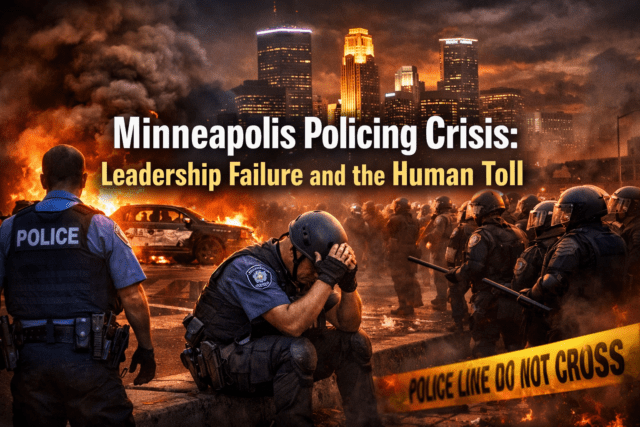
Minneapolis is experiencing a crisis of capacity and confidence. Officers assigned to the streets are exhausted, understaffed, and constrained by leadership decisions that prioritize optics and politics over officer safety and public protection.
America has seen the results of what can happen in an American city when politics reigns, but most don’t understand the dire consequences.
Travis Yates recently spoke to Jesse Watts, the Executive Director of The Wounded Blue on his podcast. Watts is in. Minneapolis, with a peer support team, and what he observed is shocking, sad, and predictable.
Cops Want To Do Their Job
Watts said that Minneapolis officers are facing a level of stress hard to comprehend outside the Twin Cities. According to Watts, the stress isn’t from the protestors or ICE, but rather from leaders within their own agency who aren’t letting them do their jobs.
They are seeing crimes, they want to help other officers as they are being attacked, but are being told they can’t.
Following the officer-involved shooting of Renee Good, Watts said that Minneapolis officers were on the scene as the crowds gathered and violence began to erupt. MPD leaders forced them to take off their protective gear because it “looked bad,” and according to Watts, “just a few minutes later, an officer was struck in the head with a bottle.”
The injury would not have occurred if the order to remove helmets had not come from their leaders.
Critical Staffing Levels
While the chief and mayor keep saying they have 600 officers, the reality is that fewer than 300 can respond to calls for service, including those in the academy and on injury/sick leave. Just last week, 17 officers resigned, and with just 21 in the academy, staffing is getting worse, not better.
At a recent squad meeting, Watts observed that there were just 7 officers and 12 open slots in an area that is the most demanding for the department.
Consequences of Cowardly Leadership
The immediate effects are predictable and troubling. Fatigue and anxiety only make the job more dangerous, and when officers see leaders choosing public perception over safety, trust is gone. The long-term consequences are even worse. When officers are ordered to disengage, stand down, and “manage optics” rather than stop obvious criminal behavior, the message is simple: the people in charge are more afraid of headlines than they are committed to public safety. That kind of leadership doesn’t just demoralize a department; it changes how crime spreads across an entire city.
Criminals Watch and Adjust
Violent offenders are not confused about what is happening in Minneapolis. They watch responses. They test boundaries. They learn which calls get delayed, which areas are thinly staffed, and how long it takes for backup to arrive. When staffing collapses and proactive policing is discouraged, criminals don’t become more compassionate. They become more confident.
Watts said the most frustrating part is that officers are trying to do what they were hired to do. They are seeing assaults, robberies, carjackings, and disorder events unfold in real time, but are being forced into a posture of paralysis.
When Law Enforcement Can’t Enforce the Law
Minneapolis has reached a point where the basic promise of policing is under strain. Officers show up late because there are not enough of them. They hesitate not because they lack courage, but because they know leadership may punish them for doing their job correctly. They wonder if they will be supported if a chaotic situation turns violent. That uncertainty is toxic.
The public pays the price first. Calls stack up. Victims wait. Neighborhoods lose trust. Families feel it in small ways at first, like slower response times and fewer patrols.
Officers pay a different price. They work extended shifts. They miss time with their families. They absorb stress and frustration, then carry it home. And when they finally decide they’ve had enough, they leave.
Watts described the mood as a department still filled with good people, but exhausted people. Professionals who want to protect the city, but are being drained by a system that treats them like liabilities instead of guardians.
A City Can’t Survive on Public Relations
This is the core problem: Minneapolis leadership wants the appearance of control without the reality of enforcement. They want calm optics while chaos grows. They want slogans and committees, but not consequences for offenders. They want to “reimagine” policing while ignoring the basic conditions required for policing to function.
You cannot govern a city through messaging. You cannot protect communities by restricting the very people tasked with responding to violence. And you cannot recruit or retain officers in a place where leadership refuses to prioritize their safety.
The Human Toll
It is easy for critics to speak in abstract terms about “reform.” It is harder to confront what reform looks like when it becomes a weapon against the rank and file. The officers in Minneapolis are still responding. They are still showing up. They are still doing their best under policies and staffing levels that make success nearly impossible.
But there is a breaking point.
Every resignation is another gap on a shift. Every gap adds more forced overtime. Every forced overtime adds more burnout. Every burnout adds more mistakes, more injuries, and more risk. It becomes a cycle, and Minneapolis appears to be deep in it.
This is not a mystery, and it is not “unexpected.” When politicians and administrators treat policing as a performance and officers as props, the outcome is predictable.
What Must Change
Minneapolis does not need another task force. It needs courageous leadership. The kind that tells the truth about staffing. The kind that supports officers making lawful arrests. The kind that does not punish proactive policing simply because it creates uncomfortable video clips for social media. The kind that puts safety over optics.
The city also needs an honest conversation about what the community expects. If residents want faster response times, fewer violent repeat offenders, and safer neighborhoods, then officers must be allowed to intervene decisively when crime is happening in front of them.
That requires political courage and leaders willing to accept criticism in exchange for results.
The Bottom Line
Watts’ observations from Minneapolis are not just “shocking.” They are a warning. A city cannot function when enforcement is restrained, staffing is collapsing, and officer safety is treated as a public relations problem.
Minneapolis still has officers who want to do their job. That is the good news. The bad news is that leadership is testing how long those officers will stay.
If Minneapolis continues down this path, it will not be a story about one incident, one protest, or one policy. It will be a story about how a city chose optics over protection, and paid the price in blood, burnout, and broken trust.