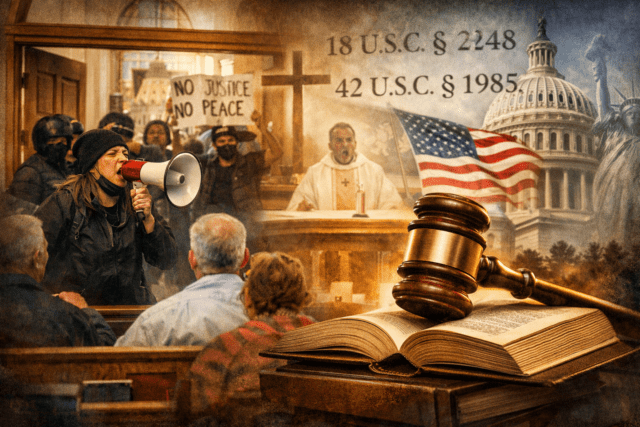
(www.washingtongunlaw.com): The recent incident in Minnesota, where a group of protesters entered a house of worship and interrupted services, has raised immediate legal questions about federal civil and criminal liability. The most relevant laws are the Freedom of Access to Clinic Entrances Act (the FACE Act), 18 U.S.C. §248, and provisions of the Ku Klux Klan Act of 1871, now codified in several sections of Title 42 (most commonly invoked through 42 U.S.C. §§ 1983, 1985, and 1986). Below is an analysis of how those statutes apply, who can act, and what hurdles any enforcement or civil action would face.
The FACE Act: What it is and how it applies
The FACE Act was passed in 1994 in response to aggressive protests at reproductive health clinics. While it is commonly associated with protecting access to clinics, one of its express provisions also protects the right to exercise religious freedom at a place of worship.
Core prohibition
18 U.S.C. §248 makes it unlawful to, by force, threat of force, or physical obstruction, intentionally injure, intimidate, or interfere with — or attempt to do so to — any person lawfully exercising or seeking to exercise their First Amendment right of religious freedom at a place of religious worship.
Key legal elements
- Actus reus: Use of force, threats of force, or physical obstruction at a place of worship.
- Mens rea: Intent to injure, intimidate, or interfere with someone lawfully exercising religious liberties.
- Protected conduct: Exercising First Amendment religious rights on church premises.
Enforcement options and remedies
- Federal criminal enforcement: The Department of Justice may investigate and prosecute criminal violations under the FACE Act.
- Federal civil enforcement: The attorney general may bring a civil action where there is reasonable cause to believe a violation has occurred or may occur.
- Private civil suits: Parishioners and the religious organization that operates the place of worship have a private right of action under the statute to seek civil remedies, including injunctions and damages.
Possible penalties
Federal remedies under the FACE Act include criminal punishments and civil penalties. Federal civil enforcement can include monetary penalties; private civil lawsuits can seek damages and injunctive relief. The exact punishment in any case depends on the charged provisions, the facts, and prosecutorial decisions.
The Ku Klux Klan Act (the Reconstruction civil-rights statutes): conspiracy and failure to act
The Ku Klux Klan Act of 1871 created a federal enforcement mechanism to protect constitutional rights from organized private interference and from actions taken under color of state law. Today, these protections are enforced through several provisions in Title 42.
42 U.S.C. §1983 — what it usually covers
Section 1983 provides a civil remedy for a person who, acting under color of state law, deprives another of constitutional rights. It is primarily used against state actors or those acting with state authority, not typically against purely private individuals.
42 U.S.C. §1985 and §1986 — conspiracies and failure to prevent
- Section 1985 targets conspiracies to interfere with civil rights — for example, conspiracies to deprive a group of equal protection or to obstruct the due course of justice. If protesters coordinated a plan to deprive parishioners of their right to worship, those deprived of that right could assert a § 1985 claim.
- Section 1986 imposes liability on persons who, knowing of a §1985 conspiracy, fail to prevent it when doing so is within their power. This provision can reach organizers, coordinators, or others who had advanced knowledge and stood aside.
How these statutes might apply to a church disruption
If evidence shows planning, coordination, or a conspiratorial agreement to interfere with worship, plaintiffs could assert §1985 claims against organizers and participants. If certain individuals had actual knowledge of a planned conspiracy and did nothing to stop it, §1986 might apply to them. Section 1983 would be less likely to apply unless a person acted under color of state law.
Who can bring claims and who can prosecute?
- Private plaintiffs: Individual parishioners and the religious organization can bring civil suits under the FACE Act and under the reconstruction-era statutes seeking damages and injunctive relief.
- State prosecutors: Local or state prosecutors may bring criminal charges for state-law offenses (assault, trespass, disorderly conduct, etc.). Whether a state will prosecute depends on local prosecutorial discretion.
- Federal prosecutors: The U.S. Department of Justice can pursue criminal charges under the FACE Act and civil enforcement under the FACE Act or the Reconstruction statutes if federal elements are met.
Practical hurdles, defenses, and evidentiary needs
Proving intent and conduct
Federal liability under the FACE Act requires proof that the conduct was intentional and rose to force, threat, or physical obstruction that interfered with worship. Peaceful protest inside or near a building that does not rise to force or obstruction may be protected expression. Prosecutors and civil plaintiffs must show the conduct crossed that line.
Conspiracy claims require coordination
To succeed on a §1985 conspiracy claim, plaintiffs must demonstrate an agreement among actors to deprive rights, and an overt act in furtherance of that conspiracy. Social-media posts, prior coordination messages, or public statements admitting planning could form part of that proof. Absent such evidence, proving a coordinated conspiracy is difficult.
Political and prosecutorial discretion
Even where federal statutes provide a pathway to enforcement, government officials decide whether to investigate and prosecute. State officials may decline to act; the Department of Justice must determine whether civil or criminal federal intervention is warranted and supported by admissible evidence.
Bottom line
- Legal exposure exists. A disruptive entry into a house of worship can trigger federal statute enforcement under the FACE Act and civil liability under reconstruction-era conspiracy statutes if the facts show force, threats, obstruction, or a coordinated conspiracy to interfere with religious exercise.
- Multiple enforcement options are available. The attorney general may bring civil or criminal actions under the FACE Act; parishioners and the church have private civil remedies; conspiracy statutes provide additional civil avenues against coordinated interference.
- Outcome depends on evidence and discretion. The central questions will be intent, whether conduct amounted to force or obstruction, whether there was coordination or conspiracy, and whether prosecutors decide to act.
Those interested in the statutory text should review 18 U.S.C. §248 (the FACE Act) and the relevant sections of Title 42 concerning civil rights enforcement, including 42 U.S.C. §§ 1983, 1985, and 1986. The presence of video footage, public posts about planned actions, and statements by organizers can significantly affect how aggressively federal or private parties pursue relief.
In short, the legal tools to challenge disruptive actions at places of worship are real and substantial. Whether they will be used — and whether they will succeed — depends on the facts, documentary and testimonial evidence of intent and coordination, and prosecutorial choices.
Washington Gun Law is a channel dedicated to the lawful and responsible gun owners in Washington state and nationwide. This channel will help educate gun owners as to their rights and responsibilities under Washington law. The best way to be a lawful and responsible gun owner is to know what the law is in every situation and how it applies to you in any instance that you find yourself. For more information, visit them at www.washingtongunlaw.com