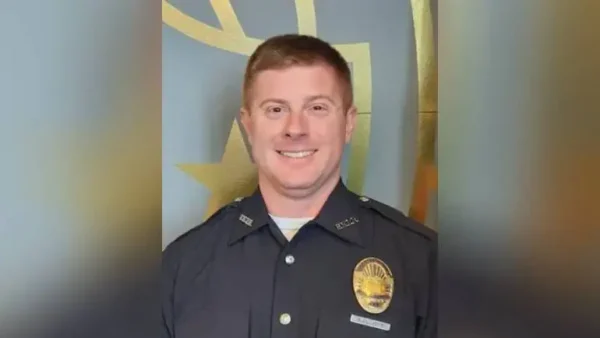
Beech Grove, Indiana: A Beech Grove police officer shot Monday evening at a domestic violence call has died. The officer killed was identified as Officer Brian Elliott. A second officer was wounded and transported for treatment.
City officials said Elliott and other officers were dispatched at 6:08 p.m. and that Elliott and another officer were shot after they arrived. Both officers were taken to Eskenazi Hospital, where Elliott later died despite lifesaving efforts. The wounded officer was reported in stable condition and expected to survive, and the department has not publicly released that officer’s name.
Indiana State Police said the incident began as a 911 call reporting a domestic disturbance at an apartment. State police said shots were fired from inside the residence as officers encountered the subjects at the doorway, and the suspect fled on foot, prompting a Blue Alert and a multi-agency search.
Officials described the call as a domestic disturbance response that escalated rapidly after officers arrived at the apartment complex. The scene is near Beech Grove High School, and the response drew assistance from multiple agencies as the search expanded beyond the immediate area.
During the hours-long search, police urged nearby residents to shelter in place as officers looked for an armed suspect. Indiana State Police and local agencies later canceled the Blue Alert after confirming the suspect had been taken into custody.
Indiana State Police identified the suspect as Kenneth T. Johnson, 47. State police said he was taken into custody at approximately 10:17 p.m. by members of the Indianapolis Metropolitan Police Department SWAT team at a different apartment building in the same area.
In a statement posted by the City of Beech Grove, Police Chief Michael Maurice identified the fallen officer as Brian Elliott and offered condolences to Elliott’s wife, Erin, and family, while also thanking hospital staff and partner agencies for their response and support.
 Field Lessons are offered strictly as general, industry-standard reminders drawn from common safety practices and typical policy considerations. They are not based on any inside knowledge of this specific incident, do not presume what actions were taken, and should not be interpreted as commentary on the decisions made at the scene.
-
Our research continues to show domestic violence calls as one of the most dangerous calls for law enforcement. They are considered an amplifier, meaning that any response requires a higher tactical awareness.
-
Amplifiers make up 91% of all officers shot in our data. Amplifiers and non-compliance make up 100% of all officers shot in the data. The existence of both within incidents should eliminate any de-escalation options, and the primary goal is to control the subject (preferably handcuffs).
- “I don’t care what your policy says or what some academic told you in the latest de-escalation class; our data is clear. When an amplifier (calls requiring a higher tactical approach) and non-compliance exist together, the only way to de-escalate further violence is to secure the hands of the subject.” Dr. Travis Yates
- Seek out a FOCUS Training Session near you to learn more.
Dr. Travis Yates has pioneered a behavioral risk framework to help officers and leaders identify, assess, and articulate risk in rapidly evolving, uncertain situations. Find out more about the FOCUS Behavioral Risk Framework.